Showing posts with label Siege of Boston. Show all posts

Sunday, March 3, 2019

Episode 086: Evacuation of Boston


Last week, the Continental Army took Dorchester Heights.  The British could not retake the heights by force, and put their entire force under risk of attack of bombardment from the heights.

Decision to Evacuate

Now months earlier, British General William Howe had planned to evacuate Boston.  Secretary of State Germain had even sent communications authorizing evacuation months earlier, but Howe felt a winter evacuation would be to difficult.

He had planned to move his army down to New York and make New York City his base of operations in the spring.  London was sending large numbers of reinforcements in a few months.  Howe was mostly awaiting their arrival.

Howe Evacuates Boston (from Mt. Vernon)
Gen. John Burgoyne was deploying to Canada, where he would reassert control there.  Burgoyne would then move down the Hudson as Howe moved up the Hudson.  With this, the two armies would cut off New England and isolate the most troublesome part of the continent.  New England colonists would suffer under a British blockade while the regulars pacified and reasserted control over the middle and southern colonies, where they thought patriot sentiment was not as universal.

It seemed like a good plan. The problem was Washington and the Continental Army had pushed up Howe’s timeline.  Howe’s reinforcements from London were not there yet.  He did not want to take his relatively small force to New York.  Part of the Continental Army, along with New York militia was already building defenses around New York.  The last thing Howe wanted was to land his relatively small force and possibly face an attack under possibly worse circumstances than the one he just left.  Howe wanted to invade with overwhelming force there to make sure they could overcome any resistance.  That could not happen for a few more months.

Admiral Shuldham made clear he was not going to leave his ships in the harbor under rebel guns.  Without the navy, Howe could not stay.  He would lose his already difficult access to food and supplies.  The regulars had to leave now.  So, Howe decided to move everyone up to Halifax in Nova Scotia, Canada.  Halifax remained under Royal control and would not be a combat zone.  Howe would wait there until he could coordinate his much larger invasion of New York with the reinforcements coming from Britain.

Evacuation Logistics

By March 7, 1776, Howe had made the decision to evacuate to Halifax.  Putting that plan into effect was a major task in itself.  First, there were over 8000 soldiers in Boston, some sources say nearly 9000, about a quarter of whom were sick.  Some sources say it was closer to 11,000, but I think that is including the estimated 2400 camp followers, wives and children of the soldiers who could not be left behind.  Some say records say the number of camp followers was smaller, but that is because records exist for only about half the regiments being evacuated.  In addition, there were more than 1100 Tory colonists who could not be left behind to face patriot vengeance.  It total, Howe had to board an estimated 12,000 people, along with all their belongings aboard ship under enemy fire, all the time worried that the patriots might attack while the regulars were in the process of evacuating.

The British had about 125 ships at their disposal, enough to carry all the people, though there was an uncomfortable amount of crowding aboard ships. There was not enough room for all the equipment, supplies, and personal effects of the colonists trying to move with the army.  Even worse, the navy had been losing sailors to disease and desertion all winter.  They did not have enough sailors to man all the ships they had at their disposal.  They ended up destroying several ships that they could not take with them.

Informal Agreement

In an attempt to make the evacuation easier, Howe sent out a notice to the patriots on March 9.  The Notice declared that the British had decided to evacuate Boston.  If the rebels fired on them while evacuating, they would burn the city.  If left alone, they would leave the city intact and allow the Continentals to take control.

Howe could not seek a direct agreement with Washington.  The problem was that Howe refused to address Washington as “General” or any other title conferred on him by the Continental Congress.  Doing so would have legitimized the authority of Congress, something he could not do.  Washington refused to accept any communication from the British which failed to address him as General.  Instead, Howe had several Boston Selectmen sign a note stating Howe’s position and had that note carried under a flag of truce out to the patriots.

Washington did not respond formally, but apparently agreed to the deal and did not fire on the regulars as they packed their ships for departure.  He did not want to waste ammunition nor see the destruction of Boston.  If the regulars would pack up and go, that was good enough for Washington.

Battle of Nook Hill

But that is not to say Washington simply sat and waited for the British to leave.  Washington had already begun deploying soldiers under the command of General Charles Lee to New York, thinking that would be where the regulars would be headed.  Lee had been hard at work setting up defenses in and around New York City.  Now Washington prepared to deploy more of his army to New York, to greet any British landing there.

But Washington also could not be sure that Howe’s planned evacuation was a trick.  He could be stalling for time as he waited for expected reinforcements to arrive.  Or, he could load up the ships, carry his men a few miles up or down the coast, land them and march back toward Boston and attack the Continentals from the rear.

Continental Artillery
(from Boston 1775)
So, Washington continued work on his defenses.  Nook Hill was a smaller hill on Dorchester Heights closest to the Harbor and well within range of British artillery at Boston Neck.  On March 9, the Continental Army began construction of a fort on Nook Hill.  They began work after nightfall in hopes of erecting a fortification by morning.

But the workers could not see enough to work and lit a fire to help them see.  The regulars immediately spotted the fire on Nook Hill.  The regulars were not ready to march out of Boston to attack, but they unleashed an artillery barrage against Nook Hill.  One report indicates the Patriots later collected over 700 cannonballs fired at them that day.  For all the firing, the regulars killed only five Continentals on Nook Hill.  That was enough to discourage the construction of the fort.  The Continentals evacuated Nook Hill.

This repeated itself over the next few days, as Continentals attempted building more fortifications in plain view of the regulars.  The British would fire artillery and the Continentals would back away.

Finally, on the night of March 16, the Continental successfully established a fortification on Nook Hill during the night.  Washington wanted the fortification in case the Regulars really were not leaving, he could be in a better position to attack the town.  By that time though, the British were so close to leaving, that they did not put up much resistance.  They fired a few cannons that they still had in place, old ones that they planned to spike on their way out of town.  Under much reduced fire, the Continentals held their occupation of the fort on Nook Hill and mounted cannons aimed directly at Boston.

Looting and Leaving Boston

While Gen. Howe had agreed not to burn Boston, he also did not want to leave anything of use in the city that could be used by the enemy to further their rebellion.  At first, Howe ordered that citizens turn over all woolens and linens.  These were apparently in short supply in the Continental Army, but also would probably be needed when the regulars arrived in Halifax.  Later, he extended the order to salt, sugar, flour, furniture, and any remaining weapons.  Soldiers looted houses looking for such goods, and taking whatever else of value they happened to find.  Howe ordered that looters be shot on site, but that didn’t happen.  No one in the army was in much mood to fight about protecting colonist property.

One of the notable looters was a man named Crean Brush, an Irish born Tory.  Brush had moved to New York back in 1762.  He had settled in the Green mountains.  That put him in direct conflict with Ethan Allen who had been fighting New York’s control of the region.  Brush had been on the committee that declared Allen an outlaw to be shot on sight.  After fighting started, Brush went to Boston to get authority to raise a Tory regiment tasked with hunting down and killing Allen and the Green Mountain Boys.

Crean Brush (from Boston 1775)
Instead, Gen. Gage had put him to work in Boston, finding housing for his soldiers, which often meant kicking locals out of their homes.  Brush later worked for Gen. Howe trying to find supplies for the army by taking control of warehouses and confiscating whatever the army wanted.  As you might guess, this did not make him many friends.  To top it off, Howe put Brush in charge of searching all the houses and confiscating everything the army wanted during the last days of the occupation.  Brush loaded up one of the ships leaving with the British fleet loaded with anything of value that he could carry.

Unfortunately for Brush, his ship, the Elizabeth was the one ship in the fleet captured by a patriot privateer and returned to patriot controlled Boston.  The patriots tried him, but amazingly could not convict him.  Still, they just kept him in jail because, you know, regardless of any trial, the guy was a Tory and a looter.  After 19 months, near the end of 1777, his wife came to visit him.  Using her clothes, he snuck out of prison dressed as a woman and fled to British controlled New York.  He could not get any help from the army getting compensated for all the property he lost.  He died the next year, allegedly from suicide.

At the risk of getting really off topic here, I should also mention that Brush’s humiliation did not end with his death.  Years, later Ethan Allen, the man who for years he had tried to kill, married his stepdaughter.  Ironically, Allen then took up the family claims from New York on Brush’s confiscated properties, putting him against the New Hampshire claims he had fought for all his life.

Map of Boston during Siege, 1776 click to zoom (from Reddit)
Anyway, back to the evacuation: On March 16, Howe ordered all Boston civilians not leaving with the fleet to remain confined to their homes, to ensure the soldiers would not have any problems and to keep the streets free for the military.

Despite their efforts, the British left behind a great many things. They spiked dozens of cannons and threw tons of food and other supplies into the Harbor.  They even had to scuttle a few ships that did not have enough sailors to take with them.  Even so, they left tons of supplies for the Continentals to capture when they re-entered the city, including stables with at least 110 horses.  Later, Washington estimated the Continentals captured supplies worth at least £30,000.

For the next week, the British Army made every effort to strip everything of value from the city, either destroying it or loading it aboard ship.  Finally, on the morning of March 17, they had packed everything they could, made their final boarding, and sailed out of Boston Harbor for the last time.

One of the last tasks fell to Cap. Jesse Adair, who you may recall was the marine lieutenant who had ordered the regulars to confront the militia on Lexington Green a year earlier rather than continue marching past them.  Howe tasked Adair with covering Boston Neck with crows feet, little spikes that would pierce a soldier’s foot unless they walked very slowly to avoid them.  The point was to slow down any entry into Boston as the last ships were leaving.  Adair started at the British entrenchments and worked his way toward the Continental lines, spreading them as close as he could until he came under enemy fire.  Brain trust that he was, he then realized he had to run back over the ground he just covered with crows feet in order to escape the enemy.  He was nearly captured, but managed to pick his way back across the neck and get back into Boston safely.

Howe was one of the last officers to board a ship and depart Boston.  He knew many in London would not understand his fleeing the city without a fight.  He had been writing letters for months saying there was no way the Continentals could ever attack Boston without being slaughtered.  Now he had to flee to save his army.  But there really was no other option.  To this day, Boston celebrates March 17 as Evacuation Day.

Continental Army Enters Boston

As the fleet sailed away, the Continental Army moved into the city.  Washington gave the honor of retaking the city to Generals Ward and Putnam, both New Englanders who had been at the siege since it began 11 months earlier when the militia chased the regulars from Lexington and Concord back into Boston.  Ward and Putnam took a select force of about 1000 soldiers into the city.  All of the soldiers selected had already survived smallpox and were therefore immune from the disease that was still ravaging Boston.

As the troops entered the city, they halted upon seeing that there were still regulars manning some of the fortifications a Boston Neck and on Bunker Hill.  On closer examination though, it turned out the defenders were simply scarecrows wearing old uniforms.

John Hancock House (from Col. Society of Mass)
The Continentals began recovering anything the British had left behind or attempted to destroy.  They were surprised by how much they could recover, including guns, ammunition, as well as other supplies.  Also, almost as soon as they entered the town, they began building fortifications to defend the harbor should the British decide to return.

Washington himself entered the city a few days later to take command.  While the British had looted most houses, Washington was pleased to report to John Hancock that his mansion was surprisingly intact.  Gen. Clinton had lived in Hancock’s home during much of the occupation, and had made an effort to protect the personal items of his unwilling host.  Washington also took note of the defenses that the regulars had built through the city, and realized that if he had attacked by water if planned, his men would have run into almost impregnable defenses.

The Departing Fleet

Although the British had left Boston, most of the fleet remained just off the coast, waiting for favorable winds.  Admiral Shuldham sent messenger ships to London to inform the ministry of the evacuation and to the other colonies to warn British ships headed for Boston to head to Halifax instead.

All of those leaving were crammed into crowded quarters.  Benjamin Hallowell, a member of the Board of Customs, left with the fleet.  He reported sharing a cabin with 36 other people, all crammed together and sleeping on the floor.  Roughly 100 of the Tories fleeing Boston with the fleet were government officials.  Most of them would settle in Canada, England, or somewhere in the Caribbean.  The other 1000 or so were private citizens, many without much of anything in the way of assets.  They had to make new lives for themselves having left the only home they ever knew.  Most of them would find themselves on lists permanently barred from ever returning to Massachusetts on pain of death.  For now, they found themselves stuck on crowded ships going nowhere.

On March 20, the final garrison at Castle William on Castle Island, blew up the walls of the fort, then burned all wooden structures on the Island, leaving nothing for the enemy.  They also boarded ships and joined the fleet in open waters.  Everyone sat miserably in crowded ships listening to Boston patriots celebrate their victory.  It would be another week before favorable winds allowed the fleet to set sail for Halifax on March 27.

Continental Army to New York

Until the fleet actually left, Washington had to keep his forces on alert in case the enemy returned.  He had to hold off on sending most of his forces to New York, where he still thought the fleet might be headed, in case of an attack.  Once the fleet definitely set sail for Halifax, he began deploying almost all of the Continental Army to New York, leaving only a small garrison in Boston.  Washington himself left to catch up with his Army on April 4.
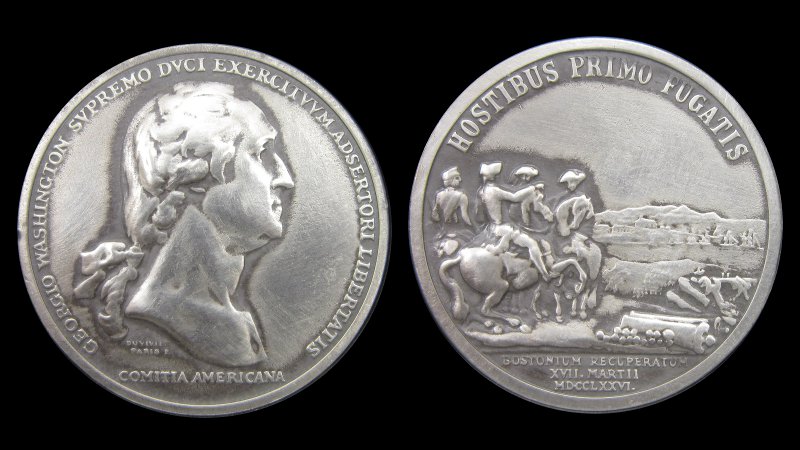
Reproduction of the Congressional Medal (from CoinCommunity)
Among those left behind in Boston were Gen. Artemas Ward and Col. Richard Gridley.  Ward, the first Commander in Chief, and Gridley the first Chief of Artillery and Chief Engineer did not make the cut to remain with the Continental Army.  Both men were old and had health issues.  Ward submitted his resignation to Washington before the Army moved south.  Washington forwarded the resignation to Congress, which rejected it.  Instead, Ward remained in Boston as commander of the “Eastern Army” which consisted of only a few hundred Continentals.  The fighting had left New England and there just wasn’t that much to do there.  Ward finally resigned the following year and went into retirement.

Gridley had already given over command of the Artillery to Henry Knox.  Following the Evacuation of Boston, Gridley also passed over Command of the Engineering Corps to Rufus Putnam, who had designed defenses for Dorchester Heights.  Gridley remained in Massachusetts where he used his forge to manufacture locally made howitzers and mortars for the Continental Army.

The Continental Congress praised Washington for his success in the Siege of Boston.  It ordered a gold medal struck in his honor.

- - -

Next Episode 87: Canada Spring, 1776

Previous Episode 85: Dorchester Heights


Click here to donate
American Revolution Podcast is distributed 100% free of charge. If you can chip in to help defray my costs, I'd appreciate whatever you can give.  Make a one time donation through my PayPal account.
Thanks,
Mike Troy


Click here to see my Patreon Page
You can support the American Revolution Podcast as a Patreon subscriber.  This is an option for people who want to make monthly pledges.  Patreon support will give you access to Podcast extras and help make the podcast a sustainable project.  Thanks again!


Further Reading

Resources to learn more about today’s topic.

Websites

What forced the British to Leave Boston? http://historyofmassachusetts.org/what-forced-british-leave-boston

Letter from Boston Selectmen to Washington, March 8, 1776: https://founders.archives.gov/documents/Washington/03-03-02-0314

Crean Brush vs. Ethan Allen: A Winner’s Tale, by John Duffy and Eugene Coyle (PDF):
https://vermonthistory.org/journal/70/vt703_402.pdf

Bell, J.L. Crean Brush in Very Distressed Times, March 2008: http://boston1775.blogspot.com/2008/03/crean-brush-in-very-distressed-times.html

Jolley Allen Missed Evacuation Day in 1776 and it Cost Him Everything:
http://www.newenglandhistoricalsociety.com/jolley-allen-missed-evacuation-1776-cost-everything

Richard Gridley, the Nearly Forgotten Patriot, by Steven Baule, Journal of the American Revolution (2013): https://allthingsliberty.com/2013/09/richard-gridley-nearly-forgotten-patriot

Free eBooks
(from archive.org unless noted)

Brooks, Noah Henry Knox, a Soldier of the Revolution, New York: G.P. Putnam's Sons, 1900.

Buell, Rowena (ed) The Memoirs of Rufus Putnam, Boston: Houghton & Mifflin Company, 1903.

Dana, Elizabeth Elery (ed) John Barker diary - The British in Boston, 1774-1776, Cambridge: Harvard Univ Press, 1924.

Drake, Francis The Life and Correspondence of Henry Knox, Boston: Samuel B. Drake, 1873.

Force, Peter American Archives, Series 4, Vol 4, Washington 1837.

Force, Peter American Archives, Series 4, Vol 5, Washington 1837.

French, Allen The Siege of Boston, New York: Macmillan, 1911.

Frothingham, Richard History of the Siege of Boston, Boston: CC Little & J. Brown, 1851.

Martyn, Charles The life of Artemas Ward, the first commander-in-chief of the American Revolution, New York: Artemas Ward, 1921.

Neeser, Robert (ed) The despatches of Molyneux Shuldham, vice-admiral of the Blue and commander-in-chief of His Britannic Majesty's ships in North America, January-July, 1776, New York: Naval Historical Society, 1913.

Stark, James H. The Loyalists of Massachusetts and the other side of the American Revolution, Boston [self-published], 1910.

Books Worth Buying
(links to Amazon.com unless otherwise noted)

Beck, Derek The War Before Independence: 1775-1776, Naperville, Ill: Sourcebooks, 2016.

Fleming, Thomas 1776: Year of Illusions, New York: W.W. Norton & Co., 1975 (book recommendation of the week).

Lockhart, Paul The Whites of Their Eyes, New York: Harper Collins, 2011.

McCullough, David 1776, New York: Simon & Schuster, 2005.

Philbrick, Nathaniel Bunker Hill: A City, A Siege, A Revolution, New York: Penguin Books, 2013.

Puls, Mark Henry Knox: Visionary General of the American Revolution, New York: St. Martin's Press, 2010.

Smith, David Whispers Across the Atlantick: General William Howe and the American Revolution, Oxford: Osprey Publishing, 2017.


Sunday, February 24, 2019

Episode 085: Dorchester Heights


When we last left Cambridge at the end of January 1776, Colonel Henry Knox had successfully returned with the cannon from Fort Ticonderoga.  But Washington and his generals still did not have a clear plan in place for how to use them.

How to Attack Boston

For months, Washington had been arguing for a direct assault on Boston.  He proposed a plan where wanted to have the army row across Boston Harbor in small boats, land in the face of enemy fire, and then assault the town.  His generals convinced him that this would be suicide.  Even if the soldiers did not break and run in the face of deadly artillery from the British Army and Navy, they would be cut to pieces before they could reach the shore.  Even if they somehow reached the shore and surprised the enemy, an urban combat battle much like Quebec but on a larger scale would almost certainly result in the capture or massacre of the Continentals.

On February 13, 1776, the British launched an evening raid across the ice, attacking Dorchester Neck.  Col. Alexander Leslie led several hundred regulars on the The raid burned a few houses, captured a few unlucky sentries, and then retreated back to Boston before the Continentals could react. This raised the concern that it was a prelude to a full British assault on Dorchester Heights.

A few days later, on February 16, Washington held another council of war with his generals. With the harbor frozen, he proposed  to march the army across the ice in a direct assault on Boston.  Again, all of his his generals resisted such a battle, arguing that it would be suicide.  Washington, usually calm and restrained, was clearly frustrated that he could not convince his generals to engage in a frontal attack.

Artemas Ward (from Wikimedia)
Over these same months, General Artemas Ward, the army’s second in command had argued that the best strategy would be to occupy Dorchester Heights.  This was high ground consisting of two hills on a peninsula just south of Boston.  Placing artillery on the heights, would give the Continental Army the ability to bombard the army in Boston as well as the navy in the harbor.  They would be at that elevation, the British would not be able to return fire effectively.  It would force the British to come out of Boston, either over the heavily fortified neck, or conduct a water landing then retake the heights by force.  Even if they could take the heights, it would almost certainly be at a terrible cost, making the battle of Bunker Hill look small in comparison.  The charge up the hill would not just be against militia with muskets.  The British would face a line of Continental canon.

The British had considered trying to capture the heights in summer of 1775.  It was the planned assault to take Dorchester that motivated the patriots to occupy Bunker and Breed’s Hills to the north and provoke that battle instead. After those losses, British General Gage and following his departure, General Howe did not want to risk another horrific loss trying to occupy Dorchester Heights.  Instead, they used threats to intimidate the Continentals from occupying it, leaving it a valuable no man’s land for months.

With spring approaching though, and now with a pile of heavy cannon to mount on the heights, the Continental generals agreed that it was time to occupy Dorchester Heights.  With a twist.  Washington agreed to occupy Dorchester.  If the British moved out of Boston to the south to attack Dorchester, Washington wanted to use that distraction to have his army row across the harbor from the north sending his army directly into Boston.  The council of war generally agreed to this plan.  One strong dissenter was General William Heath who thought that even if Howe sent half his army to attack Dorchester, there would still be thousands of entrenched British infantry and hundreds of army and navy cannon blasting away at militia trying to row across a mile and a half of open water to attack the city.  Heath was sure it would be a disaster and a bloodbath.  But everyone seemed to think they had to do something, and this was the best plan that drew a consensus.  The first step would be occupying Dorchester Heights.

Making a Plan

The problem was how to do it.  Mounting cannon on the heights could take weeks, or even months with the ground frozen solid.  There was no easy way to dig entrenchments without the enemy seeing what they were doing and sending out an army to take the heights before the Continentals were ready to defend it.

To tackle this problem. General Heath reached out to Rufus Putnam, a Massachusetts native and cousin of General Israel Putnam.  Rufus Putnam had worked with British engineers during the French and Indian War, but was not what you would call an expert in the science of military engineering.  After meeting with Washington to discuss the plan, Putnam decided to stop by Heath’s house on his way home.  While visiting, Putnam noticed a book on Heath’s table by a British Military Engineer called Attack and Defense of Fortified Places.

Rufus Putnam (from Wikimedia)

Putnam asked if he could borrow the book but Heath refused, saying he never lent out his books.  Putnam pointed out that Heath had stuck him with this job despite his lack of knowing anything about military engineering.  Now he had to build a fortification and Heath had the only book around that might explain how he could do it.  Really? You won’t let me read it? Finally, Heath agreed and let Putnam borrow the book.

A few pages in, Putnam saw the solution to his problem.  His men could not dig entrenchments in the frozen soil.  However, the book suggested building “chandeliers”.  In the terms of 18th century military engineering, a chandelier was a wooden frame.  Once built, the defenders filled the frame with sticks and branches, then covered the whole thing with dirt.  This created a defensive wall that would stop most bullets.

The soldiers could pre-build the chandeliers, then carry them up to Dorchester Heights at night, fill in the sticks and dirt, then mount the cannons.  With enough men, they could build a credible defensive wall and mount cannon in a matter of hours.

Putnam took the plan to Washington, who also conferred with Colonel Knox.  Of course, Knox would have to man the artillery once mounted there.  Washington also conferred  with Colonel Richard Gridley, still the Continental Army’s chief engineer.  All agreed it was a sound plan and supported it.  The only added suggestion was to add barrels filled with dirt or rocks as part of the defenses.  In addition to providing cover, if the British tried to storm the hill, the Continentals could roll the barrels  down on them, killing some and breaking up the attacking lines.

Preparations

Even with a plan, it would not be easy to execute.  The first step was to put hundreds of men to work building the wooden frames.  They also set to work building 45 flat bottomed boats, which could carry 80 men each.  Washington planned to use these for his assault on Boston.  With all this work, the British would almost certainly know the Continentals were up to something.  Next, the chandeliers would have be carried across Dorchester Neck, in plain view of the enemy.  If the British realized the Continentals were planning to occupy Dorchester Heights, they could rush out and storm the heights before the defenders were ready.
Chandelier packed with Fascines (from Salina Baker)

To avoid this problem, the Continentals set up large hay bales to block the road from view in Boston.  To cover the sound, they planned to start a cannonade against Boston from other locations.  This, they hoped, would distract the regulars and prevent them from hearing the sounds of hundreds of carts hauling equipment and guns up to the heights.

General Ward took charge of building the chandeliers and other prefabricated defenses that would be carried up to the heights.  Washington invited Colonel Thomas Mifflin, who was at this time Quartermaster General, to assist with logistics.  Mifflin proposed the night of March 4th for the occupation.  That way, if the British attacked the following day, it would be the anniversary of the Boston Massacre.  Others, thought that date was a mistake.  It’s not clear why, but possibly because it was a full moon, making it easier for the British to spot the work.  In any event, the council decided to adopt the date by a single vote.

Occupying the Heights

Colonel Knox had his artillery begin an attack on Boston on the night of March 2.  The plan was to continue the bombardment on the next two nights, so that by the night of March 4, the British would be focused on the artillery, but not find it so unusual that they would suspect it was being use to cover the sounds of thousands of infantrymen occupying Dorchester Heights and installing the chandeliers and mounting the cannon.

The Continentals still did not have much gunpowder, making their cannons of limited use.  The British Navy at New York had been blockading the harbor.  But they cut a deal, allowing merchant vessels to enter there in exchange for New York providing them with fresh food to feed the sailors. Taking advantage of this, the patriots smuggled in 3000 pounds of gunpowder on February 29.  They then hauled the powder overland on wagons up to Washington’s army, just in time for use in this action.

Map of Boston during Siege, 1776 click to zoom (from Reddit)
But even that amount of powder would not last long with artillery.  Since the first night was mostly about rousing the enemy, they fired a total of only around two dozen shots into Boston.  Sadly, the patriots did more harm to themselves than the enemy.  Knox’s inexperienced artillerymen destroyed three mortars and one cannon through improper use.  A British officer in Boston noted no significant damage to anything.  Of course, the barrage triggered a response from the regulars who used their own artillery to bombard Continental camps for several hours.

The next night, March 3, Knox’s artillery once again fired on Boston.  At least this time they did not damage any of their own weapons.  Once again, the British responded.  When the Continentals opened up again on the third night, March 4, the British again returned fire, but did not suspect anything else would be different that night.

The night of March 4, turned out to be an exceptional choice.  It would not be the last time that an unusual weather occurrence helped the patriots.  A bright moon helped the patriots with their labors in getting the defenses in place on Dorchester Heights.  But the bright moon did not help the British detect them, as a haze fell over the harbor, preventing the regulars from seeing much of anything across the water.

Col. Mifflin arranged for 350 ox carts to pull all the equipment up the heights beginning shortly after sundown.  They next sent 800 soldiers to occupy the heights, just to sit there with muskets and watch for any attack from the regulars in Boston.  Half of them sat near shore, watching for an attack from Castle Island.  The other half watched for an attack from Boston Neck.

Washington gave the task of emplacing all the artillery and entrenchments to Gen. John Thomas who organized 1200 more troops to do the work.  Washington himself appeared on the heights to encourage the men and see that everything went according to plan.  Colonels Knox and Gridley also worked on site, making sure everything was installed where it was planned.

But remember, occupying the heights was only half of Washington’s plan.  Washington fully expected the British to discover the occupation, either that night or certainly by morning, and that they would then scramble to launch an offensive force out of Boston to take the heights.  As soon as they did that, Washington had 4000 soldiers under the command of General Israel Putnam, ready to launch two raiding parties under the command of Generals Greene, and Sullivan.  These men would row across Boston Harbor, landing on the north side of town, fight their way through the city and link up with the soldiers on the south side commanded by General Ward at Roxbury.  For the moment, these men were just sitting and waiting for a signal that the regulars were attacking Dorchester Heights.

Dorchester Heights (from Twitter Boston NPS)
The plan seemed to move along with no significant problems.  By 10:00 PM, they had established two forts on the heights, and continued with the installation of chandeliers along the line.  Several hours before dawn, everything was in place and ready to go.  In total, if you count the guards, the men building the fortifications and those hauling the material to the site, there were a little over 3000 men involved.

Now, you may remember during the battle of Bunker Hill, no one made any attempt to relieve the men who built the entrenchments overnight, nor did anyone set up supply lines to bring them food and ammunition.  The Continentals did not make that same mistake at Dorchester.  In the morning, 3000 fresh troops came up to replace the men who had spent all night building the defenses.  But it turned out the men who did the digging did not want to let the next shift get the glory of going to battle.  Most of the night shift stayed on the heights as well, leading to as many as 6000 defenders.  By morning, the Continental Army was fully embedded on the heights, with all the infantry and artillery they needed to repulse any assault.

British Reaction

In Boston, General Howe, had received intelligence from deserters that the Continentals were planning something on Dorchester, but he did not know the date or other details.  Rather than act proactively, Howe waited until they actually did something.  He would then assault the heights while they were building the defenses.

During the night, while the Continentals secretly built the defenses, at least one officer in Boston detected activity and reported to his superior that the rebels were occupying the heights.  That superior was General Francis Smith, the same man who had led the original expedition to Lexington the previous April.  General Smith had always been a “follow orders” kind of officer, who did not grab the initiative or act with great energy.  In this case, he decided he would take up the matter with General Howe in the morning.

When dawn broke, the regulars were shocked to see not one, but two fully-built forts, and a line of entrenchments, complete with cannon, built on the top of Dorchester Heights.  According to one account, Howe said it would have taken his army months to complete such an emplacement.  Howe’s chief engineer estimated it must have taken 15,000-20,000 men to build those works overnight.

The British immediately turned their artillery fire on the new defenses but found that they were too high for them to hit effectively, either from Boston or from ships in the harbor.  At the same time, the Continentals could lob shots into the city or at naval vessels in the harbor unopposed.

Dorchester Heights
(from Twitter SW O'Connell)
Despite the entrenchments being pretty well in place, Howe launched a contingent of soldiers that morning to take the heights.  British General Valentine Jones loaded a force of just over 1200 men into boats to take them over to the Dorchester Peninsula.  They planned to attempt a water landing, in the face of cannon, musket, and rifle fire, then form up and charge the hills, defended by as many as 6000 patriots.  In other words, the British would have only a fraction of the force they had an Bunker Hill, and faced a much larger force supplemented by artillery.  This really seemed like a suicide mission.

Fortunately for the British attackers, the weather once again intervened.  High winds kicked up and prevented the force from being able to land before high tide that morning.  Once the tide was coming out, it would be even harder to effect a landing.  So, they got the force to Castle Island and planned a nighttime attack during the next high tide, just after midnight.  But the storm kicked up again even worse with hurricane force winds preventing any landing.

The following day, wind and rain continued, making a landing still nearly impossible.  Howe convened a council of war, at which just about every officer argued against an attack.  The rebels had had another 24 hours to make their defenses even stronger and there was no realistic way they were going to take the heights.

Although Howe had received reinforcements all winter, he was also losing men at a fair clip due to smallpox and other diseases.  He also had allowed Gen. Clinton to leave with some of his regulars to go conquer the Carolinas.

General Howe had maybe 6000 men ready for duty.  Even if he sent all of them against Dorchester, it probably would not have been enough to dislodge an entrenched enemy.  At the same time, and all out attack would encourage Washington to launch his invasion of Boston from the north side of the harbor.  There was just no way for Howe to win this one.

A frustrated General Howe agreed with the council of war that an attack would never work.  He admitted he only planned to order the attack for the honor of the army.  Now, accepting that plan was a pointless waste of lives in a no-win situation, Howe called off the attack completely.

This may have been a good thing for the Continentals too.  If Howe had launched his attack against Dorchester, Washington likely would have launched his ill-conceived amphibious attack on Boston.  The regulars almost certainly would have cut down that 4000 man attack force, leading to a terrible defeat for Washington.  It might even have led to his dismissal as Commander in Chief.  None of that happened though.  When Howe called of his attack, Washington called off his as well.

No attack though, meant Howe was stuck in a situation where the rebels could fire on the army and navy at will without the British being able to return fire effectively.  Well before all this happened, Howe had determined that the army should evacuate Boston and move down to New York as the center of operations.  Howe had hoped to make that move in a few more months, later in the spring, and after more reinforcements arrived from Britain.  Now he would have to move up that timetable.  He would also have to evacuate under the embarrassment of an amateur rebel army having out maneuvered him and forcing his retreat.

- - -

Next Episode 86: The Evacuation of Boston

Previous Episode 84: The Battle of Moore's Creek Bridge


Click here to donate
American Revolution Podcast is distributed 100% free of charge. If you can chip in to help defray my costs, I'd appreciate whatever you can give.  Make a one time donation through my PayPal account.
Thanks,
Mike Troy


Click here to see my Patreon Page
You can support the American Revolution Podcast as a Patreon subscriber.  This is an option for people who want to make monthly pledges.  Patreon support will give you access to Podcast extras and help make the podcast a sustainable project.  Thanks again!


Further Reading

Websites

What forced the British to Leave Boston? http://historyofmassachusetts.org/what-forced-british-leave-boston

Baker, Salina The Taking of Dorchester Heights, 2018: https://salinabakerauthor.com/2018/03/02/the-taking-of-dorchester-heights

Dorchester Heights, National Park Service: https://www.nps.gov/bost/learn/historyculture/dohe.htm

Council of War Feb. 16, 1776: https://founders.archives.gov/documents/Washington/03-03-02-0229

Letter from Lt. Col. Rufus Putnam, to George Washington  Feb. 11, 1776 re: Dorchester Heights: https://founders.archives.gov/documents/Washington/03-03-02-0214

Free eBooks
(from archive.org unless noted)

Blake, Francis Dorchester Neck. (Now South Boston.) The raid of British troops, February 13, 1776,
Boston: David Clapp & Son, 1899.

Brooks, Noah Henry Knox, a Soldier of the Revolution, New York: G.P. Putnam's Sons, 1900.

Buell, Rowena (ed) The Memoirs of Rufus Putnam, Boston: Houghton & Mifflin Company, 1903.

Dana, Elizabeth Elery (ed) John Barker diary - The British in Boston, 1774-1776, Cambridge: Harvard Univ Press, 1924.

Drake, Francis The Life and Correspondence of Henry Knox, Boston: Samuel B. Drake, 1873.

Force, Peter American Archives, Series 4, Vol 4, Washington 1837.

Force, Peter American Archives, Series 4, Vol 5, Washington 1837.

French, Allen The Siege of Boston, New York: Macmillan, 1911.

Frothingham, Richard History of the Siege of Boston, Boston: CC Little & J. Brown, 1851.

Martyn, Charles The life of Artemas Ward, the first commander-in-chief of the American Revolution, New York: Artemas Ward, 1921.

Muller John The Attack and Defence of Fortify'd Places, Woolwich: Royal Academy of Artillery, 1757 (Google Books).

Neeser, Robert (ed) The despatches of Molyneux Shuldham, vice-admiral of the Blue and commander-in-chief of His Britannic Majesty's ships in North America, January-July, 1776, New York: Naval Historical Society, 1913.

Books Worth Buying
(links to Amazon.com unless otherwise noted)

Beck, Derek The War Before Independence: 1775-1776, Naperville, Ill: Sourcebooks, 2016.

Fleming, Thomas 1776: Year of Illusions, New York: W.W. Norton & Co., 1975 (book recommendation of the week).

Lockhart, Paul The Whites of Their Eyes, New York: Harper Collins, 2011.

McCullough, David 1776, New York: Simon & Schuster, 2005.

Philbrick, Nathaniel Bunker Hill: A City, A Siege, A Revolution, New York: Penguin Books, 2013.

Puls, Mark Henry Knox: Visionary General of the American Revolution, New York: St. Martin's Press, 2010.

Smith, David Whispers Across the Atlantick: General William Howe and the American Revolution, Oxford: Osprey Publishing, 2017.


Sunday, October 21, 2018

Episode 067: Washington Takes Command


A few weeks ago, I discussed the Continental Congress’ decision to create a Continental Army and appoint George Washington as its commander in chief.  Before Washington could take charge, the Provincial Army fought the battle of Bunker Hill that I discussed for the last two weeks.  With the battle over, I’m going to pick up the story of Washington taking command of the new Continental Army.

New Generals for a New Army

The Continental Congress had voted to create the Continental Army on June 14, 1775.  It appointed George Washington as the new commander on June 15, two days before Bunker Hill.  Word of the new commander did not reach Gen. Artemas Ward until June 25, a week after the battle.  Washington took a couple of weeks to prepare, get his affairs in order, and make the trip to Boston, arriving on July 2, escorted by James Warren, the new President of the Provincial Congress, and Dr. Benjamin Church head of the Massachusetts Committee of Safety.

Washington Takes Command a Cambridge
(From New England Historical Society)
Washington first stopped to meet with General Ward, now the Continental Army’s second in command and the most senior major general in the new army.  I’m not sure if Ward was offended or relieved to have a new commander.  He did turn over command promptly and without public comment.  If there was a chance the two might develop a good working relationship, Washington put an end to that over the next few weeks.  Washington publicly criticized the lax command structure and leadership that he inherited, which Ward took personally.

With Washington were fellow Virginians the new Major General Charles Lee, third in command of the new army and newly appointed Brigadier General Horatio Gates.  As I mentioned last week, both men were in contention for the top job and both had been officers in the regular army before settling in Virginia.

Connecticut General Israel Putnam, who had played a prominent role at Bunker Hill and most other events at the siege of Boston, also received an appointment as major general in the new Continental Army.  The only major general not present was Philip Schuyler who was in Albany trying to resolve the military situation with Ethan Allen and Benedict Arnold out around Fort Ticonderoga (see Episodes 59 and 60).

Two more Massachusetts generals in the Provincial Army were among the first eight brigadier generals appointed by Congress. Generals John Thomas and William Heath received their commissions.  Generals Joseph Spencer from Connecticut, and Nathanael Greene of Rhode Island also both served in the Provincial Army and received commissions as brigadiers.

Artemas Ward loses command
(From Wikimedia)
In case you were wondering, the others in the first class of brigadier generals were Joseph Sullivan, a New Hampshire delegate to the Continental Congress, who would arrive a few days later, Richard Montgomery who was Schuyler’s second in command in New York, and David Wooster from Connecticut, the same man who had refused Captain Benedict Arnold access to the powerhouse in New Haven after the Battle of Lexington (see, Episode 59).  These men rounded out the first class of brigadiers.

Also with Washington were his new aide, Maj. Thomas Mifflin and his secretary Lt. Col. Joseph Reed, both from Pennsylvania, and both of whom will play prominent future roles in our story.  At the risk of making too many introductions at once, I want to mention one more man accompanying General Washington.  Billy Lee was Washington’s slave.  He served as his personal assistant, valet, butler, and messenger.  Washington had purchased Lee in 1768.  The two men apparently grew very close.  Lee was one of the few men anywhere who could keep up with Washington on a horse.  Both men were excellent and daring riders.  Lee would serve Washington for all eight years of the war, remaining by his side through everything.  It is unclear if Washington ever confided in Lee, because if he did, Lee never betrayed that confidence.  It was clear that Washington was close with Lee and appreciated his service.  When Washington died, Lee was the only slave he freed outright.  He also granted Lee a pension for the remainder of his life.

George Washington

I’ve already given some background on some of these new generals, and will probably need to provide more background on more of them in future episodes, but today, I just want to focus on Washington himself.  Hopefully, everybody knows who George Washington is, and there are literally over a thousand published biographies about the man, almost all of which are better than this brief summary.. But in the interest of being thorough, here is a brief background.

George Washington by Peale
1776 (from Wikimedia)
Washington was one of the earliest people I introduced in this story, way back in Episode 5. There, as a young man he blundered into the Ohio Valley and kicked off the Seven Years War between Britain and France, known in America as French and Indian War.  In 1759, as the French and Indian War was nearing its end, Washington married Martha Custis, a wealthy widow with two children of her own.

George, then 26, left active military service and got elected to the House of Burgesses later that year.  For the next 15 years, he spent his time as a gentleman farmer and minor legislator, while remaining a Virginia militia officer.  Washington had begun wearing his militia uniform to the Second Continental Congress, where he was a delegate.  Some have argued he was angling to be made the new commander of the Continental Army.  As I mentioned in an earlier episode, from the public and private statements of Washington around this time, I think he hoped to be made a general, but did not anticipate being appointed Commander in Chief.   When offered the command though, he stepped up and accepted it.

Washington was also an extremely formal, quiet, and reserved man.  As a boy, he came from one of the lesser families in Virginia and was always focused on comporting himself more like the wealthier leaders in the colony.  He focused obsessively on his dress, speech, manners, and behavior, and expected others to do the same.  He rarely took anyone into his confidence or engaged in casual conversation.  If anyone ever betrayed his confidence, even in a minor way, he would cut them off rather coldly and would not allow them to become close ever again.

Reorganizing the Army

When Washington arrived in Cambridge, the southern officer experienced a bit of a culture shock with his new army made up of New Englanders.  Washington had expected to command an army of over 20,000.  The force that met him, however, had less than 14,000 ready for duty, which referred only to the state of their health, not whether they were really trained to fight in battle.

While he did not comment publicly about his first thoughts on his new army, he did write a letter to a distant cousin at Mount Vernon:
The People of this Government have obtained a Character which they by no means deserved—their Officers generally speaking are the most indifferent kind of People I ever saw. ….. [T]they are by no means such Troops, in any respect, as you are led to believe of them from the Accts which are published, but I need not make myself Enemies among them, by this declaration, although it is consistent with truth. I daresay the Men would fight very well (if properly Officered) although they are an exceeding dirty & nasty people.
Gen. Charles Lee
(From Wikimedia)
He was shocked at the level of disorganization, that soldiers and officers did not respect the chain of command, and that blacks and whites were fighting alongside one another.  He immediately began to try to change all these things.

One of the things though, that helped make Washington great, was his ability to accept advice and to change his views when convinced of a better idea.  Washington initially ordered the dismissal of black troops.  As a Virginian he was raised with the concern that armed blacks created a risk of slave insurrection.  New Englanders though, had no such fears.  Free whites outnumbered both slaves and free blacks combined by overwhelming numbers.  Convinced by his New England officers that dismissing the black troops was a bad idea, he soon reversed himself and permitted the racially integrated units to continue.  He soon grew to admire and appreciate the capabilities of these men.

His concerns about organization, deportment, and the chain of command though, required change.  After personally inspecting the lines, and getting numerous reports on the state of his new army, One of Washington’s first actions was to hold several courts martial, to remove officers who had exhibited cowardice during the battle of Bunker Hill.  He also took an inventory of his army, including men, arms, and supplies.  He did away with the right of soldiers to elect their officers.  All Continental officers would receive a commission from the Continental Congress.

Washington knew that an effective army needed discipline.  He issued rules against profanity, drunkenness, and gambling.  Officers and men had to attend daily religious services.  Violations could be punished with floggings.  He ordered officers to improve the neatness and appearance of their men and the camps, keep their men from wandering away from camp without orders, and crack down on the destruction of private property.

The new commander issued an order for sentries not to communicate with the enemy.  Soldiers on the front lines at Boston Neck or Charleston Neck often stood within shouting distance of their counterparts on the other side.  Such conversations were banned as was any correspondence with the enemy.

Billy Lee, Washington's servant
(from findagrave)
Supplies were also a primary concern.  Washington tried to get Congress to buy more shirts for his army.  He really wanted whole uniforms but realized this was impossible for now.  Many men had been wearing the same unwashed shirts for months, reducing them to rags.  Washing them was impossible as there were no women around to do the work.  Apparently, it was inconceivable that a soldier might wash his own clothes.  New shirts would go a long way toward improving morale.  Congress, however, could not come up with the money even for that.  Instead of uniforms, Washington ordered his generals and aides to wear ribbons over their shoulders much like a Miss America sash.  Washington wore light blue, his general wore pink sashes and his aides green ones.  Field officers would wear colored cockades, a smaller ribbon tied in a bow, in their hats.

Washington organized his army into three divisions, one for each of his major generals at Boston.  He put General Ward in charge of the the army’s right at Roxbury, defending Boston Neck.  General Lee took charge of the left, which included the defense of Charlestown Neck against the British on Bunker Hill.  Putnam commanded the center at Cambridge, under Washington’s direct supervision.

Washington may have expected that the men in his new army would need training and discipline.  What really shocked him was the lack of ammunition and supplies.  Originally his aides told him the army had just over 300 barrels of powder, about enough to give each soldier a one full cartridge box, and not much more, not even counting the needs of any artillery.  That count, however, was based on old paperwork.  It had not counted all the powder that had been used over the past month, including the Battle of Bunker Hill.  When his aides actually did a physical check on inventory, they found only 90 barrels for the entire army.  When Washington heard the news, he apparently was struck speechless for some time.  He realized he did not have enough to fight even one battle with the British.  If the British attacked, his army could not fight back.

Siege of Boston (from Journal of the American Revolution)
Washington did not write any letters to Congress about this desperate shortage.  He feared that if the enemy learned of this fact, they would march out of Boston and crush his army as they could not even return fire for very long.  In fact, the British commander, Gage, did hear about the powder shortage.  He still had his spy network including Benjamin Church, head of the Committee of Safety. Gage, however did not believe it, thinking it was an attempt to draw him out of Boston into battle.  Washington made getting more powder a priority, but it would take months to get any significant increase in stock.  He had to issue orders banning any firing practice or other unauthorized discharges in order to conserve what little powder they had.  Also, to counter the lack of bayonets for most of his men, the army ordered the production and deployment of spears to defend against an attack.  Even these were slow in coming.

Disease also became more of a problem over the summer.  Dysentery and smallpox swept through both the British and Provincial camps, killing or disabling many.  At one point nearly 20% of the Continental Army was unfit for service.  Hundreds of them would die that summer, without ever seeing battle.  In late July, Washington appointed Benjamin Church as the head of a newly formed “Hospital Department” a position that would be referenced as “Surgeon General”.

For the most part, the army seemed to accept its new commander and complied with his policies.  It could all fall apart quickly though.  Ward, his second in command soon took offense at Washington’s criticism of the condition of the army when he took control  Ward knew that reflected poorly on his leadership.  Lee, third in command, was still upset that Congress had not selected him as commander in chief.  He seemed to be waiting for Washington to screw up, so that he could move into the top slot.  Both men, however, bided their time and, for the moment, enforced Washington’s policies.

Skirmishes

Washington was eager to do battle with the British, but the condition of his army and the lack of ammunition made this impossible. Both armies remained well entrenched in defensive position, neither side willing to attempt to dislodge the other.

On the British side, Bunker Hill seems to have taken the fight out of the British commanders.  In July, they received reinforcements that more than covered their losses from the battle.  But General Thomas Gage in particular seemed unwilling to initiate any new fighting. Gen. Henry Clinton had pushed to follow through on their original plan to take Dorchester Heights.  His plan would bypass Boston Neck and launch assault troops for a water landing.  Clinton got the plan as far as putting soldiers on landing craft.  Gage, however, got cold feet and sent a messenger ship to recall the invasion before they could land.

The Boston Lighthouse (from New England Historical Society)
There were occasional skirmishes.  In the days following Washington’s arrival, there were apparently several minor attacks and counter attacks near Boston Neck.  British troops attacked defenders at Roxbury, possibly in an attempt to capture some stray cattle between the lines.  After that, Gen. Ward issued an order calling for any cattle straying beyond American lines to be shot.  The Americans attacked and destroyed Brown’s Tavern, a small building on Boston Neck occupied by British regulars.  The British would launch another raid a few weeks later, attacking Americans who were trying to reinforce and extend their defensive lines.  The Americans would use the the distraction of this attack to launch a successful attack on the Lighthouse on Lighthouse Island, making night movements for the British Navy a little more difficult.  That night, the British sent a construction crew with 30 marines as guards to repair the lighthouse,  They were still working the following morning when the Patriots launched another attack on the island, capturing the construction crew and the marines, and once again burning down the repaired lighthouse.

The arrival of the new Continental rifle units from Virginia and Pennsylvania created new excitement.  Riflemen liked to show off their skills by firing on sentries across the river in Boston.  Somehow the regulars captured one of them.  It’s not clear whether they captured him alive and then hanged him, or simply hanged his dead body after they killed him.  Either way the hanging body appeared in Boston in view of the Continental lines on August 2.  Enraged riflemen received permission to fire on regulars in Boston, which they did for the rest of the day, killing or wounding an unspecified number.  British muskets could not return fire, but artillery could.  One rifleman died from a well placed cannon ball.

These are only a few examples of the ongoing small-time skirmishing that kept both armies on alert.

Plowed Hill

A slightly larger skirmish occurred when on August 26, Washington ordered the occupation of Plowed Hill (aka Ploughed Hill), a small hill across the river to the north of Bunker Hill.  Overnight, 1200 Continentals entrenched their position on the hill, giving them a good position across the river against the British on Bunker Hill.

Ploughed Hill, Cambridge 1775 (from bouseblog)
The next morning, the British opened fire on the Continental forces from Bunker Hill and several gunboats, but could do little against entrenched forces.  They killed or injured a few soldiers who ran out of the bunkers to collect British cannon balls.  Continental officers gave soldiers a reward for any balls they collected.  A few soldiers tried to use their feet to stop balls slowly rolling across the field, only to discover that a relatively slow moving 20 pound ball can still do serious damage to your foot. The Americans had one cannon with them, which they used successfully to sink one small British gunboat.

The British prepared to assault Plowed Hill by boat, but decided against it.  Continental riflemen were already picking off too many of them.  They did not want another costly win like Bunker HIll for land that they could not really hold if they took it.  In the end, they simply left the Americans in control of the hill.  So, the summer of 1775 ended with the stalemate over Boston showing no sign of ending.

- - -

Next Episode 68: Congress' Olive Branch Petition

Previous  Episode 66: British Take Bunker Hill


Click here to donate
American Revolution Podcast is distributed 100% free of charge. If you can chip in to help defray my costs, I'd appreciate whatever you can give.  Make a one time donation through my PayPal account.
Thanks,
Mike Troy


Click here to see my Patreon Page
You can support the American Revolution Podcast as a Patreon subscriber.  This is an option for people who want to make monthly pledges.  Patreon support will give you access to Podcast extras and help make the podcast a sustainable project.  Thanks again!


Visit http://www.amrevpodcast.com for a list of all episodes.

Visit https://pod.amrevpodcast.com for free downloads of all podcast episodes.


Further Reading:

Websites

LOC: Washington’s Commission as Commander in Chief: http://www.loc.gov/rr/program/bib/ourdocs/commission.html

William “Billy” Lee: http://www.mountvernon.org/digital-encyclopedia/article/william-billy-lee

From George Washington to Lund Washington, August 20, 1775: https://founders.archives.gov/documents/Washington/03-01-02-0234

Benjamin Church becomes “Surgeon General”: http://drbenjaminchurchjr.blogspot.com/2015/10/dr-benjamin-church-jr-appointed-surgeon.html

Burgoyne, Lee, and Enoch Brown’s Tavern, July 7, 2007 Journal of the American Revolution: http://boston1775.blogspot.com/2007/07/burgoyne-lee-and-enoch-browns-tavern.html

VIDEO: J.L. Bell describes George Washington’s Headquarters in Cambridge C-SPAN, 2017: https://www.c-span.org/video/?436822-4

Free eBooks
(from archive.org unless noted)

French, Allen The Siege of Boston, New York: Macmillan, 1911.

Frothingham, Richard History of the Siege of Boston, Boston: CC Little & J. Brown, 1851.

Heitman, Francis Historical register of officers of the Continental Army during the War of the Revolution, April, 1775, to December, 1783, Washington: Rare Book Publishing Co. 1893.

Leiter, Mary Biographical Sketches of the Generals of the Continental Army of the Revolution, Cambridge: University Press, 1889.

Linn, John, et. al (ed) Pennsylvania in the war of the revolution, battalions and line. 1775-1783, Harrisburg: Lane Hart,1880 (pp. 6-7 discuss Battle of Plowed Hill).

Lodge, Henry Cabot George Washington, Vol. 1, Boston: Houghton Mifflin & Co. 1898.

Martyn, Charles The life of Artemas Ward, the first commander-in-chief of the American Revolution, New York: Artemas Ward, 1921.

Books Worth Buying
(links to Amazon.com unless otherwise noted)

Beck, Derek The War Before Independence: 1775-1776, Naperville, Ill: Sourcebooks, 2016.

Beeman, Richard R. Our Lives, Our Fortunes and Our Sacred Honor: The Forging of American Independence, 1774-1776, New York: Basic Books, 2013.

Borneman, Walter American Spring: Lexington, Concord, and the Road to Revolution, New York: Little, Brown & Co. 2014.

Chernow, Ron Washington: A Life, New York: Penguin Press, 2010 (book recommendation of the week).

Fleming, Thomas Now We are Enemies: The Story of Bunker Hill, St. Martin’s Press, 1960.

Forman, Samuel Dr. Joseph Warren: The Boston Tea Party, Bunker Hill, and the Birth of American Liberty, Pelican Publishing, 2011.

Lockhart, Paul The Whites of Their Eyes, New York: Harper Collins, 2011.

Nelson, James L. With Fire and Sword: The Battle of Bunker Hill and the Beginning of the American Revolution, New York: St. Martin's Press, 2011.

Philbrick, Nathaniel Bunker Hill: A City, A Siege, A Revolution, New York: Penguin Books, 2013.

Phillips, Kevin 1775: A Good Year for Revolution,  New York: Penguin Books, 2012.