Sunday, August 8, 2021

ARP212 Port Royal & Kettle Creek


The British southern command had burst into new activity beginning with the capture of Savannah, Georgia in December, 1778.  After Colonel Archibald Campbell captured Savannah, General Augustine Prévost marched a larger force up from St. Augustine Florida to occupy the area around Savannah.

The British offensive began just as American General Robert Howe was turning over command to General Benjamin Lincoln.  General Lincoln had only reached Charleston by the time the British attacked Savannah.  Lincoln then moved to the Georgia-South Carolina border to confront the enemy.  This led to a stand off, and kept the British penned up in and around Savannah.  That is where I left things a few weeks ago in Episode 208.  In the following weeks and months, the British attempted to expand on their victory at Savannah and the Americans tried to stop them.

Battle of Beaufort

Eager to maintain the offensive, General Prévost ordered an attack on Port Royal, South Carolina, about forty miles from Savannah.  This, he hoped, would be the beginning of a British toe-hold in a second rebellious colony.   He also hoped the action would distract the Americans under General Lincoln from the British occupation of Georgia and get the Continentals to deploy more of their forces to the South Carolina coast.

William Moultrie

Port Royal was an island on the coast, meaning it would be more easily defensible, and could be backed up by the British Navy if needed.  Local intelligence also indicated that there were many loyalists in the area who would support the British liberation of the region.

The British at Savannah had a ship, the Vigilant. This was a smaller 6th rate ship with about 20 cannons on it.  The ship had been damaged months earlier in the same storm that dispersed the French and British fleets off of Newport, Rhode Island.  By the time the Vigilant reached Savannah, Georgia, it was deemed “unseaworthy” and incapable of sailing on its own.  It was still capable of floating and housing its artillery.  The British towed the ship to the waters off Port Royal Island to serve as a floating battery to back up the soldiers as they landed on shore.

Aboard several smaller ships, about 200 regulars under the command of Major William Gardner moved set sail for Port Royal in late January. However, since they had to tow the Vigilant with rowed longboats, the move took several days. 

The island’s defenses consisted of a small defensive area at the town of Beaufort, known as Fort Lyttelton.  There were a few dozen Continentals at the fort under the command of Captain John DeTreville. When Captain DeTreville learned of the approaching British, he knew he could not withstand an assault or siege.  In order to avoid capture and deny the fort to the enemy, Captain DeTreville  spiked the fort’s cannons and blew up the main bastion.  He then evacuated his men back to the mainland before the British arrived on the island.

General Lincoln, however, did not want to cede any South Carolina territory to the enemy.  By the time the British landed on Port Royal, Lincoln had already dispatched a 300 man force under the command of Continental General William Moultrie, the same officer who had defended Fort Sullivan in Charleston Harbor back in 1776.  Most of the men under Moultrie were South Carolina militia, who Moultrie himself noted, were ill-trained and ill-disciplined.  A few Continental soldiers accompanied the brigade, as did two local artillery companies from Charleston, headed by former Congressmen Edward Rutledge and Thomas Heyward.  Moultrie’s force crossed onto the other end of the island on February 1, a day before the British landing.

Beaufort, Troop Movements
On February 2, 1779, British soldiers landed on Port Royal Island.  Local loyalists served as guides.  The British force met no serious opposition as they unloaded from their ships and began to march across the island.  It was not until the following day, February 3, that Moultrie received word of the British landing and marched out to meet them.

The two forces met near the middle of the island.  Major Gardner advanced to the top of a hill and had his men fix bayonets inside a tree line.  General Moultrie formed his men in a line in a nearby field, in sight of the enemy.  To supplement his lines, he deployed his two six-pound field cannon in the middle of his line and a smaller two-pound cannon on the right flank.  General Moultrie noted later that the armies reversed their usual operations, with the Americans out in the open field and the British using the forest as cover.

The Americans outnumbered the British and also had the advantage of field artillery, while the British had none.  The Americans opened fire, but were out of musket range and did little damage.  After about 45 minutes, the Americans were beginning to run low on ammunition.  Moultrie began preparations to withdraw when he realized that the British were also beginning to withdraw.  

Major Gardner opted not to charge a superior force with cannon and decided to march back to the coast where the British would have the cover of the cannons from the Vigilant.  Seeing the retreat, Moultrie ordered a company of militia cavalry to cut off the British.  The cavalry managed to get behind the British retreat and captured a wounded captain and 25 other enemy soldiers.  However, there were not enough cavalry to contain them.  The prisoners made a break for it, with about half of them escaping back to the British lines.

The British had taken substantial casualties from the American artillery, reporting at least 40 killed or wounded.  The Americans reported 7 killed and 18 wounded.

The Americans declared victory for the battle, as the British had retreated back to their boats and returned to Savannah.  British regulars rarely backed down against militia, even if the militia has superior numbers.  After the return to Savannah, General Prévost criticized Gardner for moving his troops too far in advance of the ships and the protection of the cannons.  The men had to fight their way back to the ships in some of the bloodiest fighting of the day.  But if the Americans had failed to bring up artillery, the battle might have gone very differently.

So, by the second week of February, the British found themselves back in Savannah and still facing the danger from General Lincoln’s forces only a few miles away in Purrysburg.

Kettle Creek

Recall that Colonel Archibald Campbell had captured Savannah in late December, 1778.  He then turned over command to General Augustine Prévost in January, 1779, after Prévost marched an army up from St. Augustine, Florida.  After that, Campbell took an expedition up to take control of Augusta at the end of January, about the same time Major Gardner was moving to take Port Royal.

Kettle Creek
The purpose in taking Augusta, was to establish a British presence in the backcountry.  Once again, the British were promised that if they raised the standard, thousands of loyalists could heed the call and take back the colony for the crown.  The British hoped to raise a loyalist army of 6000 new recruits in order to solidify control of Georgia and then take the offensive into South Carolina.

In taking Augusta, the British saw the local militia flee the town with no real resistance.  Colonel Archibald Campbell then began taking loyalty oaths and trying to establish loyalist militia in the backcountry in order to secure Georgia and with plans to take an invasion force into South Carolina.

To assist in recruitment, Campbell had brought with him a prominent colonist from the Carolinas named John Boyd.  As a loyalist, Boyd had made his way to British occupied New York where he assured General Clinton that he could raise a loyalist army in the Carolina backcountry if Clinton could get some regulars down there for the men to rally around.  Boyd received a militia commission as a lieutenant colonel and joined Colonel Campbell for the invasion of Savannah.  Boyd then made his way through the Carolina backcountry, recruiting his loyalist army, well into North Carolina.  

These were the same Scotch-Irish Loyalists who had risen up to support the British when they first tried to land at Cape Fear in 1776.  The patriots had decimated and scattered them at Moore’s Creek Bridge, something I discussed back in Episode 82.  After that, the loyalists had mostly laid low and accepted patriot rule.  With the British back in Georgia, this was the opportunity for the loyalists to rise up once again and help the regulars put down this rebellion.

The problem was that the patriots had controlled the Carolinas for three years.  The loyalists knew that taking up arms against the patriots would mean that their properties could be confiscated or destroyed.  Many of those who did join Boyd saw their homes burned while they were away. These volunteers could also be hanged as traitors to the state.  Many of the more prominent loyalists took the safest option and did not join Colonel Boyd.  They stayed on their plantations and remained neutral.

While recruiting was not as fruitful as hoped, Boyd did manage to recruit several hundred men in North Carolina, and then added to his recruits as his new loyalist militia army marched south to join with the British at Augusta.  As Boyd approached Augusta, his army had reached somewhere between 600-800 men.

Andrew Pickens
The patriots were watching these events unfold, as they reacted.  Colonel Andrew Pickens of South Carolina raised an army of about 350 mostly South Carolina militia, with some Georgia militia joining him, to challenge the British control of Augusta.  Since the British force at Augusta was three times the size of his army, Pickens mostly used his militia to prevent the British from sending out small recruiting or foraging parties and harassing the British from a distance.

Campbell had deployed Captain John Hamilton with about 300 Tories to secure various outposts around Augusta.  He divided his forces to take control of more area.  Pickens’ patriots came after Hamilton who had about 100 men with him at the time.  The loyalists took refuge in a small redoubt known as Carr’s Fort.  There, the Americans began a siege, hoping to capture the loyalists before Campbell could send out a relief force from Augusta.

Just as the siege was getting started, Pickens received word that Boyd’s loyalist army was in the area, and trying to get to Augusta.  Pickens gave up on the smaller force in hopes of intercepting Boyd’s militia.

The loyalists under Boyd were still in South Carolina, near the Georgia border.  On February 11, they approached an area known as Vann’s Creek, where a patriot blockhouse guarded the ford.  There were only eight patriots guarding the ford when confronted by up to 800 loyalists.  However, the patriots had a defensive wall backed by two swivel guns.  They opened fire on the loyalists.  Another 40 patriots quickly crossed the river in canoes, to supplement the defense. 

Boyd was not looking for an encounter at this time.  It is possible that many of his men did not even have arms, something they would receive when they reached Augusta.  There is also some evidence that many of the loyalists under Boyd’s command had come under pressure to do so and were looking for an opportunity to desert.

As a result, Boyd opted to avoid having to storm the blockhouse and moved his men to a point about ten miles upstream where they could cross unimpeded into Georgia.  After that, Colonel Boyd rested easy.  He was inside British lines and only a few miles from a loyalist militia camp. Boyd awaited word from Augusta about connecting his militia with the British regulars there. His army set up camp to rest from its long march near a small stream known as Kettle Creek.  

Boyd had not heard that Campbell had decided to abandon Augusta and had put his men on the march back to Savannah. His camp was more isolated than he knew.  The patriots under Pickens had not given up the chase.  Pickens marched his patriot militia back across the Savannah River into Georgia.

On the morning of February 14, Pickens divided his patriots into three columns and attacked the Loyalist camp under Boyd.  The loyalists probably had close to twice as many men as the attacking patriots.  But they were taken by surprise.  Boyd had failed to put out sufficient pickets or patrols to keep watch for any enemy.  As I said, it is also possible that many of the loyalists still did not have muskets.  

Boyd quickly organized a defensive barrier where he and about one hundred of his men confronted the attackers, while the bulk of the patriots moved to higher ground in their rear.  The defense was fairly effective, with the battle raging for more than 90 minutes.  Eventually, the larger patriot force managed to outflank the loyalist line and force the defenders to retreat back to the main British line to the rear.  During the retreat, Colonel Boyd received a mortal wound and would die later that evening.  

The patriots continued their assault, up the heights against the main loyalist force.  Boyd’s second in command, Lieutenant Colonel John Moore was also killed or wounded.  Third in command, Major William Albertus Spurgeon Jr., attempted to rally the loyalists but failed.  The terrified loyalists broke and ran, leaving behind their horses, supplies and tents, fleeing into the swamps.  The patriots overran their lines in a complete route.

The loyalists suffered between 40 and 70 killed, another 75 or so were captured, many of whom were also wounded.  Most significantly, many of the loyalists used the opportunity to flee and return home. Some of these men surrendered later while trying to get away.  As a result, only 270 loyalists made it to Augusta, far less than half of those recruited.  The patriots suffered only 7-9 killed and 14-23 wounded or missing.  They also managed to free 33 patriots who the loyalists had taken prisoner during their march from North Carolina.

Trials

The loyalists who became prisoners at Kettle Creek had to suffer the wrath of their patriot neighbors.  Even before the battle, North Carolina patriots reported burning the homes of many of the men who had left with Colonel Boyd’s army.  Those taken prisoner were not treated as prisoners of war.  Rather, they were prosecuted as criminals who had committed treason by taking up arms against the state government.  These men had also incurred the wrath of locals by looting and pillaging homes during their march from North Carolina to Georgia.

At first, Colonel Pickens occupied Augusta following the British withdrawal.  He took about 75 prisoners captured at Kettle Creek and put them under guard in Augusta.  He also put out the word that any other loyalists who had escaped Kettle Creek should turn themselves in.  They would have to post bond and then would be released.  Another 75 or so loyalists took advantage of this offer and turned themselves in.  It turned out though, that the offer was a lie. Pickens threw these men into the prison with the men who had been captured on the battlefield.

Fort 96 Stockade
After about three weeks, the patriots marched the loyalist prisoners to Fort Ninety Six in South Carolina, where they were turned over to civilian authorities for trial.  There, roughly 150 men were held in terrible conditions in an overcrowded brick jail inside the fort.

The prisoners arrived on March 10.  The trials had been scheduled to begin the day before, but had been postponed.  The trials finally began on March 22.  It took about three weeks to try all the prisoners, which were concluded by April 12.  There are no surviving records of the trial, but we know the prisoners’ fates were decided by a jury selected by the local Sheriff, William Moore.

Of the 150 or so prisoners, roughly half of them were released without being found guilty.  Since there are no court records, it is not clear why.  Another 50 or so prisoners were found guilty of treason, but were granted reprieves.  Many of the prisoners had argued that they had been forced into joining Boyd’s army either by pretense or threats.  For whatever reason, only twenty-two of the men received death sentences.  The court scheduled the hanging for April 17.  According to one of the condemned prisoners, the gallows were constructed in the site of the jail

Five of the prisoners Charles Draper, John Anderson, James Lindley, Samuel Clegg, and Aquilla Hall went to the gallows that morning and were hanged.  We don’t have details on all the condemned men, but for those for whom we do have details, it appears that those condemned had held positions of prominence in the colonies before the war, and may have served officers under Colonel Boyd.  Clegg, for example, had served as a tax collector in South Carolina and had served in the colonial assembly.  Hall had been a wealthy plantation owner and had actively recruited for Colonel Boyd.  Lindley had served as a justice of the peace in North Carolina, and had been a captain in the provincial militia.  He had also been captured and released by the patriots on one prior occasion.

After the hanging of the first five men, a message arrived from Governor Rutledge of South Carolina with a writ of habeas corpus ordering the condemned men to be moved to Orangeburg.  The remaining 17 condemned prisoners escaped the hangman’s noose and were sent off as prisoners.  The reprieve may have been the result of British threats to begin hanging American prisoners in retaliation.  In any event none of the other 17 men were ever executed and eventually were exchanged or released.

I’ll get into those details more next week, when we cover the continuing fighting between Georgia and South Carolina at the Battle of Brier Creek.

- - -

Next  Episode 213 Brier Creek 


 Contact me via email at mtroy.history@gmail.com

 Follow the podcast on Twitter @AmRevPodcast

 Join the Facebook group, American Revolution   Podcast: https://www.facebook.com/groups/132651894048271

American Revolution Podcast Merch!

T-shirts, hoodies, mugs, pillows, totes, notebooks, wall art, and more.  Get your favorite American Revolution logo today.  Help support this podcast.  http://tee.pub/lic/AmRevPodcast


American Revolution Podcast is distributed 100% free of charge. If you can chip in to help defray my costs, I'd appreciate whatever you can give.  Make a one time donation through my PayPal account. You may also donate via Venmo (@Michael-Troy-20), Zelle, or popmoney (send to mtroy1@yahoo.com)


Click here to see my Patreon Page
You can support the American Revolution Podcast as a Patreon subscriber.  This is an option making monthly pledges.  Patreon support will give you access to Podcast extras and help make the podcast a sustainable project.

An alternative to Patreon is SubscribeStar.  For anyone who has problems with Patreon, you can get the same benefits by subscribing at SubscribeStar.

Help Support this podcast on "BuyMeACoffee.com"


Visit the American Revolution Podcast Bookshop.  Support local bookstores and this podcast!


Signup for the AmRev Podcast Mail List

* indicates required

Further reading

Websites

Encounter at Vann’s Creek (archived brochure): https://web.archive.org/web/20170211081717/http://gassar.org/revtrail/pdf/brochure_vannscreek.pdf

Battle of Kettle Creek: https://kettlecreekbattlefield.com/the-battle-of-kettle-creek

Battle of Kettle Creek https://www.battlefields.org/learn/revolutionary-war/battles/kettle-creek

Henry, William An Unfortunate Affair: The Battle of Brier Creek and the Aftermath in Georgia, Georgia Southern University, 2021: https://digitalcommons.georgiasouthern.edu/cgi/viewcontent.cgi?article=1914&context=etd

Chained and Tried: The Fate of the Loyalist Prisoners from Kettle Creek https://www.battlefields.org/learn/articles/chained-and-tried-fate-loyalist-prisoners-kettle-creek

Davis, Robert Scott. “The Loyalist Trials at Ninety Six in 1779.” The South Carolina Historical Magazine, vol. 80, no. 2, 1979, pp. 172–181. JSTOR, www.jstor.org/stable/27567552

Zachariah Gibbs http://sc_tories.tripod.com/zachariah_gibbs.htm

John Ashe: https://www.ncpedia.org/biography/ashe-john

General John Ashe: https://ashefamily.info/people/born-in-the-18th-century/major-general-john-ashe-1720-1781

Andrew Williamson: https://www.carolana.com/SC/Revolution/patriot_leaders_sc_andrew_williamson.html

Ashmore, Otis, and Charles H. Olmstead. “The Battles of Kettle Creek and Brier Creek” The Georgia Historical Quarterly, vol. 10, no. 2, 1926, pp. 85–125. JSTOR, www.jstor.org/stable/40575848

Heidler, David S. “The American Defeat at Briar Creek, 3 March 1779.” The Georgia Historical Quarterly, vol. 66, no. 3, 1982, pp. 317–331. JSTOR, www.jstor.org/stable/40580932

Cox, William E. “Brigadier-General John Ashe’s Defeat in the Battle of Brier Creek.” The Georgia Historical Quarterly, vol. 57, no. 2, 1973, pp. 295–302. JSTOR, www.jstor.org/stable/40579524

Searcy, Martha Condray. “1779: The First Year of the British Occupation of Georgia.” The Georgia Historical Quarterly, vol. 67, no. 2, 1983, pp. 168–188. JSTOR, www.jstor.org/stable/40581049

Free eBooks
(from archive.org unless noted)

Jones, Charles C. The History of Georgia Vol. 2, Boston: Houghton & Mifflin Co. 1883: 

McCall, Hugh The History of Georgia, containing brief sketches of the most remarkable events up to the present day, (1784), Atlanta: A.H. Caldwell, 1909 reprint.: 

Peck, John Mason Lives of Daniel Boone and Benjamin Lincoln, Boston : C.C. Little and J. Brown, 1847. 

Books Worth Buying
(links to Amazon.com unless otherwise noted)*

Campbell, Archibald Journal of an expedition against the rebels of Georgia in North America under the orders of Archibald Campbell, Esquire, Lieut. Colol. of His Majesty's 71st Regimt., 1778, Ashantilly Press, 1981. 

Cashin, Edward The King's Ranger: Thomas Brown and the American Revolution on the Southern Frontier, New York: Fordham University Press, 1999. 

Coleman, Kenneth The American Revolution in Georgia, 1763–1789, Univ. of Ga Press, 1958. 

Hall, Leslie, Land and Allegiance in Revolutionary Georgia, Univ. of Ga Press, 2001.  

Martin, Scott Savannah 1779: The British Turn South, Osprey Publishing, 2017. 

Mattern, David B. Benjamin Lincoln and the American Revolution, Columbia, SC: University of South Carolina Press, 1998: 

Piecuch, Jim Three Peoples, One King: Loyalists, Indians, and Slaves in the Revolutionary South, 1775-1782, Columbia: Univ. of South Carolina Press, 2008. 

Russell, David Lee. The American Revolution in the Southern Colonies. McFarland & Company, 2000. 

Wilson, David K. The Southern Strategy: Britain’s Conquest of South Carolina and Georgia 1775-1780, Univ. of S.C. Press, 2005. 

* As an Amazon Associate I earn from qualifying purchases.


Sunday, August 1, 2021

ARP211 Winter at Middlebrook


By December of 1778, the Continental Army settled into its winter quarters around Middlebrook, NJ.  The British were already behind their fixed defenses in New York City, the departure in late fall of so many regulars to other parts of the empire made it unlikely that the British would attempt any more major offensives like the grand forage into Bergen county that I discussed in an earlier episode (Episode 198).

William Tryon

Although the lines between the two armies that winter were relatively quiet, both sides did send out raiding parties from time to time.

British Major General William Tryon was one of the more active officers.  Tryon, you may recall, had been royal governor of North Carolina, and then New York before the war.  Prior to that, he had been a career officer in the regular army and was no stranger to combat.  As Governor, Tryon had developed a reputation as a tough leader, taking on the rebels at Alamance in 1771, and then against the Green Mountain Boys in the years just before the war.

William Tryon
Tryon had taken a commission as a major general of provincial forces in the early part of the war.  He was also still a colonel in the regular army.  By 1778, he had received a commission as major general in America, in the British army as well.  The rank of an officer “in America” is a bit strange.  It came with all the authority of a regular officer, but the commission only lasted in that theater of war and for the duration of the war.  If the officer transferred to another theater, or returned to Britain, he would revert back to his permanent rank.

Tryon was also still governor of the colony New York, although this meant little by 1779 since most of the state was under rebel control, and the area around New York City was under martial law.  Tryon’s rule was effectively limited to his authority as military commander of Long Island.  

Tryon was also among the most hard core of British officers who believed that the army was being too soft on the rebels.  Tryon had advocated for a complete war of destruction.  He wanted to go on raids that would burn down civilian towns, destroy food and supplies, and generally make life miserable enough that the people would demand an end to the war and once again accept crown rule.  Even though some leaders back in London also seemed to support this tough policy, to Tryon’s frustration, General Howe, and then General Clinton both rejected such a campaign of terror against civilians.

As the war continued on without any real end in sight, Tryon had petitioned the ministry to end his position as New York Governor and allow him to return to London. Tryon hoped to get a permanent military commission that would replace his compensation as colonial governor but which would also allow him to return to his family in England.  He pleaded both health and family reasons for his desire to end his term in America.

Again, Tryon would be frustrated.  Secretary of State Lord Germain wrote Tryon in late 1778 requesting that he remain in New York until the British reestablished rule, or as Germain put it “all hope is lost.”  The fact that the American Secretary in London was even articulating the possibility in 1778 that Britain could lose the war is rather telling.

General Clinton offered Tryon command of the campaign that he deployed in late 1778 to capture Savannah Georgia.  Tryon declined.  He complained of continuing ailments brought on from diseases he picked up while Governor of North Carolina years earlier in his career.  He believed that a return to the south might make his illness even worse.  Instead, the command of that mission went to Colonel Archibald Campbell.

Horseneck Landing

In February, 1779, General Tryon got approval from General Clinton to lead a raid into Connecticut.  Tryon assembled a force of mostly provincial militia, along with some regulars and Hessians, to raid a community known as Horseneck, which is in present day West Greenwich Connecticut.  On the night of February 25, his brigade marched out under cover of darkness, from the British lines at Kingsbridge.  They completed the twenty mile march to Greenwich by the following morning.

General Israel Putnam was in Greenwich at the time.  He managed to assemble a group of about 150 local militia to meet the raiders.  The Americans had three small field cannons to support their lines.  The British, however, so outnumbered the men that there was no realistic chance of sustaining a defensive line.

Putnam at Horseneck Landing
According to local lore, General Putnam ordered his men to flee into a nearby swamp where the dragoons on horseback could not follow.  Putnam remained with the cannons to distract the British attackers as his men fled.

As the enemy got close, Putnam turned his horse and rode down a steep embankment.  According to some accounts it was a set of stone steps.  Others believe it was a dirt cow path.  Whatever the exact route, the steep path down the hill was so dangerous that the British dragoons did not pursue.  Instead, they fired at the general, one of them managing to shoot Putnam’s hat, but failing to wound the man.

Again, according to unconfirmed accounts, the general stopped at the bottom of the hill, waved his sword at his attacks, and some say swore at them.  Putnam then rode to safety, where he met up with more militia and some of the men from his first assault, who had escaped and then found their way back to the general.

The British destroyed the three American field cannons. They also burned several buildings in Greenwich, along with a saltworks, and a few boats.  By 2:00 PM, the British had finished their work.  General Tryon had driven the men without sleep the previous night, but opted to begin their march back right away.  He feared the Americans might be able to rally a larger force to assault them, if they delayed too long.  

As the British began to withdraw from Greenwich, General Putnam returned again with the militia that he had been able to rally over several hours.  The Americans still did not have the numbers to challenge the British, but did continue to lay down a harassing fire on the British rear of the column.  Putnam managed to catch 38 enemy stragglers who did not keep up with the retreating column.  They also recaptured some of the ammunition and supplies that the British had seized and were trying to haul back to their lines.

By that night, the British had managed to make it out of Connecticut, but were still not back to their lines in Kingsbridge.  Tryon approved a few hours of rest for his exhausted troops, but then got the column moving again early, finally returning to their lines by the afternoon of the 27th.  The entire raid had lasted less than 48 hours, most of that time marching to and from Greenwich.

Following the battle, General Putnam sent an officer under a flag of truce with his captured prisoners to General Tryon’s lines.  He proposed a prisoner swap with some of the prisoners the British had captured in their raid.  Tryon agreed and made the trade.  He even sent General Putnam a new hat with the returning prisoners, to replace the one his officers had shot a hole through.  

Although the raid seemed to be a British victory, it did not seem to improve General Tryon’s standing with General Clinton.  The British commander criticized the raid as a pointless adventure, which led to the deaths of two British soldiers and nine others wounded.  Clinton also attacked Tryon for using his authority as governor to issue several pardons without the approval of the military commander.

Tryon, I think with some justification, returned criticism of the commander for not doing much of anything.  He claimed that, if given 3000 soldiers, he could visit devastation along the New England coast.  Tryon’s criticisms against Clinton seem reminiscent of Clinton’s complaints against General Howe three years earlier when Howe as North American commander was continually reigning in and slowing down General Clinton.

Clinton’s Plans for 1779

A few months later, General Clinton would lead his own offensive and would leave General Tryon cooling his heels in New York City. 

The British had significantly reduced their ranks in North America.  London had issued orders to Clinton not to embark on any major campaigns like the Saratoga Campaign or the Philadelphia Campaign.  The main military action was taking place in Georgia and moving into South Carolina.  Even so, Clinton would not simply sit idly and do nothing with his forces in New York and Newport.  

The British commander spent the winter developing his plans for a series of spring actions.  All of them had limited goals, making use of the limited manpower that was left to him.  He outlined three separate actions for the spring and summer:

Gen. Sir Henry Clinton

The first was a renewed assault up the Hudson River.  He would not attempt to establish a connection all the way to Quebec.  Rather, he would only move upriver to cut off the use of King’s Ferry as a point of transport between New England and the rest of the colonies.  He also planned to move further upriver and threaten the American defenses at West Point.

A second series of raids would assault ports in Connecticut. Assuming Britain could retain control of the waters around Long Island, they could attack the Connecticut coast with impunity.  A large enough raid might even provoke the Continentals into a larger battle, fought on Clinton’s terms, giving him an opportunity to use his superior strategic abilities to defeat them.

A third offensive would make use of a series of raids into the Chesapeake Bay area, destroying commerce and military stores in Maryland and Virginia.  This would not only remove much-needed supplies from the Continental Army.  It would also distract the enemy’s focus on the southern campaign, where British forces in Savannah hoped to capture South Carolina, and possibly move into North Carolina as well.

Long Island Sound

Even while making longer-term strategic plans, Clinton’s forces around New York had to defend against continual raids, particularly from Connecticut, which was just a short boat ride to British-occupied Long Island.  Because Long Island was so large, the British did not have men to defend the entire island.  Particularly isolated was the eastern end of the island, which was more than 100 miles from New York City but only a 10 mile boat ride from the Connecticut coast.

While British vessels patrolled the sound, it remained a pretty wild no-man’s land where smugglers and privateers operated with impunity.  Even posts on western Long Island, near New York City were subject to attack.  Shortly after Tyron’s raid at Horseneck Landing, Connecticut Captain Andrew Meade led a small fleet of Connecticut whaleboats.  The men rowed across the sound at night and seized a small sailing ship at Ferry Point, loaded with supplies.  The raiders sailed the ship back to Greenwich before the British could react.

James Rivington
The British sailed after the stolen vessel.  As they attempted to enter the harbor at Greenwich, they came under fire from cannons that the local militia had mounted on the hill overlooking the harbor.  The British were forced to withdraw without recapturing their lost prize.

A few days later, Captain Meade led another group of men determined to destroy the printing offices of the Royal Gazette, a Tory newspaper in British-occupied New York.  This time they infiltrated downtown Manhattan, seizing the newspaper’s type and carrying it back to Greenwich for destruction.  The newspaper’s owner was a notorious Tory named James Rivington.  The raiders, of course, did not know it, but Rivington was also an American spy, working for the Culper Spy Ring.

Occupied New York

New York City had become an increasingly difficult place to live over the winter of 1778-79.  The city had become more crowded than ever.  Although thousands of British regulars had departed, loyalists from all over the country were taking refuge there.  Thousands of Philadelphia loyalists were attempting to secure the necessary food, clothing, and shelter.  

Without limited access to crops and cattle, food became limited.  To help ease the food demands, Clinton permitted the release of 430 American prisoners in January.  He transported the prisoners to New London, Connecticut for release on parole.  The men were in such poor condition from cold, hunger, and disease that fifteen of them died during the short trip across Long Island sound.  Of those who survived the journey, many more died over the next few weeks, and almost all of them required care.  Many could not even walk.  

The Connecticut Assembly ordered depositions taken from surviving prisoners in order to document the treatment they had suffered as prisoners of war.  Most of the thousands of prisoners who had been held aboard prison ships or at the Sugarhouse left their prisons feet first.  Untold thousands died under horrific conditions.  By the end of February, there were only about 700 prisoners held in the city, including about 200 men on the prison ship Good Hope.  By mid-April, the Good Hope, reported holding only 144 prisoners.  None had been released, but 25% of the ship’s prisoner population had died in only a few weeks.

Continental Army at Middlebrook

General Washington had located the bulk of the Continental Army around Middlebrook, New Jersey, generally the same location they occupied when the British under General Howe were in New York before leaving for Philadelphia.  The Continentals had encamped there in May - July of 1777. Washington was familiar with the terrain, which he believed provided effective defenses against a British assault.  The Continentals could observe the British in New York from the mountaintops, but were also a good day’s march from the enemy, making a surprise attack unlikely.  It also provided good roads in any direction the army might need to pivot in order to counter a British offensive.

George Washington was not with his men for much of the early winter months because he had travelled to Philadelphia.  There he was trying to convince Congress that the army did not have the resources to launch a new offensive into Philadelphia.  Washington’s main focus was putting together a campaign to wipe out the hostile Iroquois and Tories that continued to bring suffering to New Yorkers throughout much of the state.  For most of December and January, Major General William Alexander, Lord Stirling, commanded the main army.

Wallace House, Washington HQ
After Washington returned from Philadelphia, he and Martha stayed at the home of John Wallace.  It was a four bedroom home.  George and Martha occupied one room, a second was shared by Washington’s aid.  The Homeowner, Wallace and his wife occupied a third, and the owner’s mother-in-law, the fourth.

Other generals took up residence at other private homes in the area. Nathanael Greene stayed at the home of Derrick Van Veghten House about one mile east of the Wallace House. Anthony Wayne and his staff occupied the home of Abraham Van Nest.  There, a confrontation with the homeowners eventually resulted in a lawsuit. Lord Stirling stayed at the Philip Van Horne House about two miles east of the Wallace House.  Von Steuben took up residence with local Abraham Staats, about four miles east of the Wallace House. Henry Knox stayed at the home of Jacobus Van Der Veer House six miles north of the Wallace House.

The main army divided into three divisions, camping separately so that the collection of local resources like wood and water would not be too concentrated. What became known as the Pennsylvania camp was laid out south of the Raritan River, to the west of the road to Princeton. The Virginia and Maryland camps deployed on the other side of the Raritan River, about four miles to the northeast, near roads leading toward New York City and the New Jersey coast. To the north of the crossroads village of Pluckemin, about seven miles from the Virginia and Maryland camps, General Knox erected an artillery park for his soldiers and guns.

The winter in New Jersey was not as cold as prior winter at Valley Forge, not nearly as bad as the following winter would be at Morristown. Deprivations continued as the army lacked sufficient food, clothing, and shelter for the men.  Again though, the deprivations do not seem to be quite as bad as the year before.  Reforms by the new quartermaster, Nathanael Greene, seemed to be having some positive effect.

Middlebrook Encampment

The winter at Middlebrook does not seem to get the same attention as the prior winter at Valley Forge, but it was quite difficult for many of the soldiers who endured there.   Most of the men, though, were spread out in the rural mountainous area around Middlebrook, near modern day Boundbrook, New Jersey.  There were not nearly enough buildings to house the men.  The army tried to build crude wooden huts 16’ by 14’ with a single fireplace that would hold a dozen soldiers each.  Even so, many of the soldiers had to endure much of the winter in tents.

One reason the deaths were not as great as at Valley Forge, was that the army had inoculated against smallpox during its stay at Valley Forge.  The inoculated soldiers did not have to suffer with that dreaded and deadly disease the following winter.  Washington first encamped in December with between 10,000 and 12,000 Continentals.  Deaths and desertions left the army with only 8000 survivors by spring.  Of the survivors, another third were unfit for duty due to illness, often brought on by the cold weather and deprivation. The army benefitted from some new uniforms provided by their French allies.  In March, the French Ambassador Gerard visited the camp and received a grand review of the army.  

Compared to other winter encampments, the winter at Middlebrook was not so bad.  Like Washington, many of the general officers had their wives join them at camp.  General Greene held a dance at his quarters in mid-march, where he noted that General Washington and his wife Catherine danced for three hours straight. The men also held a larger celebration on February 18, to mark the first anniversary of the French alliance.

As I said, the winter passed relatively quietly until the British began to deploy for their spring operations in April.  In May, the Continentals left Middlebrook to defend against attacks in the Hudson Valley.  By June, the winter camp was empty and abandoned.

Next week, we return south again as the British attempt to expand on their success in capturing Savanna, Georgia, but find patriot resistance surprisingly resilient.

- - -

Next Episode 212 Port Royal & Kettle Creek (Available August 8, 2021)


 Contact me via email at mtroy.history@gmail.com

 Follow the podcast on Twitter @AmRevPodcast

 Join the Facebook group, American Revolution   Podcast: https://www.facebook.com/groups/132651894048271

American Revolution Podcast Merch!

T-shirts, hoodies, mugs, pillows, totes, notebooks, wall art, and more.  Get your favorite American Revolution logo today.  Help support this podcast.  http://tee.pub/lic/AmRevPodcast


American Revolution Podcast is distributed 100% free of charge. If you can chip in to help defray my costs, I'd appreciate whatever you can give.  Make a one time donation through my PayPal account. You may also donate via Venmo (@Michael-Troy-20), Zelle, or popmoney (send to mtroy1@yahoo.com)


Click here to see my Patreon Page
You can support the American Revolution Podcast as a Patreon subscriber.  This is an option making monthly pledges.  Patreon support will give you access to Podcast extras and help make the podcast a sustainable project.

An alternative to Patreon is SubscribeStar.  For anyone who has problems with Patreon, you can get the same benefits by subscribing at SubscribeStar.

Help Support this podcast on "BuyMeACoffee.com"


Visit the American Revolution Podcast Bookshop.  Support local bookstores and this podcast!


Signup for the AmRev Podcast Mail List

* indicates required

Further Reading

Websites

Horseneck Landing https://www.encyclopedia.com/history/encyclopedias-almanacs-transcripts-and-maps/horseneck-landing-west-greenwich-connecticut

General Putnam’s account of the Battle of Horseneck: http://www.historycarper.com/1779/02/26/general-putnams-account-of-the-battle-of-horse-neck

Tryon’s Descent on Horseneck (British account): http://www.historycarper.com/1779/03/03/tryons-descent-on-horse-neck

Melillo “The Meaning of Memorial Day in Greenwich” Greenwich Free Press, May 26, 2019: https://greenwichfreepress.com/around-town/holiday/melillo-the-meaning-of-memorial-day-in-greenwich-123124

“To George Washington from Major General Israel Putnam, 28 March 1779,” Founders Online, National Archives, https://founders.archives.gov/documents/Washington/03-19-02-0624

1779 Campaign:  https://www.mountvernon.org/library/digitalhistory/digital-encyclopedia/article/1779-campaign

The Middlebrook Winter Encampment: http://www.doublegv.com/ggv/battles/midbrk.html

“General Orders, 6 February 1779,” Founders Online, National Archives, https://founders.archives.gov/documents/Washington/03-19-02-0135

Middle Encampment (map) http://zitthere.com/nyc-nj/mdlbrk-angelakos-map.html

Free eBooks
(from archive.org unless noted)

Hill, George C. Gen. Israel Putnam, Boston: E. O. Libby and Co. 1858. 

Irving, Washington The Life Of George Washington, Vol. 3, London: George Bell and Sons, 1905.  

Tarbox, Increase N. Life of Israel Putnam ("Old Put"), Major-General in the Continental Army, Boston: Lockwood, Brooks, and Co, 1876. 

Books Worth Buying
(links to Amazon.com unless otherwise noted)*

Burrows, Edwin Forgotten Patriots: The Untold Story of American Prisoners During the Revolutionary War, Basic Books, 2008.

Chernow, Ron George Washington, A Life, Penguin Press, 2010.

Hubbard, Robert E. Major General Israel Putnam: Hero of the American Revolution, McFarland & Co. 2017. 

Nelson, Paul David William Tryon and the Course of Empire: A Life in British Imperial Service, Univ of NC Press, 1990.

* As an Amazon Associate I earn from qualifying purchases.


Sunday, July 25, 2021

ARP210 Fort Vincennes


In early 1779, a group of Virginians attacked Fort Vincennes, which sits on the Wabash River, in what is today Indiana, right on the Illinois border.  In 1779, this was deep into Indian territory, where few people of European descent had settled, or even traveled.  This week, I want to take a closer look at the western dispute that flared up so far away from the main areas of battle.

Henry Hamilton

The British retained outposts deep in the continent’s interior, in order to maintain claims to all of the land that had not been settled or governed by any other European power.  The few white settlers in the area were almost all French, whose families had come to what is today Canada before the British took control of that region in the 1760’s.

Fall of Fort Sackville

Henry Hamilton was the British official in charge of this area.  He was Irish by birth (and no known relation to Alexander Hamilton).  His father had descended from aristocracy, but with that title passing to first-born relatives.  His father, still part of a wealthy and powerful family, served in the Irish Parliament.  His older brother, Sackville Hamilton, would also serve in the Irish Parliament, and would later become undersecretary to the Lord Lieutenant of Ireland.

Henry grew up in Ireland and as a younger son, followed a traditional route of joining the regular army as an officer.  In 1755, at age 21, he received an ensign’s commission. He had risen quickly to captain when the French and Indian War began.  Serving under General Guy Carlton, Hamilton fought at the Battle of Quebec and the Siege of Louisbourg.  By the end of the war, he served as brigade major.

As with many peacetime officers, Hamilton’s position in the army stagnated.  He returned home with his regiment after the war, but then came back to Quebec when the American rebellion began to heat up in 1775.  Hamilton was still a military officer, but served mostly in administrative positions in Quebec. 

In 1775, London offered a new opportunity.  The North Ministry created five lieutenant governorships in Quebec.  This was part of the expansion of the Quebec territory that Parliament had approved in the Quebec Act of 1774, one of several laws often listed as one of the coercive acts or intolerable acts that set off colonial violence.

Henry Hamilton
Hamilton sold his commission in the army and began a new political career as a lieutenant governor and commander of Fort Detroit, in what is today Michigan.  Other lieutenant governors took posts at Vincennes in what is today Indiana, and Kaskaskia, near the settlement of St. Louis.

Like the other new lieutenant governors, Hamilton was pretty much on his own, at a distant outpost with few resources.  By the time he left for Detroit in the fall of 1775, Americans were already invading Quebec and besieging the capital city.  Hamilton had a few companies of regulars and a handful of local administrators, who were mostly leftovers from French rule.  The judge for the territory had lost his authority with the passage of the Quebec Act.  But since there was no replacement for him, Hamilton simply allowed him to continue handing out judgments.

Because he had no real government to administer.  Hamilton’s real role was more of a diplomat.  His job was to convince the few French Canadians and the local tribes to remain neutral in any coming fights.  By most accounts, he developed a good working relationship with the leaders of the local Ottawa and Huron tribes.

As the war progressed, Hamilton pushed for a more aggressive role.  In 1777, he encouraged local warriors to go on the attack against western settlements, where supporters of American independence were taking hold.  He received the nickname of “Hair Buyer” because of rumors that he paid for each rebel scalp that the warriors collected.  There are some who dispute that Hamilton actually paid for scalps, but there is no question that he encouraged Indian attacks on American settlements.  Initially, the program was a great success.  Indians took hundreds of scalps and forced many settlers to abandon the western territories.  Governor Hamilton seemed willing to overlook that many of the scalps seemed to come from women and children.

In a few cases, the warriors brought back live prisoners.  One of these prisoners was Daniel Boone, who met with Hamilton in Detroit.  Hamilton had hoped to keep Boone a prisoner, but the Indians who captured him refused to turn him over.  Instead they wanted to accept Boone into their tribe.  Later that year, Boone escaped and returned to Kentucky.

George Rogers Clark

Although London had decided this territory was part of Quebec, Virginia still claimed that all of this land was part of Virginia.  Many of the settlements that had been attacked were  composed of Virginians moving west into what became Kentucky, as well as lower Indiana and Illinois.

The British-backed Indian raids on these western lands demanded a response.  The man in charge of responding was George Rogers Clark.  The older brother of William Clark of the famous Lewis and Clark Expedition.  Clark was born in Virginia, near Charlottesville, in 1752.  When he was still a toddler, his family moved further west, on the Virginia frontier.  This was a particularly dangerous time when France was stirring up Indians to attack British colonists  during the French and Indian War. George remained back east with his grandfather, where he attended the same school as James Madison.

George Rogers Clark
Clark, however, only attended school for a short time.  He learned a trade as a surveyor and by age 19 was surveying western lands for Virginia settlers.  He also took a commission as a captain in the Virginia militia.

In 1774, Captain Clark led a company in the frontier fighting that became known as Lord Dunmore’s War.  After that, Virginia got the Shawnee to cede control of land south of the Ohio River, thus opening up Kentucky for settlement.  There were still a few hurdles for settlers.  Britain had banned settlement west of the Allegheny mountains via a 1763 proclamation.  There were also a number of other tribes who claimed this same land as their own, and were not part of the treaty that ceded the land.  Beyond that, a North Carolina land speculator was attempting to create a new colony out of this land, based on a treaty that North Carolina had settled with the Cherokee.

To help cement Virginia’s claim to this land, Clark and others petitioned the Governor to recognize the Kentucky territory as part of Virginia.  By 1776, Lord Dunmore had fled Virginia.  The new Governor Patrick Henry did not feel constrained by any royal proclamation.  Governor Henry designated Kentucky as a county in Virginia.  The county included all of the land that is the current State of Kentucky.

Clark served as military commander of the new county.  But it was so lightly populated, and Virginia’s focus was on the war in the east, that very little happened there.

American Offensive

In 1777, after the native tribes began stepping up their attacks on settlers in the region, Clark pushed for a response. In December 1777, Clark presented a proposal to Governor Henry to lead a regiment. Henry approved the plan in a set of secret orders that he did not want to run by the state legislature.  Publicly, Clark’s mission was vaguely defined as protecting Kentucky from attack.  His secret orders were to attack enemy outposts north of the Ohio River, evict the enemy, and secure that land for Virginia.

Henry commissioned Clark as a lieutenant colonel and authorized him to raise a Virginia regiment. These were not militia. Rather, they were regular soldiers commissioned by the State of Virginia. The regiment would sail down the Ohio River from Fort Pitt, then take the British outposts north of the Ohio River that were being used as bases of operations for attacks into Kentucky. 

March to Vincennes
Clark had difficulty raising a sizable regiment since most men were already fighting in the larger campaigns in the east. Also, Clark needed to keep his military targets a surprise and could only reveal to potential recruits the vague goal of protecting Kentucky.  As he worked to recruit volunteers from Pennsylvania, Virginia, and North Carolina for his “Illinois Regiment of Virginia” he also sent spies into the Illinois territory (which includes modern day Indiana and Illinois) to scout out the enemy defenses.

While he hoped to raise a regiment of 350 men, he only raised about half of that amount for the mission.  Undeterred, the group set out from Fort Pitt in May 1778.  Their first target was the British outpost at Kaskaskia.  

Clark faced his first challenge when several of his recruits objected to the plan.  They had joined the regiment because Clark had told them they were going to be defending Kentucky.  They did not sign up for a military offensive into Illinois territory.  Several tried to desert, but were dragged back to camp.  With threats of execution, Clark managed to keep his new regiment together as they began the journey down the Ohio River.

By late June, the regiment was close to where the Ohio joins the Mississippi River.  They encountered a group of American hunters who were paddling up the Ohio.  The hunters warned Clark that Kaskaskia had lookouts along the Mississippi River to warn about any enemies approaching.  

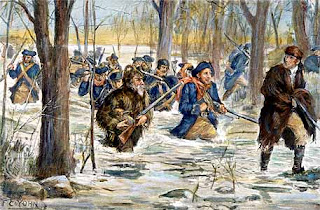
With this information, rather than approach by moving up the Mississippi River, Clark landed his regiment on the north bank of the Ohio River and marched overland to the town.  The hunters agreed to guide the regiment through the wilderness to Kaskaskia.  The march took longer than expected when the guides got lost.  The men carried four days worth of rations, which ran out during the six day march.  The hungry regiment reached Kaskaskia on July 4.  There, they only encountered the local French-speaking population.  The British lieutenant governor had abandoned the town and headed north to Fort Detroit.

Clark convinced the French locals to sign loyalty oaths to Virginia, and took prisoner several who defiantly backed British rule.  His news that France had recently formed an alliance with the Continental Congress helped to encourage the locals to support the Americans.  Of course, most locals were happy to support whichever side let them keep their property and generally left them alone.  

Clark also removed his soldiers from the town as soon as it was secured, leaving only a small garrison at the fort.  He wanted to avoid any conflicts between his soldiers and the locals that might turn the local population against him.  He also assured the local priest that Virginia would not interfere with the practice of Catholicism. This light-touch approach seemed to work well.  The locals were very happy that their town was not looted and plundered by the enemy army. Most settlers seemed happy to cooperate.

Clark’s forces next took Vincennes and the British Fort Sackville, again without a fight.  The local militia who garrisoned the fort swore an oath to Virginia and continued to garrison the fort under an American officer and flying the American flag.  No one put up any resistance as Clark’s men collected loyalty oaths over much of July 1778 from small settlements around the region and many of the local tribes.

There was some resistance.  During the occupation, a group of Indians attempted to attack and kill Colonel Clark.  After putting down the attack, Clark held several war chiefs in irons and kept them prisoner.  Many of his Indian allies attempted to intervene and get him to release the prisoners on the promise that they would not attack again.  Clark refused to do so.  Clark and his men all had families who had endured merciless Indian raids over the prior two years. Many lost friends and family to these attacks.  While they were willing to make peace with Indians who offered peace, they would also treat harshly any Indians who showed an inclination toward continued violence.

Clark also reached out to the local Spanish leaders at St. Louis.  The Mississippi river marked the border between Spanish territory and the land under dispute between Quebec and Virginia.  Spain was still neutral at this time, and was not helping either side.  Clark opened a friendly correspondence with Fernando de Leyba, the Lieutenant Governor for Upper Louisiana.  Governor de Leyba made clear that as long as they stayed on the eastern side of the Mississippi, there would not be any problems.

By late summer, Clark had largely completed his mission.  His regiment had been recruited for a term of 90 days, which expired in August.  Many of the men who had not wanted to be on this mission in the first place, were more than ready to go home. Others also were eager to get back  home for the winter.

Clark realized that they needed to hold this new territory, or the British would likely simply take it back.  He prevailed on the regiment to reenlist for another eight months.  He managed to convince about 100 of the men to remain.  The rest returned home.

British Retake Vincennes

Up in Detroit, by August, Lieutenant Governor Hamilton received news of the American incursion and the capture of Kaskaskia and Vincennes.  Hamilton sent word to Quebec and hoped to get some guidance, and military assistance from Quebec’s Governor. He wrote to Guy Carlton, not having heard that Frederick Haldimand replaced Carleton in June 1778.  After waiting several weeks and receiving no response, Hamilton decided to act on his own.

Crossing the Wabash
Although he was no longer a military officer. Hamilton raised a battalion which he would lead personally to recapture Vincennes.  He took about 30 British regulars from the Detroit garrison, as well as about 175 local French-Canadian militia.  He also recruited about 60 Ottawa warriors under the command of Chief Egushwa.  

Hamilton’s force left Detroit on October 8th, 1778 for a late season campaign that would inevitably continue into the winter.  As the British force moved south on the 300 mile journey to Vincennes, they recruited more native warriors along the way, so that they had roughly 300 warriors, for a total of about 500 soldiers by the time they reached Vincennes.  Many of the warriors who joined Hamilton had signed loyalty oaths to Clark only a few weeks earlier.

On reaching Vincennes in December, the local French Canadian militia that garrisoned Fort Sackville immediately abandoned their posts and submitted to the British force under Hamilton.  Captain Leonard Helm, who Clark had left in command of the fort, had no choice but to surrender and become a British prisoner of war.  Once again, Vincennes changed hands without any bloodshed.

Given the onset of winter, Hamilton remained in Vincennes, reaching out to local settlements and tribes to receive oaths of loyalty to the king.  He did not engage in any major acts of retribution for those who had signed loyalty oaths to Virginia.  He did not want violence to push the local population into backing the Americans.  Hamilton’s goal was to use his presence as incentive to get the locals to change their minds back to supporting Britain.  He planned to wait until spring to take back Kaskaskia and return all the land north of the Ohio River to his control.  Then, Britain could resume attacks on American settlements in Kentucky.

Clark Counter-Attacks

At the time Hamilton recaptured Vincennes, Clark was in Kaskaskia, making plans for a spring and summer campaign for 1779.  The government in Williamsburg was thrilled with his success the previous summer.  He received a promotion to full colonel and was authorized to raise an army of 500 men. 

Surrender at Vincennes
Virginia’s political leaders had given its full confidence to Colonel Clark, who was still just 25 years old.  Officials left to his discretion whether he wanted to spend the next summer subduing the Indian tribes that had been leading attacks against settlers in Kentucky, or whether he wanted to engage in an assault to take Fort Detroit.

Hamilton retaking Vincennes disrupted all that, and threatened to undo all the work Clark had done to bring the locals into the American camp.  Clark realized he could not wait until spring.  He needed to evict the British from Vincennes as quickly as possible.

Clark assembled a force of 172 Americans and local French-Canadian militia to retake Vincennes, leaving Kaskaskia on February 6.1779.  The winter was not a terribly cold one, but the nearly 200 mile trip through driving rain created its own difficulties.  The force did not reach Vincennes until the evening of February 23, by which time it had run out of food.

Once again, the locals did not seem to care much about which side was in control.  They mostly wanted to avoid suffering the vengeance of the winning side.  The Americans were able to enter Vincennes that evening without anyone in town alerting the garrison in Fort Sackville.  Governor Hamilton did not realize an attack was coming until the Americans opened fire on the fort.  Clark built a barricade opposite the fort’s main gate and began to lay siege.  Hamilton asked for terms.  Clark demanded unconditional surrender, which Hamilton refused.

The following day, a group of French Canadians and natives returned to Vincennes, unaware that the Americans occupied the town.  After a brief fight, the Americans captured two French Canadians and four Native Americans as the remainder fled.  Clark released the Frenchmen, but not the natives.  

He lined up the four natives in full view of the fort. He then proceeded to have his men tomahawk the prisoners, killing them, scalping them, and throwing their dead bodies into the river. It was intended to send a message to the fort occupants.  It was almost certainly in part in revenge for the many Indian attacks the settlers had endured over the prior years.

After one day and two nights of siege, Hamilton realized his situation was hopeless.  The French Canadian militia was unwilling to support him.  His Indian allies had returned home for the winter, and the few dozen regulars were no match for the attackers.  Over the first day of the attack, the British has suffered eleven killed and five wounded.

Hamilton surrendered the fort on the morning of February 25, 1779.  The Americans renamed Fort Sackville, Fort Henry, after Governor Patrick Henry, and once again raised the stars and stripes over the fort.  Lieutenant Governor Hamilton became a prisoner and was sent back to Williamsburg in chains.

Virginia reasserted its claims to all of the Northwest Territory, from Pittsburgh to the Mississippi River, and as far north into what is today Canada.  George Rogers Clark was widely celebrated and took command of what Virginia’s leaders now called Illinois County, Virginia.

Next week, we head back to the area around New York City as the Continental Army settles in for the winter at Middlebook, New Jersey.  

- - -

Next Episode 211 Winter at Middlebrook 


 Contact me via email at mtroy.history@gmail.com

 Follow the podcast on Twitter @AmRevPodcast

 Join the Facebook group, American Revolution   Podcast: https://www.facebook.com/groups/132651894048271

American Revolution Podcast Merch!

T-shirts, hoodies, mugs, pillows, totes, notebooks, wall art, and more.  Get your favorite American Revolution logo today.  Help support this podcast.  http://tee.pub/lic/AmRevPodcast


American Revolution Podcast is distributed 100% free of charge. If you can chip in to help defray my costs, I'd appreciate whatever you can give.  Make a one time donation through my PayPal account. You may also donate via Venmo (@Michael-Troy-20), Zelle, or popmoney (send to mtroy1@yahoo.com)


Click here to see my Patreon Page
You can support the American Revolution Podcast as a Patreon subscriber.  This is an option making monthly pledges.  Patreon support will give you access to Podcast extras and help make the podcast a sustainable project.

An alternative to Patreon is SubscribeStar.  For anyone who has problems with Patreon, you can get the same benefits by subscribing at SubscribeStar.

Help Support this podcast on "BuyMeACoffee.com"


Visit the American Revolution Podcast Bookshop.  Support local bookstores and this podcast!


Signup for the AmRev Podcast Mail List

* indicates required

Further Reading

Websites

Henry Hamilton: http://www.biographi.ca/en/bio/hamilton_henry_4E.html

Sheehan, Bernard W. “‘The Famous Hair Buyer General’: Henry Hamilton, George Rogers Clark, and the American Indian.” Indiana Magazine of History, vol. 79, no. 1, 1983, pp. 1–28. JSTOR, www.jstor.org/stable/27790676

“Patrick Henry in Council to George Rogers Clark, [12 December] 1778,” Founders Online, National Archives, https://founders.archives.gov/documents/Madison/01-01-02-0092

Gov. Patrick Henry’s Secret order 1/2/78 (image) https://indianamemory.contentdm.oclc.org/digital/collection/p16066coll31/id/31

Shepherd, Joshua “George Rogers Clark at Vincennes: 'You May Expect No Mercy'" Journal of the American Revolution, Feb. 17, 2015: https://allthingsliberty.com/2015/02/you-may-expect-no-mercy-george-rogers-clark-at-vincennes

Shepherd, Joshua “Stern Measures: Thomas Jefferson Confronts the ‘Hair Buyer’” Journal of the American Revolution, August 22, 2016: https://allthingsliberty.com/2016/08/stern-measures-thomas-jefferson-confronts-hair-buyer

Vincennes: https://www.battlefields.org/learn/revolutionary-war/battles/vincennes

Free eBooks
(from archive.org unless noted)

Barnhart, John D. Henry Hamilton and George Rogers Clark in the American Revolution, with the unpublished Journal of Henry Hamilton, Crawfordsville, Ind. R. E. Banta, 1951. 

Butterfield, Consul Willshire History of George Rogers Clark's Conquest of the Illinois and the Wabash Towns 1778 and 1779, Columbus: F.J. Heer, 1904. 

Clark, George Rogers Col. George Rogers Clark's sketch of his campaign in the Illinois in 1778-79, Cincinnati: Robert Clarke, 1907. 

English, William Hayden Conquest of the Country Northwest of the River Ohio, 1778-1783 : and, life of Gen. George Rogers Clark, Indianapolis: Bowen-Merrill Co. 1897. 

Esarey, Logan A History of Indiana from its Exploration to 1850, Indianapolis: B.F. Bowen & Co. 1918. 

Henry, William Wirt Patrick Henry, Life,  Correspondence and Speeches, Vol. 1 & Vol. 2, New York: Scribner, 1891. 

James, James Alton (ed) George Rogers Clark Papers, Springfield, Ill., Trustees of the Illinois State Historical Library, 1912. 

Law, John The Colonial History of Vincennes, Under the French, British, and American Governments, Vincennes, IN: Harvey, Mason & Co. 1858. 

Quaife, Milo Milton (ed) The Conquest of the Illinois, Chicago, R.R. Donnelly & Sons Co. 1920. 

Starkey, Daniel B. George Rogers Clark and his Illinois Campaign, Milwaukee: E. Keogh, 1897. 

Thwaites, Reuben Gold How George Rogers Clark Won the Northwest: and Other Essays in Western History, Chicago: A.C. McClurg & Co. 1903. 

Books Worth Buying
(links to Amazon.com unless otherwise noted)*

Evans, William A. (ed) Detroit to Fort Sackville, 1778-1779: The Journal of Normand MacLeod, Wayne State Univ. Press, 1978, or borrow at Archive.org.

Harrison, Lowell H. George Rogers Clark and the War in the West, Univ. Press of Kentucky, 1976. 

Nester, William R. George Rogers Clark: I Glory in War, Univ. of Okla Press, 2012. 

Van Every, Dale A Company of Heroes: The American Frontier, Morrow, 1962. l

* As an Amazon Associate I earn from qualifying purchases.