Showing posts with label Continental Navy. Show all posts

Sunday, January 9, 2022

ARP233 Bonhomme Richard vs Serapis


Last week we left John Paul Jones leading a small fleet of ships against the British coast.  The main purpose of the raids, at least as far as the French were concerned, was to distract the British from the armada that France and Spain planned to use to begin a massive invasion of Britain.  After smallpox decimated the French and Spanish crews, the allies cancelled the invasion.  But by that time Jones was well into the North Sea, looking to cause whatever disruption he could.

A Mutinous Crew

Jones’ fleet left in mid-August.  The French Armada had left France nearly six weeks earlier. After a shakedown cruise in June, Jones ran into some delays, falling ill for several weeks.  He was also still trying to recruit more sailors. About the same time Jones sailed into the English Channel, the combined French and Spanish fleets were also moving into the Channel in search of battle. 

Bonhomme Richard & Serapis
Jones had to collect a crew of mostly European sailors and marines.  Some of the sailors were British prisoners, eager to escape jail - not exactly what you would call dedicated to the cause.  Other sailors were similarly poor men, looking for opportunities to make some money.  They were not idealists looking to join a cause either.  Some of his crew were ideologically inclined.  Among Jones’ crew of about 380 men, he took with him 140 French marines, a large number for a fleet his size, but necessary if he wanted to conduct coastal raids.  Many of the marines were part of the French Navy, but were from an English speaking Irish regiment that always enjoyed an opportunity to shoot at the English.  Another hundred or so were American seamen that Jones had obtained through a prisoner exchange with Britain.  Many of these sailors were also eager to get back into the fight.

The voyage did not begin particularly well.  As the Bonhomme Richard left port, a sailor fell from the rigging above Captain Jones.  If he had fallen on the captain, he likely would have killed him.  As it was, the fall was close enough to knock off Jones’ hat.  The unfortunate sailor hit the deck with a thud and died instantly.  Jones did not flinch.  He reached down, picked up his hat, and returned to his duties without comment.

The Bonhomme Richard was the largest of the ships in the small fleet, but also the slowest.  The Alliance, Pallas, Vengeance, and Cerf continually had to slow down and wait for the flagship to catch up with them.  Two other privateer ships, the Monsieur and Grandville also joined the fleet.

One evening off the Irish coast, the current threatened to push the Bonhomme Richard onto the rocks.  Jones sent out his captain’s barge, with oarsman, to tow the ship back out to safer waters.  The man in charge of the barge was one of the sailors that Jones had lashed for abandoning the barge while they were ashore. He and the other oarsman decided to make a break for it.  They cut the tow line and rowed for the Irish shore.  

Jones fired cannons at the escapees into the dark but had no good chance of hitting such a small target at such a distance.  He ordered a longboat to be lowered and go after the barge.  Not only did the barge disappear, but the longboat chasing after them also vanished.  Jones spent several days sailing up and down the coast, looking for signs of his deserters. He sent the smallest ship in his fleet, the Cerf, closer to the coast to look for the sailors. To Jones’ frustration, the Cerf also disappeared.

Jones and Landais

Jones captained the Bonhomme Richard, while Pierre Landais commanded the second largest ship in the small fleet, the Alliance.  As I explained last week, Landais was an experienced French naval officer who had left the service several years before joining the Continental Navy in 1777.
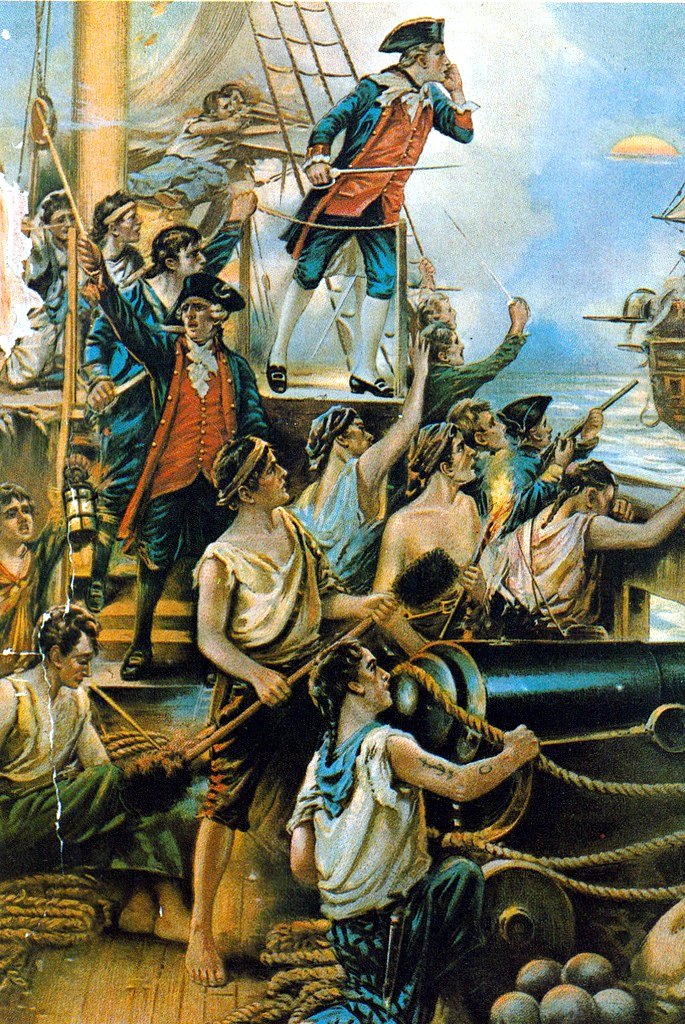
Jones aboard ship

By the time the fleet left, Jones and Landais had spent months getting to know each other and working together.  They were not, however, what you would call a good match.  Rather, they were two incompatible officers who were thrown together.  Landais was not particularly happy with his assignment.  He would have preferred to be ferrying VIP’s like John Adams back to America, and keeping an eye out for valuable merchant prizes that would improve his bottom line.  Like most of the crew, Landais did not share Jones’ interest in gaining glory and furthering the war effort against the British.  Not only did Jones have very legitimate trust issues about his crew, he did not trust his second in command either.

Normally, a military chain of command should be very clear.  As commodore of the fleet, Jones should be able to expect that his orders would be obeyed.  That might not always be the case, as Jones discovered during his previous mission, when Lieutenant Simpson simply abandoned Jones and sailed off aboard his prize ship.  In some ways, this mission was even worse.  French officials had forced Jones to sign a concordat just before leaving France.  The primary purpose of the document was to spell out how prize money would be divided.  But the document also contained language that essentially said that the fleet strategy should be based on consensus, rather than giving Jones the final word on everything.  Writing years later, Jones ruminated that, under other circumstances, he never would have signed such a document, but that the French official had the ability to replace him as commodore if he proved troublesome, and he did not want to have any further delays.  So Jones signed the agreement in hopes of finally getting to sea.  

Once at sea, his officers were testing just how deferential they would have to be.  As Jones was searching for his escaped crew along the Irish coast, Captain Landais came aboard, upset that Jones had prevented him from chasing a prize ship into rocky waters that Jones deemed too risky.  Landais announced to the Scottish-born Jones that since he, Landais, was the only American captain in the fleet (having been granted Massachusetts citizenship during his last voyage) that he planned to make his own decisions going forward.

According to Jones’ later account of the matter, he took Landais to his cabin and tried to work out their differences.  He told Landais that Jones had supported Landais continuing to captain the Alliance, despite having spawned two mutinies on his last two voyages.  Landais rejected the idea that Jones had anything to do with his command.  Jones tried to change the subject, turning to the deserters that he had been trying to recover.  Landais said that Jones was to blame for their loss, by allowing the boats to go out during a fog.  

Landais later reported that Jones’ response to that comment was to mutter “that’s a damn lie.”  Accusing a gentleman of a lie was fighting words, and usually led to a duel.  Landais challenged Jones.  According to Landais’ account Jones locked the cabin door and the two men drew swords.  However,  the two men agreed that, for the good of the service, such a confrontation would have to wait until the mission was over.  

Landais returned to his ship, but after that time, simply ignored any of Jones’ orders, badmouthed the commander to other officers and men, and refused to set foot again on the Bonhomme Richard.

Ransom of Leith

Because Jones’ ship was so slow, the chances of capturing prizes with it were not very good.  Landais began sailing the Alliance away from the fleet, looking for prizes.  Jones had to give up on efforts to catch several prize ships because he was always struggling to catch up with the Alliance.  The announced purpose of the fleet’s actions was to disrupt merchant traffic and capture prizes.  But Jones had other goals as well.  He had told Franklin that he planned to attack British towns and ports, as he had attempted with Whitehaven on his earlier cruise. Franklin let him know that the French expected him to go after shipping, but that people probably wouldn’t be upset if he also attacked some coastal areas as well.

Edinburgh & Leith, 1779
As the fleet sailed on, the deserters who landed in Ireland began to spread word that the Pirate Jones was on the prowl again.  Coastal towns built up their defenses and set out night watchmen.  The Admiralty dispatched two frigates to patrol the waters off Whitehaven, just in case Jones returned to finish the job he started a year earlier.

Jones, however, avoided those familiar waters.  Instead, he sailed his fleet up the west coast of Ireland, avoiding contact with land, and simply looking for merchant ships.  The fleet made it up to the North Sea and turned east toward Scotland.  

On September 14, the fleet was in the waters off Edinburgh. Jones called aboard the Captains of the Pallas and the Vengeance.  The two privateer ships had left the fleet.  The Cerf had disappeared during the search for the deserters, and Captain Landais of the Alliance still refused to come aboard.  Jones revealed plans to his remaining captains to capture the port town of Leith, just outside Edinburgh.  They would force the town to release American prisoners to avoid having their homes put to the torch.  The captains were hesitant to go along until Jones sweetened the pot by calling for a ransom of £200,000.

British defenses at Leith consisted of a small twenty-gun ship and a couple of smaller cutters.  The attacking fleet would be far enough away from the cannons of Edinburgh Castle to prevent them from becoming a threat.  

Jones planned to overwhelm the British vessels, send ashore a landing party to capture the city leaders, and hold them for ransom.  Instead, things seemed to go awry from the beginning.  During his discussions with the captains, the fleet had drifted south and needed to sail back to the mouth of the waterway, known as the firth of Forth, where the Forth River emptied into the sea.  By the time the fleet returned, it was daylight.  Jones decided on another tact.  He put on the uniform of a British naval officer and sailed in plain sight, appearing to be a friendly ship.

Jones' Raiding Voyages

The Bonhomme Richard soon encountered a small British cutter, which mistook the enemy for a British ship that was in the area. The cutter warned them that the “Pirate Jones” was thought to be in the area, and asked if they had a cask of gunpowder to spare.  Jones played into the mistake and sent over a cask, asking the cutter to send over a pilot to help guide them upriver.

The cutter sailed away, unsuspecting.  The pilot who came aboard repeated the warning that the Pirate Jones was in the area and that he deserved to be hanged.  Jones then revealed that he was, in fact, the “Pirate Jones” at which the shocked man dropped to his knees, fearing death.  Jones assured him that he was quite safe, as long as he helped to navigate the ship, but that he was a prisoner.

The ruse did not work for long.  As the Americans struggled to get upriver, against the currents and wind.  The alarm went out across the land.  Families and businesses fled inland with whatever valuables they could carry.  Men scrambled to find arms for a defense.  But since Scotsmen were forbidden from possessing firearms since the battle of Culloden, it was hard to come up with much of a defense.

As Jones tried to approach Leith, the winds grew stronger, and blew against him.  It began to rain hard.  The storm put an end to any hope of landing a force at Leith. The fleet was blown out to sea.  With the element of surprise now gone they had to abandon the raid entirely.

Jones was not ready to give up completely.  He suggested a different raid, down the coast, on Newcastle to destroy the coal ships there.  The other captains, however, refused to go along.  The alarm was spreading.  The enemy knew their location and would almost certainly be sending ships to capture them.  They were leaving, and Jones should too.  Jones later said he considered going in on his own, but that his crew was equally reluctant to participate in such a plan.

The Pallas and the Vengeance had already sailed off - moving south down the English coast.  Jones struggled to catch up to them.  His slow ship was even slower after the storm damaged his main topmast.  After a couple of days he managed to catch up with his fleet, which had once again joined up with the Alliance.

By this time it was the evening of September 22.  Jones had orders to be in Texel, a Dutch island off the coast of the Netherlands, to escort a French merchant fleet.  Feeling defeated at the few prizes he managed to collect, Jones saw his mission coming to a disappointing end.  The following morning, all that changed.

The Serapis

On September 23, the Serapis and another smaller sloop were escorting 44 merchant ships from Scandinavia to England.  The fifth-rate ship normally carried 44 cannons but had recently taken on several extra, bringing her armament to 50.  Not only did this outnumber the 40 gun Bonhomme Richard, but most of the cannons aboard the Serapis were much larger and in better condition.  She was a faster ship, with far more firepower, and an experienced crew.

When the Serapis Captain Richard Pearson spotted the small American fleet, the thirty year veteran of the navy had every reason to believe he could defeat them.  However, he also had to worry about the merchant fleet that he was protecting.  

Flamborough Head  

The two opponents did not see each other until early afternoon.  It then took several hours for each to maneuver into position.  The ships met in the waters just off an outcropping of land near Yorkshire, known as Flamborough Head.  Pearson ordered the merchant fleet to sail for the shore where they could find safety, while he moved the Serapis to intercept the strangers.
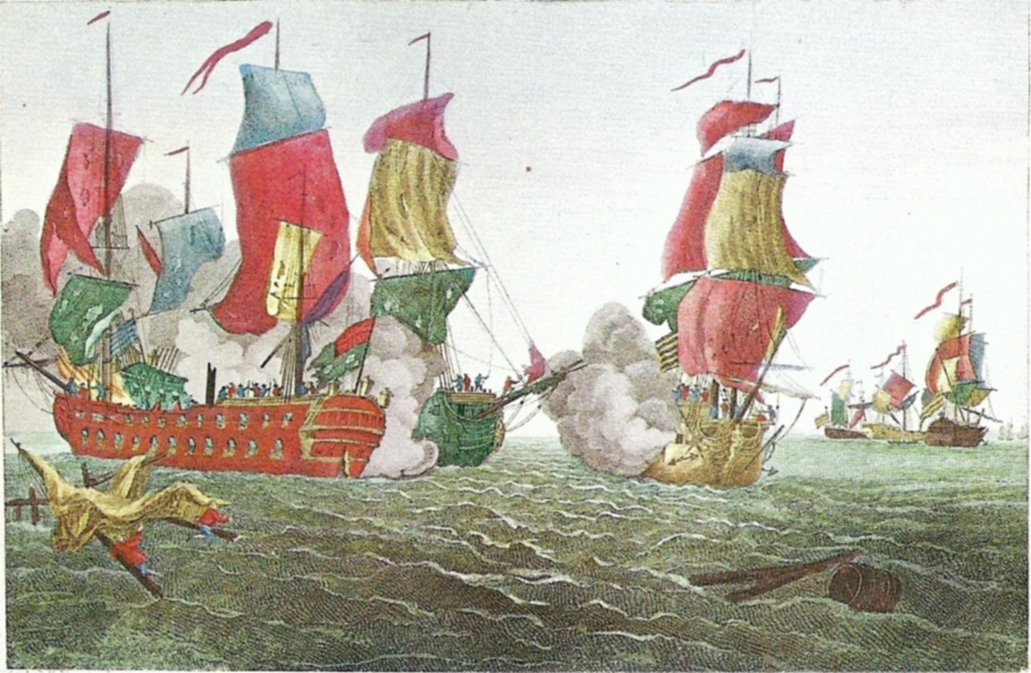
Bonhomme Richard & Serpais
Jones ordered his ships to form a line of battle.  Instead the three other ships simply sailed away, trying to cut off the merchant fleet, and leaving the Bonhomme Richard to face the Serapis on its own.  Through his looking glass, Jones spotted his counterpart, Captain Pearson, nailing his flag to the staff, to ensure that no one would be able to lower the flag and surrender the ship.

It was dark by the time the two ships got within range of each other.  Captain Pearson identified the Serapis and demanded to know who he was facing.  Jones called out, claiming to be a merchant ship, hoping to get the enemy captain to hold off firing until he drew closer.  When a sailor on the Bonhomme Richard rigging fired his gun, the nervous crew on both ships immediately fired their broadsides. 

This was the first time that Jones had the opportunity to fire his large 18-pound cannons with live ammunition.  The older guns were not up to the task. One or two of the guns exploded, killing the gun crews and taking a chunk out of the starboard side of his ship.  The loss of his larger guns also meant that the firepower advantage of the Serapis was that much greater.  

After the first broadside, the Serapis sailed behind the Bonhomme Richard and used its working 18 pound cannons to fire massive volleys through the ship’s stern.  The faster Serapis then circled around to fire another broadside into the bow of its enemy.  Jones, however, managed to get some speed out of his ailing ship and rammed into the Serapis.  He then tried to turn to fire a broadside into the British ship, but Pearson rammed him during the attempt.

Over the course of the next hour, the two ships fearlessly launched volley after volley at each other at near point blank range.  The fatalities on both sides exploded.

The Bonhomme Richard had taken more damage to its hull, while American marines, firing from the rigging, managed to decimate the sailors on the deck of the Serapis.  

Jones realized that he was sinking.  His ship had far less firepower and was moving at about half the speed of the Serapis.  Much of his surviving crew was below decks trying desperately to plug holes and keep the ship afloat.

Marines boarding the Serapis
Jones’ only chance was to storm the Serapis.  Taking advantage of a lull in the wind, the Bonhomme Richard slowly drifted up to the Serapis.  American sailors and marines used grappling hooks to pull the ships together and crossed onto the enemy deck.  The British, however, managed to cut the lines, and push back the attackers.  As the Serapis pulled away, it fired another point blank broadside into the enemy’s hull.  

Remaining barely afloat, Jones managed to move in front of the Serapis leading to another slow motion collision.  Once again, his crew tried to tie the ships together and board the enemy.  With many of the British sailors and marines on deck killed by the American marines firing from the rigging, the American boarding crew was able to get aboard and begin hand to hand combat.  Pearson tried to drop the Serapis anchor in order to stop it from drifting along with the sinking Bonhomme Richard, but by this time the ships were too well tied together.  As the Americans began to take control of the Serapis’ deck, the British cannons below deck continued to fire into the Bonhomme Richard’s hull.

As both ships were locked together in a death grip, Captain Landais returned aboard the Alliance.  He fired a volley into both ships, killing a number of Americans aboard the Bonhomme Richard.  

As Jones struggled to assist one of his cannon crews, he heard one of his men call for quarter.  Apparently, the man thought Jones and first officer Dale were both dead.  Jones immediately called from another deck for someone to shoot that man.  He pulled his own pistol and tried to fire at the frightened sailor, but his gun misfired.  He then threw his pistol at the man.

British Captain Pearson heard the call for quarter and called out to Jones to confirm if he was surrendering.  It was then that Jones allegedly responded “Sir, I have not yet begun to fight!”

The fighting continued for another hour, during which time the Alliance made another pass, firing grapeshot at the men on both ships.  The Americans firing from the rigging were still able to maintain deadly fire against the Serapis.  A little after 10:00 PM, one of the men carried up a bucket full of grenades, small baseball sized bombs with 20 second fuses.  The Americans tried throwing several into the open hatch of the Serapis.  After several attempts, they succeeded.

Below decks, the British gunners had gotten sloppy, leaving powder and shells sitting out in the open near their cannons for faster loading.  The grenade set off a chain reaction of explosives below decks on the Serapis, killing many and horribly burning more of the crew.  By this time, it was nearly 10:30.  The Serapis had suffered a 50% casualty rate, had multiple fires aboard ship, and was threatened with being pulled under by the sinking Bonhomme Richard.  Captain Pearson finally called for quarter.

Jones ordered Lieutenant Dale to take a boarding party and secure the Serapis and asked Pearson to join him in his quarters for a glass of wine.

After a short time Jones had to concede that the Bonhomme Richard was sinking.  A fire had nearly blown up the powder magazine.  Men below decks could not patch the massive cannonball holes.  Despite efforts over the next 24 hours, Jones had to order both crews aboard the Serapis and cut loose the Bonhomme Richard to sink below the surface. The Alliance, Vengeance, and Pallas also returned to assist with the survivors.  

Of course the Serapis, now commanded by Jones, was also seriously damaged.  At least eight British frigates were storming toward the area in search of the Pirate Jones. The American fleet managed to sail to Texel in the Netherlands and put into the neutral port for repairs.

Jones’ capture of a British ship of the line would lead to celebration throughout Europe and America and make Captain Jones a celebrity.  The British made it an even greater priority to capture the Pirate Jones.

Next week, the French fleet cooperates with the Continental army to besiege British-held Savanna, Georgia.

- - -

Next Episode 234 Siege of Savannah 


 Contact me via email at mtroy.history@gmail.com

 Follow the podcast on Twitter @AmRevPodcast

 Join the Facebook group, American Revolution   Podcast: https://www.facebook.com/groups/132651894048271

 Join American Revolution Podcast on Quora 


American Revolution Podcast Merch!

T-shirts, hoodies, mugs, pillows, totes, notebooks, wall art, and more.  Get your favorite American Revolution logo today.  Help support this podcast.  http://tee.pub/lic/AmRevPodcast


American Revolution Podcast is distributed 100% free of charge. If you can chip in to help defray my costs, I'd appreciate whatever you can give.  Make a one time donation through my PayPal account. You may also donate via Venmo (@Michael-Troy-20), Zelle, or popmoney (send to mtroy1@yahoo.com)


Click here to see my Patreon Page
You can support the American Revolution Podcast as a Patreon subscriber.  This is an option making monthly pledges.  Patreon support will give you access to Podcast extras and help make the podcast a sustainable project.

An alternative to Patreon is SubscribeStar.  For anyone who has problems with Patreon, you can get the same benefits by subscribing at SubscribeStar.

Help Support this podcast on "BuyMeACoffee.com"


Visit the American Revolution Podcast Bookshop.  Support local bookstores and this podcast!


Signup for the AmRev Podcast Mail List

* indicates required

Further Reading

Websites

“To Benjamin Franklin from John Paul Jones, 3 October 1779,” Founders Online, National Archives, https://founders.archives.gov/documents/Franklin/01-30-02-0366

Excerpts from John Paul Jones’ Memoirs https://www.americanrevolution.org/jpj.php

Landais, Pierre https://www.encyclopedia.com/history/encyclopedias-almanacs-transcripts-and-maps/landais-pierre-de

Norton, Louis Arthur “The Battle between Bonhomme Richard and SerapisJournal of the American Revolution, August 20, 2019. https://allthingsliberty.com/2019/08/the-battle-between-bonhomme-richard-and-serapis

Norton, Louis Arthur “The Revolutionary War’s most Enigmatic Naval Captain: Pierre Landais” Journal of the American Revolution, July 17, 2018. https://allthingsliberty.com/2018/07/the-revolutionary-wars-most-enigmatic-naval-captain-pierre-landais

Battle of Flamborough Head https://www.battlefields.org/learn/articles/battle-flamborough-head

I have not yet begun to fight https://emergingrevolutionarywar.org/2019/09/23/bonhomme-richard-vs-serapis

Schellhammer, Michael “The Real Immortal Words of John Paul Jones” Journal of the American Revolution, January 19, 2015. https://allthingsliberty.com/2015/01/the-real-immortal-words-of-john-paul-jones

Free eBooks
(from archive.org unless noted)

Abbott, John S. C. Life of John Paul Jones, New York, Dodd, Mead and Co. 1898. 

De Koven, Anna The Life and Letters of John Paul Jones, Vol. 1, New York: Charles Scribner’s Sons, 1913. 

Honeyman, A. Van Doren Admiral Paul Jones, Plainfield, N.J. Honeyman & Co. 1905. 

Morison, Samuel Eliot John Paul Jones: A Sailor's Biography, Boston: Little, Brown, 1959. 

Paullin, Charles Oscar The Navy of the American Revolution: Its Administration, Its Policy and Its Achievements, The Burrows Brothers Co. 1906. 

Tooker, L. Frank John Paul Jones, New York: The Macmillan Company, 1916. 

Walker, George Benjamin Life of Rear-Admiral John Paul Jones, Philadelphia: J. B. Lippincott & Co. 1876. 

Books Worth Buying
(links to Amazon.com unless otherwise noted)*

Boudriot, Jean & David H. Roberts John Paul Jones and the Bonhomme Richard: A Reconstruction of the Ship and an Account of the Battle With H.M.S. Serapis, Naval Institute Press, 1987. 

Bowen Hassell, E. Gorden, Dennis Conrad, and Mark Hays Sea Raiders of the American Revolution: The Continental Navy in European Waters, Univ of the Pacific Press, 2004.

Fowler, William M. Jr. Rebels Under Sail: The American Navy During the Revolution, Charles Scribner’s Sons, 1976.

Lardas, Mark Bonhomme Richard vs Serapis: Flamborough Head 1779 (Duel), Osprey Publishing, 2012. 

McGrath, Tim Give Me a Fast Ship: The Continental Navy and America's Revolution at Sea, Caliber, 2014.

Thomas, Evan, John Paul Jones: Sailor, Hero, Father of the American Navy, Simon & Schuster, 2003.

* As an Amazon Associate I earn from qualifying purchases.


Sunday, January 2, 2022

ARP232 Jones and the Armada


This week, we return to Continental Navy Captain John Paul Jones.  We last left Jones’ story in Episode 180.  In 1778 Jones had raided the British coast, captured numerous merchant ships as prizes and eventually returned to France, where he lost his ship and was stuck on land for nearly a year.

A Year in Paris

The French celebrated Jones for his earlier exploits against the British.  At the same time, they seemed in no hurry to give him a new ship to continue those exploits.  Jones spent his time meeting with French officials, as well as the American Commissioners in Paris.  

John Paul Jones

Jones still hoped to get command of L’Indien, a ship built in the Netherlands for the American Commissioners.  This was the ship that Jones had been promised back in 1777.  The British got word of the project and protested a ship being built by an ally for their enemy.  In the end, the French Navy had to purchase the ship.  At the time, France and Britain were still at peace, and Britain could not object to the purchase.

French officials dangled L’Indien to the Americans, suggesting possibly making Jones its captain, but it never happened.  The French were building up their own navy and did not want to give away such a valuable ship of the line to an American.

Jones also continued to feel the effects of his disputes with Lieutenant Thomas Simpson, with whom he had argued constantly on the prior voyage.  In France, Jones had Simpson thrown into prison for disobeying orders while at sea.  John Adams had taken Simpson’s side in the matter, and against Jones, believing that Jones was just trying to take all the credit for the voyage and slandering the good name of this New England officer whose family was related to that of Adams. 

After a few months, Jones, under pressure, agreed to drop the charge against Simpson and allow him to captain the Ranger on its return to America.  Franklin and other French officials hinted that he needed to do this before getting another command.  After Simpson sailed for America aboard the Ranger, Jones remained without a ship.

He spent time with Lafayette, as the two men schemed to put together a substantial invasion of about 1500 men in England.  French officials put the kibosh on those plans as they were planning a much larger invasion.  They transferred Lafayette to a command on the other side of France, where he could not be as much trouble.

comte d'Orvilliers

Jones also met with French Admiral the comte de Orvilliers, who had fought the Battle of Ushant against British Admiral Keppel in 1778 (see Episode 194).  Jones suggested that he be given a ship or small fleet.  He could destroy the coal fleet at Newcastle in order to cause a fuel shortage in London.  He could destroy the fishing fleet of Greenland in order to cause food shortages, or perhaps more disruption of trade by picking off some of the longer distance trade ships.  While his ideas intrigued de Orvilliers, Jones still could not get a ship.

Jones spent the summer of 1779 trying anything to get back to sea, but was continually frustrated. His prize ship, the Drake was plundered and sold for a pittance, meaning his crew was out of much of their hoped-for prize money.  

He did almost get a small fleet to take into the Irish Sea.  He worked out his plans with Edward Bancroft, who was Benjamin Franklin’s secretary.  In the end, the plans fell through when, once again, he was not given the ships promised. In this case, it was probably a good thing since Bancroft was a British spy and had forwarded Jones’ plans to London.  Had he set sail, he probably would have sailed right into a British trap.  Jones was never aware of that.  He continued to express frustration at his inability to get a new ship.

Bonhomme Richard 

In September of 1779, Jones finally received a new ship - well, new to him.  The Duc de Duras was a thirteen year old merchant vessel that had made several trips to China before being converted to more local trade.  

The French Navy purchased the ship in February 1779 and assisted the Americans with outfitting it as a naval vessel.  They added 44 guns, which was a fairly impressive number, although all but six of those were 12 pounders or less.  Larger guns were critical to sinking an enemy ship.  It was an impressive armament to take merchantmen, but not for taking on a British ship of the line.  It was not a particularly fast ship and not one that the French wanted to use.  So they were happy to make it available to the Americans.

Bonhomme Richard

Because the ship had been built as a long distance merchant ship, it had a large and luxurious captain’s quarters.  This appealed to Jones, who liked to present himself as a gentleman of substance.  He even had a set of plates bearing his family crest made for himself so that he could entertain his guests aboard ship in style.

That said, he was wary of the ship.  Early test voyages proved that it was very slow.  That did not matter much for a merchant ship in peacetime.  It mattered very much for a military ship that needed to chase down targets and escape from pursuing naval vessels.

Jones, of course, had been lobbying to get the ship for months.  He would take anything he could get.  Jones renamed the ship the Bonhome Richard, an honor to Benjamin Franklin whose Poor Richard’s Almanac sold in France under the name Les Maximes du Bonhomme Richard

The Bonhomme Richard ready to sail in the fall, Jones received a fleet to sail with him.  It included the 36 gun Alliance, the 32 gun Pallas, the 18 gun Cerf, and the 12 gun Vengeance.

Captain Landais

Commanding the Alliance was the fleet’s second-in-command, Captain Pierre Landais.  He was a French officer of 30 years.  He had been wounded in action during the Seven Years War and had spent time as a British prisoner.  He had also accompanied Captain Louis Antoine, Compte de Bougainville on a voyage around the world after the war. 

Pierre Landais
By 1775, Landais was discharged from the service for his reputation as an incompetent officer.  Two years later, he was one of many down-on-their-luck officers who went to Silas Deane looking for work. In 1777, Deane gave Landais a captain’s commission and command of the newly converted merchant ship, the Alliance, full of covert French military aid for the Continental Army. 

Why did Deane give a disgraced terminated officer a commission? Well, the American commissioners did not exactly do any due diligence in checking the backgrounds of their officer applicants.  Landais appeared to have been able to present himself well, and he did have decades of experience.

Landais would prove to have a rather poor record with the Continental Navy. As one historian put it “If he was not the worst of the frigate captains, it was only because, with a few notable exceptions, so many of them were incompetent.” 

During Landais’ voyage from France to America, he had to put down a mutiny, but arrived in Portsmouth, New Hampshire with his cargo intact.  The captain met with top officials in America and received praise from Samuel Adams.

Based on his successful mission, and his very high view of himself, during interviews Congress affirmed his captaincy and his command of the Alliance.  He also became a citizen of Massachusetts during his visit. In January of 1779, he was given the honor of returning the Marquis de Lafayette to France.  During the return voyage, he had to put down another mutiny, but manage to complete his voyage successfully once again.

Landais was supposed to bring the Alliance back to America, returning John Adams home.  Benjamin Franklin, however, countermanded those orders and assigned Landais to the squadron under Captain Jones to sail into the North Sea and harass British shipping.

Jones and Landais did not seem to get along, despite efforts to spend some bonding time together before the voyage.  During a shake-down cruise, the Bonhomme Richard crashed into the Alliance, causing some minor damage.  At the time, Jones was asleep in his cabin. Landais was on duty, but rather than attempt to avoid the ship, he ran down to his cabin to grab his pistols.  He later said that he thought the crew on the other ship had mutinied and was deliberately trying to ram him.  Captain Jones dismissed Lieutenant Robert Robinson who had the con on the Bonhomme Richard during the collision, but also began to doubt Landais’ abilities as a captain.

Commodore of a fleet

The crew of the fleet was pretty problematic.  Most of them were European sailors, who mostly wanted rum and money, and cared about little else.  A fair percentage of the crew were English sailors who had been taken from French prisons.  Landais’ fear of a mutiny was not without cause.  Many of the men would have happily overthrown their officers and sailed for England if given the chance.

Jones had to resort to repeated lashings to keep control of his crew.  He broke a mutiny plot among the English sailors and sentenced the ringleader to 250 lashes.  On another occasion, he had a crew take him ashore for some business.  While he was away, the crew abandoned their boat and went off to get drunk.  Jones had to find a local fisherman to get back to his ship.  When the crew returned with the launch, he sentenced each man to twelve lashes.

Richard Dale

Captain Jones did have a few good men among his crew.  After he fired Lieutenant Robinson for crashing into the Alliance, Jones appointed Lieutenant Richard Dale as his new second in command.  The 22 year old Virginian had seen his share of difficulties before his assignment on the Bonhomme Richard.  

Dale had gone to sea in 1769, at age 12. His father, a merchant and shipwright from Norfolk, Virginia, had died two years earlier, and the boy needed to support himself.   His uncle gave him his first position aboard ship.  Dale traveled to Liverpool, England as he learned the trade of a seaman.  After five years as an apprentice, the 17 year old Dale was serving as chief mate on colonial merchant vessel.

Richard Dale
In 1776, Dale joined the Virginia Navy, but was captured almost immediately by a British ship, the Liverpool, at that time still fighting under Lord Dunmore to take back Royal control of Virginia.  Dale knew many of the men serving on the British vessel.  They persuaded him to sign on with the British crew.   A short time later, Dale was wounded while fighting for the British as they tried to capture several smaller American ships.  While traveling to Jamaica, an American ship, the Lexington, under the Command of Captain John Barry, captured the British ship on which Dale was serving.  Dale agreed to return to switch sides again and took a position as a midshipman in the Continental Navy.  He remained aboard the Lexington after Captain Barry transferred to a larger ship.

Once again though, the fates were against him.  The British ship Pearl captured the Lexington and Dale was taken aboard as a prisoner.  Although a storm soon allowed the Lexington to escape, Dale remained a prisoner aboard the Pearl.  A prisoner exchange returned Dale to the Lexington, but it was only January 1777, and he had already been a prisoner of war twice.

The Lexington then sailed for France, where it joined a small fleet under the command of Lambert Wickes, raiding the Irish coast, a raid I discussed back in Episode 137.  The raiders took many merchant ships and returned to France.  There, however, British diplomats forced France, which was still at peace with Britain, to expel the American ships from its ports.  The Lexington attempted a return voyage to America, but was captured at sea in September of 1777.

Dale and the rest of his crew were sent to Mill Prison in Plymouth, England.  There, the crews of a number of ships were being held under horrific conditions.  Charged with treason, the men were often held in irons, and almost never fed.  Malnutrition threatened their lives. At one point the prisoners killed and ate a dog.  Other desperate meals included cats, rats, and grass.  Some of the locals even took pity on them and raised funds to provide a bit of food, disgusted that the British government was simply allowing the prisoners to starve to death.

The prisoners managed to dig a tunnel under the prison wall, allowing several dozen men to escape.  I mentioned this incident once before as one of the successful escapees was Gustavus Conyingham, another Continental Navy captain.  Dale managed to get away from the prison, but was arrested as he attempted to board a ship in London that was headed for France.  He was returned to Mill Prison, where he spent 40 days in the black hole as punishment.

After about a year at the prison, Dale managed to obtain the uniform of a British officer, and simply walked out the front gate of the prison.  This time, he managed to get aboard a ship and make his way to France in February 1779.  This was about the time that John Paul Jones had received word that he would get command of the Bonhomme Richard.  Desperate for crew members, Jones happily signed on Dale as an officer.

French-Spanish Armada

The reason that the French government provided Jones, not only with a ship, but a small fleet, at this time, was that it was part of a larger plan by French officials.  France and Spain’s combined fleet, along with the British Navy’s distraction in America, provided the best opportunity for an invasion of Britain in centuries.  

Armada off the British Coast, 1779
The plan was for the French fleet to sail down to Spain and combine with the Spanish fleet.  The combined fleet would sail into the English Channel and defeat the smaller British fleet.  Once in control of the channel, troop transports would carry 40,000 soldiers from France to the coast of Britain.  They would then force a battle with the British army and capture London.

The numbers seemed to favor the would-be invaders.  France had 30 ships of the line to combine with 36 Spanish ships of the line, along with many more smaller ships.  Britain had less than 40 ships of the line to defend the island, commanded by Admiral Charles Hardy, who had not had a sea command in twenty years.  The rest of the officers and ships were away, defending other parts of the empire.

The British army had only about 20,000 soldiers in Britain.  It could supplement these with militia.  But the English militia had even less training and experience than colonial militia.  The English militia had not seen combat in generations.  It had not seen combat in generations.  If the French and Spanish could clear the Channel with their larger fleet, then land a larger army in England, they had a real chance of repeating William the Conqueror's success of 1066.  

Britain was completely unprepared for such an invasion.  Coastal defenses had already proved ill-equipped to handle small coastal raids, let alone a full invasion.  Fortunately for the unprepared British, the invasion fleet ran into problems from the outset.

In an attempt to throw off British spies in France, the French fleet, under the command of Admiral d'Orvilliers, left Brest quickly and without taking on rations for an extended tour.  The fleet set sail on June 3, 1779 to meet up with the Spanish off the northwest coast of Spain.  Where they awaited the arrival of the Spanish Armada. They waited and waited and waited.  June turned into July with no Spanish fleet in sight.

French sailors and marines suffered through terrible heat below decks during the Spanish summer.  Without proper rations, the men began to show signs of scurvy.  On top of that smallpox and typhus spread through the fleet.

Finally, after about six weeks of waiting, the Spanish fleet, under the command of Don Luis de Córdova, arrived.  By this time, it was late July.  It was not until mid-August that the combined fleet could get underway and reach the English Channel.  The fleet made it to the British coast with no opposition.  They encountered only one British naval vessel, the Ardent, which was sailing to join the British fleet.  The captain mistook the French and Spanish Armada for the British fleet, sailed toward it, and was promptly captured.

British Defensive Encampment in Kent
The sight of the enemy fleet off the coast of Plymouth set off alarms all over Britain.  But the Armada was not the invasion force.  It was looking for the British Navy in order to clear the way for the invasion force.  The British had received word that the French and Spanish had sailed out into the Atlantic and had sailed after them, thus leaving an open path in the English Channel. But until the Allied French and Spanish defeated the British Navy, they could not launch the invasion fleet of troop transports.  Otherwise, the British Navy could show up at the wrong time and destroy the troop transports.  So, the French and Spanish continued to sail around the channel, looking for their enemy.

A storm blew the armada out into the Atlantic.  At the same time, the British fleet used foggy conditions to sail back to Plymouth, where the smaller fleet could be supported by many smaller ships and coastal defenses.

Meanwhile, all of these many weeks of delay meant that thousands of French and Spanish soldiers, sailors, and marines were dying.  Typhus and smallpox in the French fleet has spread to the Spanish ships as well.  Hundreds of men were dying each day.  Further, it was already September, meaning a land campaign in Britain, even if launched successfully, would probably be fought into the winter, which French and Spanish leaders thought would put them at great disadvantage. 

In the end, the allied fleet simply returned to Brest and gave up without a fight.  The armada had not fired a single cannon shot in battle, but lost over 8000 men to disease.  Admiral d’Orvilliers resigned his command shortly after returning in failure.  The British, now on high alert, began improving their coastal defenses all over Britain.

It was in the context of this planned invasion that John Paul Jones embarked on the raid that led to one of the most famous naval battles in American history. We will get to that next week, when the Bonhomme Richard takes on the British ship Serapis.

- - -

Next Episode 233 Bonhomme Richard vs. Serapis 


 Contact me via email at mtroy.history@gmail.com

 Follow the podcast on Twitter @AmRevPodcast

 Join the Facebook group, American Revolution   Podcast: https://www.facebook.com/groups/132651894048271

 Join American Revolution Podcast on Quora 


American Revolution Podcast Merch!

T-shirts, hoodies, mugs, pillows, totes, notebooks, wall art, and more.  Get your favorite American Revolution logo today.  Help support this podcast.  http://tee.pub/lic/AmRevPodcast


American Revolution Podcast is distributed 100% free of charge. If you can chip in to help defray my costs, I'd appreciate whatever you can give.  Make a one time donation through my PayPal account. You may also donate via Venmo (@Michael-Troy-20), Zelle, or popmoney (send to mtroy1@yahoo.com)


Click here to see my Patreon Page
You can support the American Revolution Podcast as a Patreon subscriber.  This is an option making monthly pledges.  Patreon support will give you access to Podcast extras and help make the podcast a sustainable project.

An alternative to Patreon is SubscribeStar.  For anyone who has problems with Patreon, you can get the same benefits by subscribing at SubscribeStar.

Help Support this podcast on "BuyMeACoffee.com"


Visit the American Revolution Podcast Bookshop.  Support local bookstores and this podcast!


Signup for the AmRev Podcast Mail List

* indicates required

Further Reading

Websites

“To Benjamin Franklin from John Paul Jones, 3 October 1779,” Founders Online, National Archives, https://founders.archives.gov/documents/Franklin/01-30-02-0366

Excerpts from John Paul Jones’ Memoirs https://www.americanrevolution.org/jpj.php

Landais, Pierre https://www.encyclopedia.com/history/encyclopedias-almanacs-transcripts-and-maps/landais-pierre-de

Norton, Louis Arthur “The Battle between Bonhomme Richard and Serapis” Journal of the American Revolution, August 20, 2019. https://allthingsliberty.com/2019/08/the-battle-between-bonhomme-richard-and-serapis

Norton, Louis Arthur “The Revolutionary War’s most Enigmatic Naval Captain: Pierre Landais” Journal of the American Revolution, July 17, 2018. https://allthingsliberty.com/2018/07/the-revolutionary-wars-most-enigmatic-naval-captain-pierre-landais

Battle of Flamborough Head https://www.battlefields.org/learn/articles/battle-flamborough-head

I have not yet begun to fight https://emergingrevolutionarywar.org/2019/09/23/bonhomme-richard-vs-serapis

Schellhammer, Michael “The Real Immortal Words of John Paul Jones” Journal of the American Revolution, January 19, 2015. https://allthingsliberty.com/2015/01/the-real-immortal-words-of-john-paul-jones

Free eBooks
(from archive.org unless noted)

Abbott, John S. C. Life of John Paul Jones, New York, Dodd, Mead and Co. 1898. 

De Koven, Anna The Life and Letters of John Paul Jones, Vol. 1, New York: Charles Scribner’s Sons, 1913. 

Honeyman, A. Van Doren Admiral Paul Jones, Plainfield, N.J. Honeyman & Co. 1905. 

Morison, Samuel Eliot John Paul Jones: A Sailor's Biography, Boston: Little, Brown, 1959. 

Paullin, Charles Oscar The Navy of the American Revolution: Its Administration, Its Policy and Its Achievements, The Burrows Brothers Co. 1906. 

Tooker, L. Frank John Paul Jones, New York: The Macmillan Company, 1916. 

Walker, George Benjamin Life of Rear-Admiral John Paul Jones, Philadelphia: J. B. Lippincott & Co. 1876. 

Books Worth Buying
(links to Amazon.com unless otherwise noted)*

Bowen-Hassell, E. Gordon, Dennis Conrad, and Mark Hays Sea Raiders of the American Revolution: The Continental Navy in European Waters, Univ. of the Pacific Press, 2004.

Fowler, William M. Jr. Rebels Under Sail: The American Navy During the Revolution, Charles Scribner’s Sons, 1976.

McGrath, Tim Give Me a Fast Ship: The Continental Navy and America's Revolution at Sea, Caliber, 2014.

Thomas, Evan, John Paul Jones: Sailor, Hero, Father of the American Navy, Simon & Schuster, 2003.

* As an Amazon Associate I earn from qualifying purchases.


Sunday, August 29, 2021

ARP215 The Dunkirk Pirate


In the spring of 1779 Gustavus Conyngham sailed into Philadelphia.  The ship captain had been away for years and was returning home after many successful raids and harrowing experiences. 

Gustavus Conyngham

Conyngham had been born in Ireland, but moved to Philadelphia with his family as a teenager in 1763.  His cousin had already established a successful shipping company.  Gus joined the family business and was soon commanding merchant ships in trade with the West Indies and Europe.  He purchased a home in Philadelphia, got married, and settled into the life of a merchant ship’s captain.

Gustavus Conyngham
Conyngham supported the patriot cause.  In late 1775, the Maryland Council of Safety contracted with Conyngham to sail to Europe and purchase gunpowder and other military supplies.  Conyngham sailed his ship, the Charming Peggy, to Dunkirk, France to purchase the needed items.  

British agents took notice of his purchases and notified French authorities.  The French, at this time, were obligated by treaty to prevent the colonies from buying any war materials, but also did not really want to live up to that treaty.  French officials inspected his ship as the British Ambassador demanded, but found nothing.  Conyngham had received advance notice, and had dumped his gunpowder into the harbor before the inspectors arrived.

Conyngham made his escape, but was still without the gunpowder.  He then sailed for the Netherlands, where he made another deal to purchase gunpowder.  This time, one of his own crew members informed authorities.  Officials seized the ship, put it under a prize crew, and arrested the captain and crew.

Conyngham, however, was not ready to go to prison.  His crew overpowered the prize crew aboard his ship and made a dash back to the Netherlands.  There, Conyngham made a quick deal to sell his ship before it could be confiscated.  He made a deal to sell it to the Dutch government, but ended up never getting the money.  Dutch officials simply kept his ship and never paid him.

So, by early 1776, Conyngham was still a free man, but was stuck in the Netherlands without a ship, supplies, or money. He spent a year stuck in Europe as the war in America heated up.  In early 1777, Conyngham received word that the American Commissioners in Paris were trying to purchase and outfit ships to harass British shipping.

Benjamin Franklin had arrived in France with pre-signed commissions from the Continental Congress.  He granted Conyngham a commission as a captain in the Continental Navy in March, 1777.  Franklin also put Conyngham in contact with William Hodge, a recently appointed  American agent in Dunkirk.  The men then outfitted a merchant ship into a converted warship which they named the Surprize.  

By May, Conyngham had assembled a crew and sailed the Surprize out into the English Channel and began seizing British merchant ships. The ten-gun ship was small, by naval standards.  But, living up to its name, it was a real surprise for British merchant ships in the English Channel. Conyngham was able to get in close and demand the surrender of ships unaccustomed to attack in these friendly waters..  The Surprize captured two ships and sailed back to Dunkirk.

The British of course, were apoplectic about this.  In early 1777, France and Britain were still at peace. The British ambassador to France lodged a formal protest with Vergennes.  France was permitting its harbors to be used by American pirates.  They had taken British ships that were engaged in lawful commerce.

France was treaty-obligated to prevent the use of their ports for anyone attacking British shipping.  Under pressure, French officials seized all three ships, returning the captured vessels to British authorities, and arrested the crew.  The British wanted Conyngham sent to London to be tried for piracy and hanged.  The British Ambassador, Lord Stormont, began referring to Conyngham as the “Dunkirk Pirate.”

Franklin was able to intervene and get Conyngham freed before the British could take him to England for trial. France continued to play it’s dangerous game of supporting American efforts as much as possible, while still avoiding war with Britain.  Impressed by Conyngham’s first voyage, Hodge was able to convert an even larger ship for Conyngham’s next voyage.  The new ship, dubbed the Revenge, had fourteen cannons and twenty-two swivel guns.  It was also extremely fast.

The Revenge at sea
The French government learned of the new ship but allowed it to leave on the promise that it would sail to America.  Everyone knew that was a lie, but it gave the government the cover it needed to release the ship.  Aboard his new ship, the Revenge, Conyngham then spent most of the next two years harassing British shipping all around England, Scotland and Ireland.  By some accounts, he captured or destroyed at least sixty ships, using Spain as a neutral port to sell his prizes and make necessary repairs.

In Britain, word of the “Dunkirk Pirate” spread as he became the most effective American raider in Europe.  His efforts, along with the three other Continental navy ships harassing British shipping in 1777, created a real problem.  British merchant ships could not get insurance, except at astronomical rates.  British merchants began shipping on foreign ships that they knew would not be subject to attack, as long as they sailed under a neutral flag.  British commercial shipping came almost to a standstill.  The British navy sent out ships in all directions with orders to capture the Dunkirk Pirate, but without success.

At Versailles, the British Ambassador threatened war.  Stormont accused French officials of tolerating the Revenge, allowing it to operate with its mostly French crew, as it was disrupting British shipping.  Unless French officials put a stop to it, Britain would go to war with France and begin seizing French ships at sea.  This was in the summer of 1777.  The British army from New York was launching its offensive against Philadelphia, and another army from Quebec was moving into New York.  

French officials saw a real possibility that the American rebellion might come to a quick end.  They did not want war with Britain if Britain was not distracted in America.  French officials began cracking down on the Americans.  At one point, Conyngham was being held in a French harbor pending arrest, but then somehow got permission to leave. Officials arrested the American agent, Hodge, and threw him in the Bastille. They also began cracking down on officials who had allowed Conyngham to leave port with his ships.

Conyngham’s crew of mostly European sailors had joined the ship’s crew for the money.  Many of them were would-be pirates who would have been happy to attack any ship from any country.  Conyngham had to keep his crew in line, manage the politics of neutral ports, where the British wanted him arrested, and fight the entire British Navy that was looking to hang him.  He managed to remain active, raising thousands of dollars in prize money for the patriot cause and disrupting British trade.

Conyngham continued to raid British shipping around Britain for the rest of the summer and fall.  He sailed north to the Baltic and also through the Irish Channel.  He even seized several ships right at the mouth of the Thames River.  At one point, he even disguised his ship and put into an English port for repairs.  Over the course of 18 months, he captured 27 ships and sank or burned another 33.

By 1778, France had gone to war with Britain.  But Conyngham’s difficulties with authorities did not end there.  He faced accusations that he had attacked neutral ships, including merchant ships from Sweden and Spain.  It appears Conyngham had taken the controversial position of seizing British property that was being carried by neutral ships.  This was in contravention of generally accepted norms of privateering.  Eventually, he found all European ports were closed to his ship.  No one wanted to be associated with the Dunkirk Pirate.

Return to America

Conyngham eventually sailed to the West Indies, thinking he could disrupt shipping there as well. By early 1779, Conyngham had been away from home for over three years. The American agent at Martinique, William Bingham, asked Conyngham to deliver a load of weapons to Philadelphia.  With that mission Conyngham finally had an opportunity to return home and see his family.

Conyngham returned to Philadelphia to what should have been a hero’s welcome.  He had captured more ships than any other privateer or captain in the Continental Navy.  He had completely disrupted shipping between Britain and the continent, and had provided prize money that left the American Commissioners in Paris with desperately needed funds.  

The Continental Congress, however, did not see it that way.  Several of his crew had returned to Philadelphia before him and had accused him of not paying promised wages to his crew.  More importantly though, Conyngham got caught up in Congress’ efforts to assault the reputation of Silas Deane.

Arthur Lee

Paris' American Commissioner Arthur Lee had reported that the Surprize and the Revenge were operating as privateer ships.  Lee further alleged that this was part of a larger scheme by Silas Deane to enrich himself at government expense.  Lee alleged that Deane had pocketed prize money and that Conyngham has possibly shared in that money.

The Chair of the Maritime Committee in Congress was Arthur Lee’s brother, Richard Henry Lee.  The committee called on Conyngham to give an account of himself.  The first thing he needed to do was establish that he was, in fact, a Continental Navy officer, as he alleged.  For that, he needed to produce his commission.

Unfortunately for Conyngham, French officials had seized his commission when they had arrested him to appease British officials before the two countries had gone to war.  Conyngham had had to slip out of France rather quickly and unofficially to avoid arrest and never got back his commission.

Conyngham also did not have any paperwork, or often even any first-hand knowledge about the sales of the prizes he had captured.  Typically, he sent his prizes to a port where they could be sold quickly and quietly before officials got wind of them and tried to seize them.  It did not make much sense to keep records of ships that were captured and sold.  That information could only be used against him later at a piracy trial if the British captured him.  Further, his goal was not to raise money.  It was to disrupt shipping.  The sales of the ships were just an added benefit, which he had left to others.

The committee seemed to accept Conyngham’s explanation about the disposition of the ships.  But without the proof of a commission, they concluded that he was a privateer, not a captain in the navy.  Since Benjamin Franklin had provided his commission, and he was still in Paris, there was no way to confirm Conyngham’s claim, at least not for many months.

Instead, Congress ordered Conyngham’s ship, the Revenge, seized as government property.  Since Congress could not raise a crew to make use of the ship, Congress (always desperate for cash) opted to sell the ship at auction.

The state of Pennsylvania tried to buy the ship for river defenses, but was outbid by a private bidder, a merchant named Gustavus Conyngham.  Yes, Captain Conyngham bought back his own ship.  If Congress would not recognize his commission, he could at least go back to work on his own terms against British shipping.

He received a letter of marque from Pennsylvania to protect commerce along the Delaware River.   But that was only a short term gig.  Once that ended for Conyngham, in the spring of 1779.  After that, he once again went out into the Atlantic in search of British prizes.

Capture

Conyngham very quickly came up against the British navy ship the Galatea in late April.  Although he attempted to escape, the Galatea was faster and managed to force his surrender.  The British crew captured the ship and put Captain Conyngham in irons.  The capture of the Dunkirk Pirate was a big deal for the British.

Because neither side was willing to recognize Conyngham as a naval officer at the time of his capture, and because his letter of marque had expired, the British treated Conyngham as a pirate.  The Galatea took him back to British-occupied New York, where he was held in a prison ship in pretty horrific conditions.

Mill Prison
He only remained in New York a short time before the British leadership shipped the famous Dunkirk Pirate back to England to face trial for treason and piracy.  For a time, he was held at Pendennis Castle in Falmouth, then moved to Mill Prison in Plymouth. For most of his stay his captors kept Conyngham in irons and held him under continuing horrific conditions. Conyngham lost 50 pounds and was in danger of starvation.

Conyngham knew that he was in serious danger of being hanged.  He made several attempts to escape from prison, including one where he dressed up like a visiting doctor and simply walked out the front gate with a group of visitors.  But the guards realized it just after he got out and recaptured him.

His captors did offer him a way out of his predicament.  If he agreed to join the British Navy, he could leave prison and return to sailing.  Conyngham, however, was a committed patriot.  He not only refused the offers, but also joined in a signed agreement with his fellow prisoners that none of them would enlist with the British in order to gain release from prison.

Meanwhile, back in America, Conyngham’s reputation was improving.  Benjamin Franklin, in Paris, had been able to get word to Congress that Conyngham was a legitimate navy captain.  Once that was established, the Continentals protested the treatment of this captured officer.  In retaliation for Conyngham’s treatment by the British, the Americans confined a captured British officer being held in Boston to conditions similar to those that Conyngham experienced.

The British, however, were undeterred. They still planned to try, and likely hang the Dunkirk Pirate.  Messing with British shipping was a serious offense, and examples had to be made.

Conyngham was not interested in sticking around to see if the Americans could convince the British otherwise. He and several prisoners were able to break into a prison store room and steal some digging tools.  The group managed to dig a tunnel under the main prison wall.  

On the night of November 3, the group made its escape.  The plan was for hundreds of prisoners to use the tunnel that night and make their escape.  However, after the first few dozen had gotten through, the scramble to get out turned into chaos. One boy got trampled and had his arm broken.  His screams alerted the guards, who shut down the tunnel and recaptured most of the escaping prisoners.

Conyngham, however, had been one of the first few out of the tunnel.  He managed to avoid capture. A national manhunt for the Dunkirk Pirate got underway. Despite this, Conyngham managed to make his way to London, where he had friends who provided him with shelter and money.  After a few weeks, he was able to get smuggled out of England aboard a ship bound for Rotterdam in the Netherlands. 

Joining with Jones

In 1779, the Netherlands was still a neutral party in the war.  It had treaties with Britain, but was tolerating the semi-covert use of its ports by the American Navy and some privateers.  When Conyngham reached the Netherlands, he was able to make contact with Commodore John Paul Jones.  Jones had landed at Texell, a small Dutch Island just off the northern coast of the Netherlands.  Jones had just captured the British ship Serapis in a recent battle, losing his own ship the Bonhomme Richard in the process.  That’s a whole separate story that I want to cover in a separate episode.

Suffice it to say that as soon as Jones had rehabbed his fleet, Conyngham joined with Jones’ fleet. The British were pressuring Dutch officials to turn over all of these American pirates to Britain.  The neutral Dutch were doing their best to avoid doing so, while still trying to avoid going to war with Britain.  The British also had a fleet just offshore, in case the Americans attempted to escape from port.

Despite the blockade, Jones and Conyngham managed to slip out of Texel at night on December 27, and evade their would-be captors.  Jones had given Conyngham command of a new frigate, the Alliance.  The squadron once again began wreaking havoc on shipping in the English Channel.

By this time though, Conyngham was eager to get home.  When the American fleet reached Spain, after a few weeks of raiding, Conyngham parted ways with Jones and, as a passenger, boarded another privateer ship, the Experiment, which was headed to America.

Recapture

Unfortunately, the British captured the Experiment at sea in March of 1780. They identified the Dunkirk Pirate and sent him back to Mill Prison in Plymouth.  There, once again, the authorities held Conyngham in chains and under close confinement.  However, they never did hold any trial.  It seems that this time they accepted his status as a prisoner of war. That said, he still was not accorded the honorable treatment usually granted to a captured officer.  

After about a year in prison, Conyngham was permitted to return to France as part of a prisoner exchange in the summer of 1781.  This is where his timeline gets a little sketchy.  Supposedly, the Commissioners gave Conyngham another ship, the Loyola, which he outfitted and prepared for another cruise against British shipping.

But before the cruise could get underway, Conyngham received word of a peace treaty that would end the war.  The treaty negotiations did not begin until the spring of 1782.  So, Conyngham may have been cooling his heels in France for a year after he left prison, before he had a new ship that was ready to go.

In any event, with news of the treaty, Conyngham decided not to launch another cruise against British shipping.  Instead, Conyngham boarded the Hannibal as a passenger and returned to Philadelphia.  There, he would return to his life as a merchant captain, and renew his fight for recognition of his service in the Continental Navy, this time for veteran’s benefits.

Next week, we return to the southern frontier for the battle of Chickamauga Creek.

- - -

Next  Episode 216 Chickamauga Creek


 Contact me via email at mtroy.history@gmail.com

 Follow the podcast on Twitter @AmRevPodcast

 Join the Facebook group, American Revolution   Podcast: https://www.facebook.com/groups/132651894048271

American Revolution Podcast Merch!

T-shirts, hoodies, mugs, pillows, totes, notebooks, wall art, and more.  Get your favorite American Revolution logo today.  Help support this podcast.  http://tee.pub/lic/AmRevPodcast


American Revolution Podcast is distributed 100% free of charge. If you can chip in to help defray my costs, I'd appreciate whatever you can give.  Make a one time donation through my PayPal account. You may also donate via Venmo (@Michael-Troy-20), Zelle, or popmoney (send to mtroy1@yahoo.com)


Click here to see my Patreon Page
You can support the American Revolution Podcast as a Patreon subscriber.  This is an option making monthly pledges.  Patreon support will give you access to Podcast extras and help make the podcast a sustainable project.

An alternative to Patreon is SubscribeStar.  For anyone who has problems with Patreon, you can get the same benefits by subscribing at SubscribeStar.

Help Support this podcast on "BuyMeACoffee.com"


Visit the American Revolution Podcast Bookshop.  Support local bookstores and this podcast!


Signup for the AmRev Podcast Mail List

* indicates required

Further Reading

Websites

Norton, Louis Arthur “Captain Gustavus Conyngham: America’s Successful Naval Captain - or Accidental Pirate?” Journal of the American Revolution, April 15, 2015. https://allthingsliberty.com/2015/04/captain-gustavus-conyngham-americas-accidental-pirate

Norton, Louis Arthur “Plight of the Seamen: Incarceration, Escape, or Secured Freedom” Journal of the American Revolution, Jan. 7, 2021. https://allthingsliberty.com/2021/01/plight-of-the-seamen-incarceration-escape-or-secured-freedom

Paton, Robert Pirates of the Revolution: https://www.historynet.com/pirates-of-the-revolution.htm

Conyngham, Gustavus. “Narrative of Captain Gustavus Conyngham, U. S. N., While in Command of the ‘Surprise’ and ‘Revenge’, 1777-1779.” The Pennsylvania Magazine of History and Biography, vol. 22, no. 4, 1898, pp. 479–488. JSTOR, www.jstor.org/stable/20085820

 Prelinger, Catherine M. “Benjamin Franklin and the American Prisoners of War in England during the American Revolution.” The William and Mary Quarterly, vol. 32, no. 2, 1975, pp. 261–294. JSTOR, www.jstor.org/stable/1921564

“From Benjamin Franklin to Gustavus Conyngham, 6 February 1782,” Founders Online, National Archives, https://founders.archives.gov/documents/Franklin/01-36-02-0377

“The American Commissioners: Three Covering Notes for Captured Mail, 10–11 May 1777,” Founders Online, National Archives, https://founders.archives.gov/documents/Franklin/01-24-02-0029

“The American Commissioners to the Committee for Foreign Affairs, 25 May 1777,” Founders Online, National Archives, https://founders.archives.gov/documents/Franklin/01-24-02-0052

“Gustavus Conyngham to the American Commissioners, 4 January 1778,” Founders Online, National Archives, https://founders.archives.gov/documents/Franklin/01-25-02-0334

“The Commissioners to Gustavus Conyngham, 19 April 1778,” Founders Online, National Archives, https://founders.archives.gov/documents/Adams/06-06-02-0030

“To Benjamin Franklin from Gustavus Conyngham, 18 November 1779,” Founders Online, National Archives, https://founders.archives.gov/documents/Franklin/01-31-02-0065.

“Franklin: Certificate for Gustavus Conyngham, [7 August 1782],” Founders Online, National Archives, https://founders.archives.gov/documents/Franklin/01-37-02-0466

Free eBooks
(from archive.org unless noted)

Barnes, James With the flag in the Channel: The Adventures of Captain Gustavus Conyngham, New York : D. Appleton Company, 1902. 

Conyngham, Gustavus “Narrative of Captain Gustavus Conyngham, U. S. N., while in Command of the "Surprise" and "Revenge", 1777-1779The Pennsylvania Magazine of History and Biography, 1909. 

Cooper, J. Fenimore History Of The Navy Of The United States Of America, Vol. I, London: Richard Bentley, 1839. https://archive.org/details/dli.granth.37530

Jones, Charles H. Captain Gustavus Conyngham; a Sketch of the Services he Rendered to the Cause of American Independence, Philadelphia: Sons of the Revolution, 1903. 

Neeser, Robert W. Letters and Papers Relating to the Cruises of Gustavus Conyngham, Naval History Society, 1915. 

Books Worth Buying
(links to Amazon.com unless otherwise noted)*

Bowen-Hassell, E. Gordon, Sea Raiders of the American Revolution: The Continental Navy in European Waters, University Press of the Pacific, 2004 

McGrath, Tim Give Me a Fast Ship: The Continental Navy and America's Revolution at Sea, Caliber, 2014. 

Willis, Sam The Struggle for Sea Power: A Naval History of the American Revolution, W.W. Norton & Co. 2016. 

* As an Amazon Associate I earn from qualifying purchases.