Sunday, June 10, 2018

Episode 048: The First Continental Congress


During the fall of 1774, at the same time the colonists in Massachusetts were taking military and political control of the colony, colonial leaders headed to Philadelphia to see if the could coordinate a peaceful, yet effective response to the Coercive Acts.

Travel to Congress

In Episode 45, I discussed how in June 1774 Samuel Adams had gotten the Massachusetts Assembly to call for the Congress.  After, Gage closed Boston Harbor and moved the legislature to Salem, Adams locked the assembly doors, passed the resolution calling for a Continental Congress in September.   The legislature appointed himself, his cousin John Adams, Speaker Thomas Cushing, Robert Treat Paine, and James Bowdoin to the delegation that would attend.  He did this all while the Governor’s representative was screaming outside the locked doors that the assembly was dissolved and all of this was illegal.

First Continental Congress (from US Capitol)
Even so, the invitation went out to the other colonies.  Most them had also called for some similar sort of meeting, if only to avoid any immediate and devastating economic boycott of Britain.  I’m not going to go through the list of all the 55 delegates.  The men represented 12 of the colonies, only Georgia failed to send a delegation from the colonies that eventually became States.  Many of the men were already well known Patriots.  George Washington and Patrick Henry came with the Virginia delegation.  John Dickinson attended with the Pennsylvania delegation.  Many others attended not to create a united opposition, but to prevent radicals from committing their colonies to some crazy scheme.  Many of them ended up on the loyalist side once war began.

Quite a few of the delegates arrived early, allowing them to chat with other colonial delegations and get to know each other in an informal setting, such as dinner or a night of drinking at a tavern.

Setting up Congress

Carpenters Hall
(from Wikimedia)
On September 5, 1774, Congress convened and got to action.  Before getting to the debate, they settled a few preliminary matters.  First, they had to settle on where they would meet.  The 44 delegates present on the first day met at City Tavern.  That was great for informal meetings, but not to host the Congress.  They considered using the State House, the same building we today call Independence Hall.  They decided against it though.  Using the colony’s legislative building might imply they were taking government power without the consent of the Crown.  In the end, they decided on a smaller hall a few blocks away.  Carpenters Hall was a relatively newly built structure for local artisans to use.  The delegates decided it would meet their needs.

Delegates took their seats and got to business.  They elected Peyton Randolph of Virginia to serve as President of the Congress.  They decided each colony would get one vote regardless of size.  A majority of each delegation would determine how that colony would vote.  Finally, on September 7, they prepared to turn to the issue which had brought them together, how to respond to the Coercive Acts.

News of War

Just as delegates were getting down to business a messenger brought news from Boston that the British army had fired artillery on Boston, killing six.  This news was not true.  It was only a rumor based on the British powderhouse raid on Salem I discussed two weeks ago in Episode 46.  But it took a few days for the true story to arrive.

Duché leads opening prayer (from Weebly)
Just after receiving the news, the Congress opened its session with a prayer from local Anglican minister Reverend Jacob Duché of Christ Church.  Even the selection of the reverend was a political test of sorts.  The New England delegations were made up of Congregationalists, and not part of the Church of England.  By selecting an Anglican chaplain, they showed that they were willing to retain some ties with the old country and will the Anglican delegate in the central and southern colonies.

Still thinking regulars had just killed colonists in Massachusetts, the delegates began to debate as if open war had already begun.

On September 16, Paul Revere arrived with more details about the crisis in Massachusetts.  Delegates learned that the people had essentially shut down all government operations in Massachusetts outside of military-occupied Boston.  Blood had not been spilled, but a military standoff made clear that it would if neither side backed down.

Suffolk Resolves

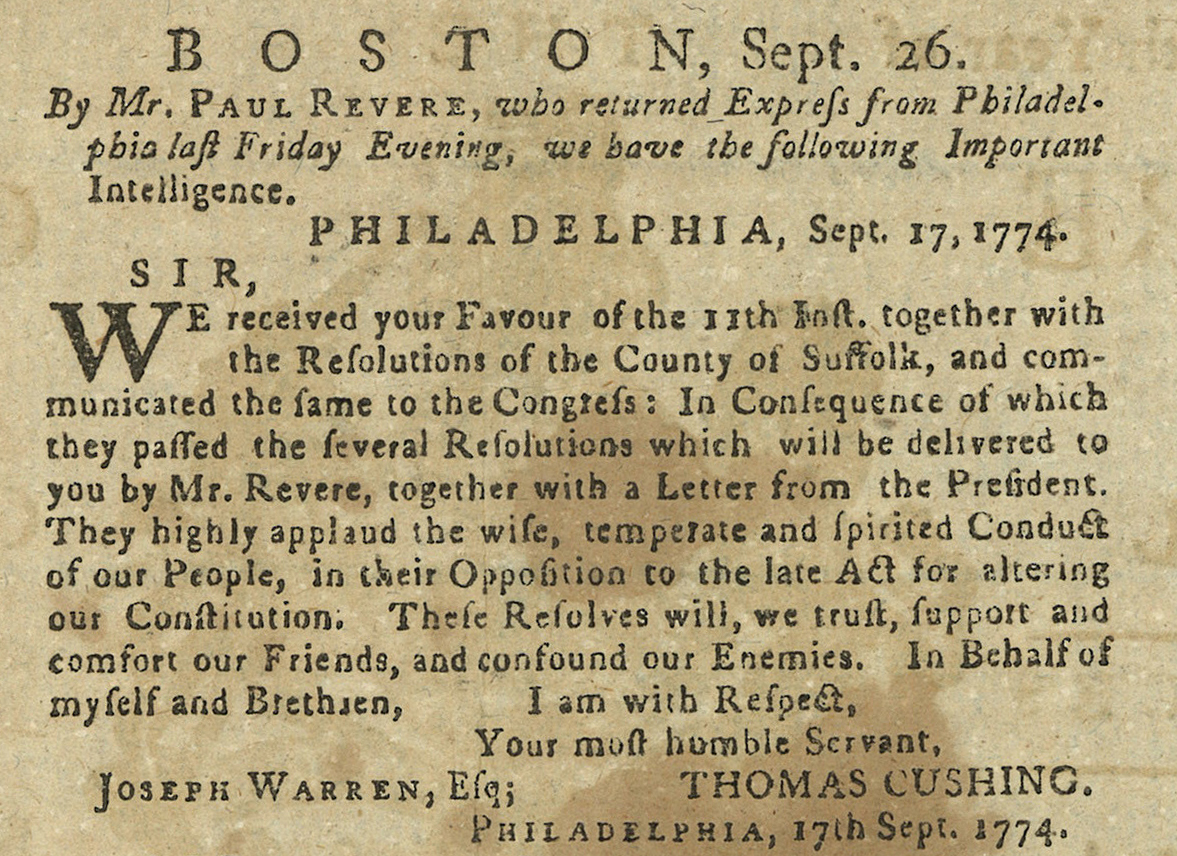
Revere also brought with him the Suffolk Resolves that I discussed last week.  The Congress published and unanimously approved the resolves.  I find it amazing that the Congress would approve such a radical document given some of the moderate and downright loyalist members sitting in the Congress.  Part of this may have been that Congress had thought for over a week that the British had fired on Boston and killed civilians.  Even after they discovered that was not true, the news of the Powder Alarm left an impression with many that a shooting war could break out at any time.  The other colonies felt that Massachusetts was getting a raw deal.  Even if they were not ready to sacrifice all in a fight with Britain, the Congress seemed to admire the courage of Massachusetts to stand against their oppressor in such a bold and open way.

Richard Henry Lee
(from Wikimedia)
Part of the effectiveness of the radicals in Congress was in their strategy.  Many of the moderates and conservatives from New York and Pennsylvania prepared to take on the New Englanders directly, assuming they would call for radical action.  The moderates would counter that they had gotten themselves into this mess through their own actions and that moderation and compromise would lead to a better resolution.

The New Englanders, however, remained relatively silent in the debate.  They left the radical argument to southerners, men like Richard Henry Lee and Patrick Henry of Virginia, as well as Christopher Gadsden of South Carolina.  These men did not call on the Congress to help their own colonies, they acted out of principle to help their New England comrades.  This was designed to guilt the middle colonies into expressing support as well.

Several of the southern delegates proposed sending soldiers to Massachusetts, and calling on the citizens of Boston to abandon the city so that a colonial force could assault the military garrison occupying the town.  The delegates defeated this proposal, but after doing so, supporting the Suffolk Resolves seemed like the more moderate approach.  As a result, moderate and conservative leaders felt compelled to go along.

The Galloway Plan

Some moderates did try to develop a better long term solution to the ongoing fights between Britain and her colonies.  Joseph Galloway from Pennsylvania had long been an advocate for having Parliament grant the colonies some representation in Parliament.  This, he argued would end the fight over taxation without representation.  Years ago, some members of Parliament seemed amenable to such an idea.  The radicals, however, had long rejected such a plan.  A small minority in Parliament would do nothing to prevent Parliament from taxing the colonies with impunity and against their interests.  One would have to look no further than Scotland where members made up less than 10% of the Parliament, which routinely passed laws against Scottish interests.

Joseph Galloway (from Wikimedia)
At Congress, Galloway did not make an argument for Colonial representation in Parliament.  He knew that was a losing battle.  Instead Galloway proposed the creation of a Grand Council of colonies.  This council would be made up of representatives from all the colonies, much like the current Congress, and would have authority to veto any Parliamentary laws affecting the colonies.

The radicals saw the Galloway plan as a danger to their agenda of getting a united colonial effort to boycott Britain and force Parliament to back down fully.  They wanted Parliament to recognize the sovereignty of colonial legislatures, not create another layer of bureaucracy to control those legislatures.

In the end, the delegates tabled Galloway’s plan and even expunged all references to its debate in the Congressional Journal.  They simply did not want such a plan to become a distraction.

No Independence

Despite the shift toward more radical ideas, it does not seem that anyone in Congress was considering independence.  At least no one said it out loud.  Virginia delegate George Washington heard rumors that the Massachusetts delegation was seeking independence.  He spoke directly with the delegation.  John Adams told him there was some talk of independence among some of the country radicals, probably the source of the rumors Washington had heard.  The leadership though, had absolutely no wish to move in that direction.  Washington later reported this conversation in a letter to a friend.  He noted that no one was considering independence and that “no such thing is desired by any thinking man in all North America.”

Declaration of Rights and Grievances

If the moderates had hoped to use the Congress to slow down the radical opposition to Parliament, they were sorely disappointed.  Events in Massachusetts allowed the radical position to control the agenda in Congress.

Over the next few weeks, Congress integrated many of the proposals set forth in the Suffolk Resolves into a new document spelling out the consensus view of the Congress.  They also drew heavily from a document entitled A Summary View of the Rights of British America submitted by a Virginian named Thomas Jefferson.  Jefferson was not a delegate, but was a member of the Virginia legislature.  His work seemed to resonate with many members of the Congress.  On October 17 Congress issued and approved its Declaration of Rights and Grievances.  The Summary view and the Declaration are worth reading these in full at the links above.  But I will summarize the Declaration of Rights and Grievances:

Summary View pamphlet, sent to members
of the First Continental Congress
(from Declaration Project)
The Declaration first challenged the Parliament’s authority in the Declaratory Act to pass any laws for the colonies in all cases whatsoever.  It challenged Parliament’s authority to impose duties for the purpose of raising revenue, objected to the American board of Customs Commissioners, and the use of admiralty courts.  It also objected to making colonial officials dependent on the Crown for their salaries, for keeping standing armies in the colonies in times of peace, and for threatening to transport colonists accused of treason to England for trial.

Next, the declaration turned to the Coercive Acts, calling the Port Act, the Government Act, the Justice Act, and the Quebec act “impolitic, unjust, and cruel, as well as unconstitutional, and most dangerous and destructive of American rights.”  It also objected to Colonial Governors regularly dissolving elected assemblies which were attempting to discuss grievances or draft petitions to resolve disputes peacefully and according to law.

Because of these actions the Congress held it appropriate to declare following:

First, like all men, they had a right to “life, liberty, and property,” an expression of fundamental rights coined by John Locke a century earlier.  Second, that as their ancestors had emigrated from England, they have the same rights and liberties as the subjects still living in England.  Third, that emigrating from England or being a descendant of an emigrant did not forfeit or lose such rights.

Fourth, a fundamental English liberty is the right to representation in the legislature.  English colonists could not properly be represented in Parliament, and therefore had authority to maintain their own colonial legislatures.  These local legislatures had full authority over taxes and local laws, with only the King having authority to veto legislation, just as the king could veto acts of  Parliament.  Not mentioned was the fact that the King had not vetoed a bill in almost 70 years.  In other words, colonial laws would, in almost all cases, be final for the colonies, just as Parliament’s laws were in England.  The Congress did recognize Parliament’s right to regulate external trade and to control foreign policy for the Empire.

Payton Randolph
(from history.org)
Fifth, the Congress demanded recognition of the common law right to trial by jury in the locality where a crime was committed.  Also sixth the right to benefit from the laws of England as they existed when their colonies were first established.  Seventh, they further held the rights established in their colonial charters or in laws passed by their colonial legislatures.

Eighth, they retained the right to assemble, consider grievances, and petition the King.  Ninth, keeping standing armies in a colony in time of peace without the consent of the colonial legislature is illegal.  Tenth, legislative power by an appointed council was unconstitutional.  Not only had Parliament just made this change in Massachusetts, but several other colonies had long lived under appointed councils.  Therefore, they backed off a bit and said they were only concerned about changes made since the end of the French and Indian war.  They then listed the specific acts of Parliament they found objectionable.

In light of these wrongs, the Declaration agreed to a non-importation, non-consumption, and non-exportation agreement, with an association to enforce such rules.  The Congress also agreed to prepare a public address for the people of Great Britain and America, as well as a petition to the King consistent with the Declaration.

The Continental Association

The most controversial proposal to come out of the Congress was the creation of the Continental Association.  Effective December 1, the Congress agreed that the Colonies should stop all imports from and exports to Britain, Ireland and the West Indies (in other words the British colonies in the Caribbean).  They also included a non-consumption clause, agreeing not to consume any such products.  This meant that smugglers who had violated the import agreement would have no market to sell their goods anywhere in the colonies.

John Dickinson
(from American History Central)
The articles also completely banned any participation in the international slave trade, though it did nothing to prevent the internal sale and purchase of slaves in and among the colonies.  No one was thinking about this being a first step toward emancipation.  Rather, there were too many slaves in the colonies.  This was reducing the price of slaves by more than the slave owners liked.  The ban was also part of the larger effort to shut down trans-Atlantic trade on everything.

Delegates also pledged to use “Frugality, Economy, and Industry” to limit extravagances that had led them to be indebted to Britain.  It discouraged any horse racing, cock fights, plays, etc.  It even asked mourners at funerals to cut back on traditions that required purchase of goods from Britain.

The southern colonies balked at some of this.  And it had nothing to do with the slave trade ban.  Virginia and South Carolina were particularly concerned about the ban on all exports.  Both colonial economies were almost completely dependent on exports of cash crops, tobacco for Virginia, and indigo and rice for South Carolina.  Even a cut back on imports and extravagances would not save many rich planters from bankruptcy if they could not service their debts by selling their cash crops.

In the end, Congress compromised, calling for the ban on exports to begin a year later, in September 1775 if Britain had not yet repealed the Coercive Acts by then.  Even with that, delegates could only convince South Carolina to go along by allowing the continued export of rice permanently.

Unlike earlier merchants agreement, the Congress created an ongoing Association to observe trade throughout the colonies and report anyone violating the terms of the Association.  Many conservatives both in the Congress and in the population generally objected to the terms.  They noted that colonial legislatures objected to Parliament legislating on their behalf.  Why then, they asked, was it ok for this quasi-legal Continental Congress to legislate on behalf of colonial legislatures?

Many though, supported the action.  If the British closed the Port of Boston to all trade, the other colonies had to stand in solidarity with the people of Boston.  Surely London could not handle a complete cessation of trade with her colonies for long.  She would have to back down and respect colonial rights.

Petitioning the King

Petition to the King
(from history.com)
Congress’ final product for the year was the Petition. A committee headed by Richard Henry Lee, and thought to be drafted primarily by John Dickinson, modeled the Petition on the Declaration of Rights and Grievances that they had approved a week earlier.  It largely spelled out the same sentiments, primarily requesting that the coercive acts be repealed.  But it began and ended with praise for the king and humble language, and an expression of loyalty. Basically, it was a request to undo all the laws and rules relating to colonial trade and taxes since the end of the Seven Years War, which coincidentally was about the same time George III became King.  Congress received the petition on October 25, made a few changes and gave final approval the following day.  It ordered the final document shipped to King George.

Lord North received the Petition in December on behalf of the King.  Parliament had refused even to receive earlier petitions that had questioned Parliament’s authority to pass laws for the colonies.  Despite that this petition similarly denied that right, North found it respectful enough to allow Parliament to receive it.  Still, he did not make it available to Parliament until late January.  He simply laid it before Parliament with other newspapers and information about events in the colonies without any effort to debate it or respond to it.  Leaders in London ended up paying far more attention to the Declaration and other reports printed in newspapers.

Let’s do this again next year.

On October 26, 1774, the same day Congress gave final approval to its petition it wrapped up its work, allowing the delegates to return home after nearly two months in session.  Before leaving the delegates agreed to meet again for a second congress the following spring, May 1775.  By then Britain would have had time to react to the petition and to back down and resolve all these problems.

Next week, Massachusetts sets up a Provincial Congress that is completely independent of Britain.

Next Episode 49: The Provincial Congress of Massachusetts

Previous Episode 47: The Suffolk Resolves

Visit the American Revolution Podcast (https://amrev.podbean.com) for free downloads of all podcast episodes.

Further Reading:

Web sites: 

Declaration of Rights and Grievances (full text): http://www.history.org/almanack/life/politics/resolves.cfm

First Continental Congress Petition to the King (full text): https://docs.google.com/document/d/1biFBF6IyWgq4SR95fWu-v2Q1aG1RlwyOjiushjXtEJM

Wolf, Edwin “The Authorship of the 1774 Address to the King Restudied” The William and Mary Quarterly, 1965, pp. 189-224: http://www.jstor.org/stable/1920696 (free to read online with registration).

Cecere, Michael “The First Continentental Congress responds to the Coercive Acts” Journal of the American Revolution, 2014: https://allthingsliberty.com/2014/09/the-first-continental-congress-responds-to-the-intolerable-acts

The Continental Association: https://www.landofthebrave.info/continental-association.htm

Articles of Association: https://www.landofthebrave.info/articles-of-continental-association.htm

Free eBooks
(from archive.org unless noted)

Journals of Congress, Vol 1, (contains minutes of First Continental Congress and first year of the Second Continental Congress.

Boucher, Jonathan, A letter from a Virginian: to the members of the Congress to be held at Philadelphia, on the first of September, 1774, (Supposedly written by John Adams, 1774).

Gray, Harrison, A few remarks upon some of the votes and resolutions of the Continental Congress: held at Philadelphia in September, and the Provincial Congress, held at Cambridge in November 1774, Boston? 1775 (loyalist pamphlet by the Treasurer of Massachusetts).

Miller, John Origins of the American Revolution, Stanford, Stanford University Press 1943 (Based on date, I am not sure about the copyright status of this book.  Since it may get pulled, I have also included a link to Amazon below).

Books Worth Buying
(links to Amazon.com unless otherwise noted)*

Beck, Derek, Igniting the American Revolution 1773-1775, Naperville, Ill: Sourcebooks, 2015.

Beeman, Richard R. Our Lives, Our Fortunes and Our Sacred Honor: The Forging of American Independence, 1774-1776, New York: Basic Books, 2013.

Bunker, Nick An Empire on the Edge, New York: Alfred A. Knopf, 2014.

Carp, Benjamin Defiance of the Patriots: The Boston Tea Party and the Making of America, New Haven: Yale University Press, 2010.

Daughan, George C. Lexington and Concord: The Battle Heard Round the World, New York : W.W. Norton & Co., 2018.

Knollenberg, Bernhard Growth of the American Revolution 1766-1775,  Indianapolis: Liberty Fund 1975.

Miller, John Origins of the American Revolution, Stanford, Stanford University Press (1943) (also available as a free eBook, see above).

Raphael, Ray & Marie The Spirit of ‘74: How the American Revolution Began, New York: The New Press, 2015.

Smith, Page A New Age Now Begins, Vol. 1, New York: McGraw-Hill 1976.


Sunday, June 3, 2018

Episode 047: The Suffolk Resolves


Last week, I discussed attempts by both Gov. Gage and the Massachusetts militia to grab as much arms and ammunition as they could get.  Gage quickly realized that the problem was not just a few radicals in Boston.  The entire colony would resist the government and the military.  Gage barricaded himself in Boston and sent word to Lord Dartmouth in London that he was going to need many more soldiers if they wanted to retake the colony.  Gage put a battery of cannon on Boston Neck to prevent any invasion by land, and put naval vessels in place to prevent anyone moving in or out of the town by water.

Gage Holds up in Boston

By September, 1774, the colonial government controlled only Boston.  The Governor completely lost control of the rest of the colony.  Gage accepted this fact and seemed content to remain in Boston until he could begin a new campaign in the spring.  He sent several letters to Dartmouth in London calling for reinforcements of at least 20,000.  As Gage put it: “A large force will terrify, and engage many to join you, a middling one will encourage Resistance and gain no Friends.” Gage wanted overwhelming force.  Otherwise, you would just be poking a bear with a stick.  Until he could get sufficient reinforcements, presumably some time in the spring of 1775, he would sit tight and remain on the defensive.

Gage brought in some reinforcements on his own that fall, transferring regiments from Quebec, Newfoundland, and New York to Boston.  Even after the reinforcements arrived in October, his force totalled only around 3000 men.  He divided his force into three brigades, one under Gen. Hugh Percy, a second under Gen. Robert Pigot, and a third under Lt. Col. Valentine Jones (who received a brevet commission as General).  His troops continued to drill and prepare, but went into winter quarters.  Gage focused his immediate attention on gathering intelligence and preparing for a spring campaign.  With only one or two exceptions, the army would remain inside Boston until spring.

In order to fill the power vacuum, Suffolk County, which includes Boston and the surrounding area, held a meeting.  Top patriot leaders Thomas Cushing, Samuel and John Adams, and Robert Treat Paine had left in August for the Continental Congress in Philadelphia.  Dr. Joseph Warren of Boston led the meeting.  Even without the top leaders, momentum for resistance and rebellion grew among the population.

Joseph Warren

Before we dive into the Resolves themselves, I want to say a few words about Joseph Warren.  I’ve mentioned him in a few episodes now, but have not given him much of a background.  Warren was a medical doctor in Boston.  He was a native born to Massachusetts and a graduate of Harvard college.  Although he was only in his early 30's in 1774, he had been active in the Patriot movement for quite some time.  In the 1760’s he had become an early leader in the Patriot cause, working for the Sons of Liberty with Hancock and the Adamses during the Stamp Act protests and beyond.

Joseph Warren
(from Wikimedia)
He conducted the autopsy on Christopher Seidens, the boy killed just before the Boston Massacre.  He also assisted with the Committee report on the Boston Massacre.  He delivered two public orations for the anniversary commemorations of the Boston Massacre.  For years he served on Committees of Correspondence and Safety for the Patriots, and wrote numerous newspaper articles furthering the Patriot cause.  By late 1774 he was one of Samuel Adams’ top lieutenants in the resistance, which is why he took command when Adams and the other top leaders left for the Continental Congress.  I think it is telling that Adams left Warren in charge rather than John Hancock.  Hancock had, at times behaved with a little too much moderation.  Some might call it timidity.  Warren, on the other hand, had always shown his commitment to the Patriot cause.  As a well respected Patriot leader, Warren was more than ready to lead the meeting that approved his Resolves.

Drafting the Resolves

Warren had begun working on the resolves even before the Powder Alarm set everyone on edge on September 1.  The week before, Committees of Correspondence had met in Faneuil Hall in Boston met to discuss their opposition and urged closing all the courts rather than operating under the Coercive Acts.

Suffolk County was not the only county to draft similar resolves regarding their actions.  But since the Suffolk Resolves went to the Continental Congress for approval, they tend to get the most attention.  The other resolves make clear though, that the radical sentiments expressed were not unique to Boston.  The general populous or at least a significant percentage of it, throughout the colony felt the same way.

Daniel Vose House, where Warren wrote the Resolves
(from Wikimedia)
Initial meetings to prepare the Suffolk Resolves took place in private homes in Milton and Dedham.  Warren introduced them on September 6 to a Convention meeting of Committees of Correspondence.    After a few days of editing and discussion, the Committees approved them.  On September 9, the Convention met at the Woodward Tavern in Dedham.  There, the convention gave unanimous approval to the 19 resolves.

If you have never read the Suffolk resolves, I recommend doing so.  They are only three or four pages long, and spell out a radical patriot view that makes the road to independence seem almost inevitable.  I thought about reading the full text here, but decided it would be better to discuss it in my own words.

Coming right on the heels of the Powder Alarm, when colonists were literally taking up arms to challenge the regular army, the Resolves capture the hostile sentiment of the people.  The preamble proclaims that their ancestors had fled the persecution of Great Britain, which now sought to use its power and vengeance against the colonists.  Their ancestors had sacrificed and toiled to build the free and just society that they now enjoyed.  Now, the British sought to destroy all that by asserting full sovereign power over the colony and reducing its people to a state of slavery.  The colonists’ only choice was to submit to slavery or resist.  Clearly they favored the latter.

The Resolves

The first resolve starts off on a conciliatory note.  It recognizes King George III as their rightful sovereign.  The colonists proclaim their continued allegiance.

Up until the Declaration of Independence in 1776, almost all colonial documents stressed their loyalty to the King.  Many of them held that the King would support their rights.  He just needed to stand up to Parliament and assert his authority.  It is unclear whether colonists were truly ignorant of the fact that the King wholeheartedly supported, and even encouraged, Lord North’s colonial policies, or whether they simply chose to pretend ignorance, in order to give the King an opportunity to change policies and appoint a new ministry once he realized that North’s policy of coercion would not work.

The second resolve proclaims their duty to fight for the rights and liberties established by their forefathers.  They recognized that they only have the rights they have because their ancestors fought for them.  This generation had to continue that fight to keep the freedoms for their descendants.

The third and fourth resolves criticize the Parliament for closing Boston Harbor, altering the colonial charter, and allowing criminals to be removed for trial elsewhere.  They proclaim that they will not obey such laws.

These resolves specifically focus on the Coercive Acts passed a few months earlier as the cause of the current crisis.  There is no mention of taxes or the longer term fights over trade rules.  Those are still a problem, but they are not why the people object to the colonial government.  It is the laws Parliament created to compel obedience that are causing the current disobedience.

The fifth and sixth resolves focus on the appointment of judges.  Because such appointments violate their colonial charter, as it existed before the Coercive Acts, the people should ignore any court orders from judges acting under these unconstitutional laws. It calls on sheriffs, jurors, and others to ignore the courts and refuse to obey them.  In the absence of a working court system, it calls on colonists to try to resolve disputes or submit to arbitration.  Anyone using the colonial courts going forward, will be deemed to be collaborating with the enemy.

The seventh resolve calls on tax collectors and other local officials not to send any taxes to the illegitimate colonial government.  Rather, they should hold all money until a proposed Provincial Congress could be established.

Suffolk Resolves Notice (from Journal of the American Revolution)
While London paid the salaries of a few colonial officials, most of the money needed to run the local government came from local taxes.  These had never been a matter of contention.  Colonists had always paid taxes authorized by the elected colonial legislature to support the government.  Now, Parliament’s changes to the Charter rendered the whole colonial government illegitimate.  Another resolve we’ll get to in a minute, discusses the creation of a new Provincial Congress to run things.  In the meantime, we are not going to hand over our money to the illegitimate government when the new government is going to need it.

The eighth resolve calls on those colonists who have accepted seats on the Governor’s Council to resign.  Most appointees had done so already.  The resolve tells the hold outs that if they do not do so by September 20th, less than two weeks away, they will be considered enemies of this country.  Again, the colonial government appointed under the Coercive Acts is illegitimate.  No more time for compromise.  It’s time to pick a side.  If you work for the colonial government, you are an enemy of the people.

The ninth resolve criticizes the fortifications the army is building on Boston Neck.  They fear it might cause people to think the army has some hostile intention against them.  The resolve also attacks Gov. Gates for removing powder from the Charleston powder magazine and also his decision to prohibit Boston authorities from returning powder to private owners.  Hey guys, we’re all friends here.  Why are you acting so hostile?  I’ve got to think Gage laughed when he read this one.  The people are planning an armed revolt and they are going to be upset that the army wants to defend itself and not hand over guns and ammunition to be used against them, really?

The tenth resolve attacks the Quebec Act.  It accuses Parliament of establishing Catholicism and French laws.  They see this as a danger to Protestants and to the whole continent’s rights and liberties as free Englishmen.

Colonists had fought multiple wars over the last century trying to push the Canadian French Catholics back, at great cost of both lives and money.   The Canadians had repeatedly invaded their borders and stirred up Indian tribes against them.  This was an age old war between two distinct civilizations.  Finally, with the end of the French and Indian War, the English had won.  The French were out of Canada and the the English were in control.  Now after they had WON, Parliament was giving the French everything they had ever wanted.  French speaking colonists with their Catholic religion and French laws, which did not include an elected legislature, would now push against the borders of the English colonies, all under the authority of the British Government.  What the heck!

The eleventh resolve calls for a complete restructuring of the colonial militia.  It recommends taking away commissions from all current militia officers.  Each local militia should elect new officers based on both competence and whether they are willing to support colonial rights.  It also calls on the new militia to prepare for war and to drill at least weekly.

In the past, militias tended to be casual affairs.  They would meet about four times a year for one day of drill.  Most drill days tended to be an excuse for a town wide party, where everyone came with families, watched the militia parade, and had a picnic.  Now was time to get serious and prepare for war.

I guess fearing the eleventh resolve might be taken as an act of treason, preparing for war against the government, the twelfth resolve, reiterates their affection for the King and promises to use the militia only defensively to protect themselves.  We just want to be ready just in case.  Really, we are not planning to attack the army.  It didn’t really matter.  Within days of receiving the document the British Attorney General declared the Resolves to be treasonous.

The thirteenth resolve addresses the fear that officials are planning to arrest the leaders of any resistance.  If that happens, the people resolve to take hostages of any official working for the colonial government and to hold them until any prisoners are released.

This was a real concern.  In fact, Lord North would soon order Gage to arrest the ringleaders and ship them back to London.  Gage, however, understood by now that arresting a few leaders would do nothing.  The rebellious attitudes were embedded throughout the colony.  Arresting a few leaders would not stop anything, but would almost certainly inflame more acts of violence.  Still, the colonists were putting the government on notice that they would not tolerate any arrests and would take their own prisoners if Gage imprisoned anyone.

The fourteenth resolves calls for a complete end to all trade with Britain, Ireland and the West Indies, and an agreement to abstain from the consumption of all British merchandise and manufactures, including anything from the East Indies, that is anything the the East India Company controls.

This reiterated essentially the same thing the Boston Town Meeting had called for when word of the Port Act first reached the colonies, the so-called Solemn League and Covenant.  It was the main issue under debate at the Continental Congress.  Economic boycotts had worked before.  It was the best way to challenge Britain absent military rebellion.

The fifteenth resolve calls for the creation of a committee to consider the best ways to promote local arts and manufacturing, presumably to take the place of goods manufactured in Britain.  If a complete boycott was going to work, colonies would have to do more for themselves.  As much as Parliament wanted to keep the colonies dependent on Britain, the colonists now fought to make sure they could operate economically independent of Britain.

The sixteenth resolves calls for the creation of a Provincial Congress to take the place of the colonial government.  Specifically, it calls on all the local towns to select members to attend such a Congress in Concord on the second Tuesday of October. A call for a Provincial Congress really was an act of independence.  Massachusetts would create its own government without any involvement from London.  Even under the new laws, it still had an elected legislature in the colonial government.  But that legislature’s power was so limited and under the thumb of the appointed governor and council that it could not act as a voice of the people.  This new Congress, would act on its own authority and do whatever it liked.

The seventeenth resolve pays respect to the Continental Congress meeting in Philadelphia.  The resolve promises to “pay all due respect and submission” to anything the Congress recommends to the colonies to reestablish their rights and restore harmony between Britain and its colonies.  Even the most radical leader in Massachusetts realized that an all out war between Britain and Massachusetts would not go well for the colony.  Even while they created a new government and prepared for war, they hoped that the moderates would find a way to convince Britain to back down and compromise. At the very least, Massachusetts needed the other colonies to join with them in resistance.  Going it alone was not an option.  Therefore, they hoped the Continental Congress could find a political solution.

The eighteenth resolve calls on the people to respect private property during this time when government is effectively absent.  It calls on the people to avoid riots or any other attacks on people or property.  They want to impress on the outside world that this is not a lawless mob, but rather a free people worthy of keeping their rights and liberties.  If the colony fell into anarchy, it would only hurt any support for their cause.

The nineteenth and final resolve calls for the creation of a committee or select individuals in each town to serve a dispatch riders.  Should the army attempt to launch any sort of attack, the dispatch riders would seek assistance from neighboring towns and alert the countryside to any attack.  It seemed inevitable that sooner or later, the British Army in Boston would once again venture out to threaten some other part of the colony.  Without a standing army to oppose them, communication between all the local militia had to get the word out on a moment’s notice.

Once complete, the County Convention published the resolves.  The Massachusetts Gazette printed a special supplement on September 16 for distribution all over the colony. Paul Revere carried a copy of the Resolves to the Continental Congress in Philadelphia.

Next week, we will take a look at how Congress responds to these resolves.

Next Episode 48: The First Continental Congress 

Previous Episode 46: The Powder Alarm 

Visit the American Revolution Podcast (https://amrev.podbean.com) for free downloads of all podcast episodes.

Further Reading:

Web sites: 

Web site devoted to Joseph Warren: http://www.drjosephwarren.com

Suffolk Resolves (full text - both transcript and image of original Gazette Article): http://www.masshist.org/database/viewer.php?item_id=696&img_step=1&mode=dual

The Story of the Suffolk Resolves (Milton Historical Society): http://www.miltonhistoricalsociety.org/DigitalArchives/1973%20The%20Story%20of%20the%20Suffolk%20Resolves.pdf

Free eBooks
(from archive.org unless noted)

Bolton, Charles (ed) Letters of Hugh, Earl Percy, from Boston and New York, 1774-1776, Boston: Charles E. Goodspeed, 1902.

Dana, Elizabeth Ellery (ed) John Barker diary - The British in Boston, 1774-1776, Cambridge: Harvard Univ. Press, 1924 (Barker was a British officer stationed in Boston).

French, Allen The Siege of Boston, New York: Macmillan, 1911.

Frothingham, Richard History of the Siege of Boston, Boston: C.C. Little and J. Brown, 1851.

Frothingham, Richard Life and times of Joseph Warren, Boston: Little, Brown & Co. 1865.

Miller, John Origins of the American Revolution, Stanford, Stanford University Press 1943 (Based on date, I am not sure about the copyright status of this book.  Since it may get pulled, I have also included a link to Amazon below).

Scaife, Lauriston Milton and the Suffolk Resolves, by Lauriston Scaife, Boston: Thomas Todd Co. 1921.

Warren, Joseph An oration delivered March 5th, 1772: at the request of the inhabitants of the town of Boston; to commemorate the bloody tragedy of the fifth of March, 1770, Boston: Edes & Gill, 1772.

Books Worth Buying
(links to Amazon.com unless otherwise noted)*

Beck, Derek, Igniting the American Revolution 1773-1775, Naperville, Ill: Sourcebooks, 2015.

Bunker, Nick An Empire on the Edge, New York: Alfred A. Knopf, 2014.

Carp, Benjamin Defiance of the Patriots: The Boston Tea Party and the Making of America, New Haven: Yale University Press, 2010.

Daughan, George C. Lexington and Concord: The Battle Heard Round the World, New York : W.W. Norton & Co., 2018.

Knollenberg, Bernhard Growth of the American Revolution 1766-1775,  Indianapolis: Liberty Fund 1975.

Miller, John Origins of the American Revolution, Stanford, Stanford University Press (1943) (also available as a free eBook, see above).

Philbrick, Nathaniel Bunker Hill: A City, A Siege, A Revolution, New York: Viking, 2013.

Raphael, Ray & Marie The Spirit of ‘74: How the American Revolution Began, New York: The New Press, 2015.

Smith, Page A New Age Now Begins, Vol. 1, New York: McGraw-Hill 1976.


Sunday, May 27, 2018

Episode 046: Powder Alarm


Last week I discussed General Gage’s early attempts to enforce the Coercive Acts and cow the colonists into submission following the Boston tea party.  He quickly learned that the rebellious leaders were not ready to roll over and that the people were most certainly not ready to tolerate the new government. The free people of New England were heavily armed and not afraid to use their weapons against anyone they saw as threatening their liberties.  Tens of thousands of armed colonists who were ready to confront the British regulars were no match for the force that Gage had under his command. He sent increasingly frantic letters to London indicating that he needed a much much larger army by spring if he was going to be able to regain control of the colony. In the meantime, Gage hunkered down in Boston and left the rest of the colony to run itself for the rest of the fall and winter.

Gage’s decision to retreat into Boston and await reinforcements was not a strategy that many of his junior offices supported.  Col. Alexander Leslie (soon to be Gen. Leslie) still believed that a military show of strength would force the locals to back down and submit.  Gage did not think the colonists were particularly capable, but just in terms of large numbers, they could overwhelm the Regulars.  Once Gage realized it was not just Boston in rebellion, but all of New England, he kept his defensive posture until he could get a bigger army.

Powder House

Most of the mob activity designed to intimidate judges, sheriffs, Council members, and other government officials came from mobs armed only with clubs or cutlasses.  But Massachusetts had one of the most heavily armed citizenries that the world has ever seen.  Almost every free man between the age of 16 and 60 had a firearm and ammunition at home.  Colonial law required almost everyone to own and maintain them for use in militia duty.  Decades of regular threats from the French or Indian tribes had caused the people to be prepared for attack at any time.  In the last few years, Massachusetts had even purchased several more canon because, well you know, we might need them for Indians or something.

One weakness though, was the fact that the colonies did not make their own gunpowder.  All of that was imported from England.  Colonies always kept plenty on hand in case of immediate danger, but then had to rely on imports for any extended need.

The Powder House on Quarry
Hill (today Somerville) still
stands today (from Wikimedia)
They kept very little of the powder on hand in their homes.  Powder was very dangerous, especially in homes with candles, fireplaces and other open flames.  Storing large amounts of powder in the home was too great a danger.  Instead, most of it was stored in powder houses.  These were large stone buildings, usually in some isolated area so that in case they blew up, they would not take out a bunch of neighbors.  Different local militia groups, and even some individuals might store extra powder in communal powder houses.

Boston stored much of its powder in a stone powderhouse a few miles north of town, up near the Mystic River at a place called Quarry Hill.  Militia units from towns around the region stored their powder there.  As tensions increased, many townships reclaimed their powder before the government decided to cut off their access to it.

When Gage heard rumors that colonists were removing their powder, he sent a note to William Brattle, asking for information about the powder house stores.

Gen. Brattle, at this time in his late 60’s, was generally a loyalist by ideology, but had tried to remain on the good side of the radical Whigs as well.  He had started showing some fondness for Whig ideals as far back as 1765.  Remember when Gov. Bernard made Hutchinson the head of the Massachusetts Court in 1765, causing James Otis to quit his job and become an advocate for smugglers because he thought his father should have gotten the appointment?  Well Brattle was upset too, not for Otis, but because he thought he should have gotten the appointment.  Brattle also started associating with radical Whigs, but never really joined their cause.

In 1774, he was a militia general and commander of the Middlesex militia and in charge of the Powder House.  When Gage inquired about status, Brattle made the mistake of answering honestly. He reported to Gage that the Medford militia had removed their portion of powder from the powder house.  With that, the only remaining powder was the King’s powder, that is belonging directly to the colonial government.  He further implied that the remaining powder might be at risk of seizure.  His second mistake was to send this as a letter, which somehow never made it to Gage, but got printed in a patriot newspaper.  Colonists saw Brattle as a collaborator.

Powder Raid

Gage did get the information though, and acted on the information quickly and decisively.  He had concerns about marching his regulars miles into the countryside for fear the militia would assemble and confront them.  Gage did not fear an armed battle, but wanted it on his terms and timetable.

William Brattle
(from Wikimedia)
On August 31, Gage sent the local sheriff to collect the powder house key from Brattle.  Since Brattle did not want to be a part of the dispute, he cheerfully turned over the key.

Before dawn on September 1, Gen. Gage deployed about 260 regulars from the 4th Regiment under the command of Lt. Col. George Maddison.  The Regulars crossed the Charles River and rowed up the Mystic River to within a mile of the powder house, arriving there before sunrise.  The soldiers took the remainder of the gunpowder, over 200 barrels, put them on boats and brought them back to Boston.  On the return, a contingent of soldiers marched back through Cambridge.  There, they took two militia cannon back to Boston as well.  Once in Boston, Gage ordered the artillery and powder to a more secure location on Castle Island in Boston Harbor.

By late morning the mission was complete.  Gage had secured his powder and returned his soldiers to Boston before the colonists could react.

Powder Alarm

Before raid began, by the evening of August 31, patriot leader Joseph Warren was aware that the regulars were up to something.  He observed the regulars assembling in Boston for an unusual night mission.  However, he did not have a system in place to warn the surrounding countryside.

It was not until the next morning, when the regulars were already on their way back to Boston, that word spread throughout the region that the soldiers had conducted a raid of some sort.

Map showing route of the regulars to the powder house at
Quarry Hill (from erenow.com)
Rumors spread through the countryside that British soldiers had raided local militia and killed six men in a showdown.  Thousands of men from all over Massachusetts, Connecticut, and elsewhere in New England, began to descend on Boston with muskets in hand, ready to do battle.

Although some estimates say as many as 30,000 armed men started out for Boston, most turned back when they learned the rumors of colonists being shot were not true.  By Friday morning, September 2, about 4000 men had congregated around Cambridge, just across the river from Boston.

A mob visited the home of Gen. Brattle.  Wisely, Brattle had already decided to flee to Castle William for protection.  Next, the mob moved on his neighbor, Attorney General Jonathan Sewall, who also had left home.  The mob threw rocks through a few windows, but could not find a good target for their wrath.

Several key leaders, including Samuel and John Adams, were away at the First Continental Congress in Philadelphia.  The remaining patriot leaders in Boston did not want to see this immediate crisis turn into an armed battle.  Neither did Gage, whose regiments of British regulars were already outnumbered by the armed militiamen gathering nearby.

Newly appointed Lt. Gov. Thomas Oliver, no relation to the former Lt. Gov. Andrew Oliver who died in 1773, lived in Cambridge.  He observed the groups of men passing his home heading toward Boston.  Many of them were men he knew from neighboring towns.  He went with them to Cambridge Common, where everyone seemed to be congregating.  At one point a rumor spread that Gage was sending soldiers to disperse them.  Oliver agreed to go into Boston, and see if he could resolve all this without bloodshed.

On his way into Boston, he met with Joseph Warren, William Mollineux, and several other leaders headed from Boston to Cambridge to speak with the growing mass of angry colonists.  The men met with the colonists and dispelled the rumor that anyone had been shot.  They assured them that the powder removed had belonged to the King’s forces and not to any local militia.  In short, they made every attempt to calm the situation.

Thomas Oliver
(from ColonialSociety.org)
Two of the men sent to pacify the colonists sat on the Governor’s Council, as did Lt. Gov. Oliver.  The crowd demanded that they publicly resign on the spot since the Council was unconstitutional.  Two of the Council members had already tendered their resignations to Gage and readily announced that to the crowd.

The situation seemed like it was coming to a peaceful end, when Customs Commissioner Benjamin Hallowell decided to ride past the crowd in his carriage.  The crowd quickly turned on the hated commissioner who fled toward Boston.  More than 100 men mounted their horses and chased him.  Hallowell had a good lead on them, but his carriage broke down as he sped along the road.  He jumped on his servant’s horse and continued at a full gallop.  The horse then faltered and fell a few hundred yards from the Boston Neck defenses.  Hallowell then took off on foot running the final distance to the safety of the British guards at Boston Neck.

During the confusion Oliver slipped back to his house in Cambridge.  A group soon came to his door still demanding his resignation from the Council, but not as Lt. Governor.  After some debate, Oliver reluctantly signed his resignation, noting coercion by the crowd of 4000 men surrounding his house.  Later that day, Oliver would slip into Boston since Cambridge was no longer a safe place to live.

Meanwhile Gage continued to monitor the situation from Boston, sending out soldiers dressed as civilians to spy on the militia.  The militia began to return home by the end of the day.  Gage, however, increased his defenses, building a better defensive gate at Boston Neck, adding several artillery pieces there, and getting Admiral Graves to move several navy ships into the rivers to prevent any river crossing of angry patriots.

Boston was the only place in Massachusetts where Gage could assert any government authority, and the only safe place for anyone who cared to express Tory opinions.  Even there, some Tories were not safe.

Castle Island, Boston Harbor (from Wikimedia)
A few days after the raid, local newspapers published accounts of Brattle’s involvement in informing Gage about the powder.  Although Brattle argued he had simply done his duty to keep the Governor informed about the state of the powerhouse, Patriots deemed him an informant worthy of punishment.  Brattle would spend the remainder of his time in the colony, living out on Castle Island in the harbor under military protection.  He could not even return to Boston.  When the British evacuated Boston in 1776, Brattle went with them to Canada, where he died of natural causes later that year.

Patriot leaders realized that it has taken them more than 24 hours to muster a response to the raid on the powder house.  They needed a better warning system.  On September 21, they met in Worcester to discuss the problem.  The solution was to organize a group of the most patriotic militiamen, to agree to turn out at a minute’s notice if there was any future alarm.  These so-called minutemen could produce an army of thousands from among the population for almost immediate use to confront any future raids.

Paul Revere

Since all the regulars were in Boston, patriots needed men in Boston willing to ride out and warn the population of any imminent raids.  Joseph Warren was in charge of intelligence, but someone else needed to handle the communications network.  That job went to a local Boston patriot named Paul Revere.

Now, Revere was not an elected official, nor a big speaker or writer, but involved himself in all of the major events leading up to this point.  He produced a famous illustration of the Boston Massacre and appears to have been one of the gang leaders at the Boston Tea Party.  He had also served as a reliable messenger to bring news of major events to New York, Philadelphia, and other towns and cities.

Revere was a silversmith by trade, born and raised in Boston. Besides the Sons of Liberty, Revere was part of many other associations around town, including one of the local Masonic lodges.  Revere worked closely with Joseph Warren to create a network of about thirty workers around town to gather and disseminate intelligence.  Warren would rely on Revere to serve as a primary messenger if the British tried anything.

Paul Revere (from Wikimedia)
Paul Revere rose to fame decades after the war, often attributed to Henry Wadsworth Longfellow’s famous 1861 poem about his ride before the battles of Lexington and Concord. By the early twentieth century, historians downplayed his importance, arguing that he was merely one of many riders and did not even complete his famous ride.  I think Revere’s reputation came most under attack in the 1920’s when Vice President Charles Dawes, tried to play up the importance of his ancestor William Dawes, who was one of the other riders sent out just before Lexington and Concord.  As William Dawes’ importance in that event was raised by historians, Revere’s necessarily fell.

Personally, I think this revisionism went too far in the other direction.  Sure, there are many riders who played important roles that may not be as well known.  But Revere was an important player in many of the early events, and was more than merely a messenger boy.  He was a key player in the early strategic efforts and coordination of the patriot cause.

Revere would spend much of the winter planning and organizing communications networks across the colony.  He knew the key militia leaders in every town and where they lived.  He knew who needed to be contacted to spread any alarm as quickly and efficiently as possible.  He would make numerous visits out to Concord and other key patriot strongholds.  He worked with all the top patriot leaders including Hancock, Adams, and Warren.  Revere’s organization and planning was critical to the movement.  In short, Revere did more than ride. He helped build the network necessary to implement an early warning system for future raids.

The next time Gage attempted to move his soldiers out of Boston, the patriots would have this early warning network in place.  They would be ready to confront the regulars before they could reach their objective.

Securing Arms

The patriots also used the Powder Alarm, as it became known, to secure any remaining arms.  Guns, equipment, powder, and ammunition in other colonial powder houses were emptied, their contents hidden from any future British search and seizure missions.

The "Hancock Cannon" one of the brass  three pounders the
Patriots stole from Gage. (from Wikimedia) - special thanks to J.L. Bell
Across the river from Boston, Charleston had a battery of large cannon and shell in place to prevent any naval assaults.  Gage received reports of activity in the battery, and on September 7 sent a night time party of soldiers to investigate and secure the weapons.  Upon arrival they found all of the cannon and ammunition gone.

Only in Boston, could Gage order that the local ordinance be secured.  Many private citizens as well as local militia kept powder stored in powder houses in order to reduce the risk of explosion by keeping it at home.  Gage refused everyone in Boston access to their powder.  Boston also had four brass field cannon, two two pounders and two three pounders (referring to the weight of the cannon balls they could fire.  The guns themselves were several hundred pounds each).

One night, the two pounders simply disappeared.  Gage put sentries to guard the three pounders, which were stored in an armory right next to the British camp.  When an officer brought in a party to move the cannon, he discovered that they too had disappeared, despite the guards.

The other 3 pounder, known
as the Adams Cannon.
(from Jake @ hubhistory.com)
The hunt for guns and ammunition continued throughout the fall.  Several private citizens in Boston owned cannons, although most of them were keeping it secret at this time, so no one knows exactly how many.  They continued to try to smuggle them out of occupied Boston to safe patriot strongholds in the country.  One morning, British soldiers found several cannons stuck on a mudflat in the water north of town.  Evidently the rowboat got stuck as smugglers tried to move them overnight.  John Hancock later received reimbursement from Congress for four cannon that he donated to the cause around this time.  William Mollineux died suddenly from an illness in October.  Among his effects, authorities found two swivel guns and four mortars.  The Navy stopped another shipment of 12 cannon from London to Thomas Cushing.


There were also lots of smaller items.  When soldiers searched a Bostonian’s wagon leaving Boston, they found 19,000 rounds of ammunition.  They confiscated it.  The man then angrily demanded the return of his property.  The officer asked him why he needed 19,000 rounds of ammunition, he just said it was for personal use.  He did not get them back.

British officers also found several merchants in town with heavy artillery, light weaponry and thousands more rounds of ammunition, which they took possession, paying for them of course.  On at least one occasion a mob of patriots attempted to stop a merchant from delivering his weaponry to the army.  Merchants selling arms to the British were deemed collaborators.  They received death threats and saw their shops trashed.  Even in occupied Boston, enough patriots remained to influence behavior.

Both sides were now in all out competition to arm themselves.  Neither would admit why yet, but everyone knew a showdown as coming.

Next Week: The people of Suffolk County resolve to run the colony without the Governor.

Next Episode 47: The Suffolk Resolves

Previous Episode 45: Governing from Salem

Visit the American Revolution Podcast (https://amrev.podbean.com) for free downloads of all podcast episodes.

Further Reading:

Web Sites 

The Big Mystery of Lt. Gov. Thomas Oliver http://boston1775.blogspot.com/2008/04/big-mystery-of-lt-gov-thomas-oliver.html

A Description of Occupied Boston, 1774-75: http://www.loc.gov/teachers/classroommaterials/presentationsandactivities/presentations/timeline/amrev/shots/describe.html

VIDEO: Jane Triber discusses her book: True Republican: the Life of Paul Revere, CSPAN 1998: https://www.c-span.org/video/?110989-1

Free eBooks
(from archive.org unless noted)

Bolton, Charles (ed) Letters of Hugh, Earl Percy, from Boston and New York, 1774-1776, Boston: Charles E. Goodspeed, 1902.

Cushing, Harry (ed) The writings of Samuel Adams, Vol. 3, New York: G.P. Putnum's Sons, 1907.

Dana, Elizabeth Ellery (ed) John Barker diary - The British in Boston, 1774-1776, Cambridge: Harvard Univ. Press, 1924 (Barker was a British officer stationed in Boston).

French, Allen The Siege of Boston, New York: Macmillan, 1911.

Frothingham, Richard History of the Siege of Boston, Boston: C.C. Little and J. Brown, 1851.

Frothingham, Richard Life and times of Joseph Warren, Boston: Little, Brown & Co. 1865.

Miller, John Origins of the American Revolution, Stanford, Stanford University Press 1943 (Based on date, I am not sure about the copyright status of this book.  Since it may get pulled, I have also included a link to Amazon below).

Smith, Whitney (ed) Concord town records: manuscript transcripts, 1774-1776, Boston, 1774.

Books Worth Buying
(links to Amazon.com unless otherwise noted)*

Beck, Derek, Igniting the American Revolution 1773-1775, Naperville, Ill: Sourcebooks, 2015.

Bunker, Nick An Empire on the Edge, New York: Alfred A. Knopf, 2014.

Carp, Benjamin Defiance of the Patriots: The Boston Tea Party and the Making of America, New Haven: Yale University Press, 2010.

Daughan, George C. Lexington and Concord: The Battle Heard Round the World, New York : W.W. Norton & Co., 2018.

Knollenberg, Bernhard Growth of the American Revolution 1766-1775,  Indianapolis: Liberty Fund 1975.

Labaree, Benjamin W. The Boston Tea Party, Oxford University Press, 1964.

Miller, John Origins of the American Revolution, Stanford, Stanford University Press (1943) (also available as a free eBook, see above).

Philbrick, Nathaniel Bunker Hill: A City, A Siege, A Revolution, New York: Viking, 2013.

Raphael, Ray & Marie The Spirit of ‘74: How the American Revolution Began, New York: The New Press, 2015.

Smith, Page A New Age Now Begins, Vol. 1, New York: McGraw-Hill 1976.

Unger, Harlow American Tempest: How the Boston Tea Party Sparked a Revolution, Cambridge: Da Capo Press, 2011.