Showing posts with label Connecticut. Show all posts

Sunday, May 18, 2025

ARP353 Ratification in New England

Last week we covered the first four state ratifications of the Constitution.  Delaware, New Jersey, and Georgia, all relatively small states, ratified quickly and unanimously.  Pennsylvania also ratified, but only after anti-federalists objected to how quickly the federalists pushed it through.  Stronger headwinds began to blow as the opposition got more organized and the more skeptical states began to consider this document.

By the end of 1787, just over three months after its release, more than 200 printers had reproduced copies of the Constitution across the continent.  Essays and editorials, both for and against ratification, pushed their way into the public debate as well.

Federal Pillars adding Massachusetts
There were a host of reasons that opponents raised, about both the process and the principles.  The lack of a bill of rights became a major sticking point for many.  But the more general philosophical objection was that this new Constitution was an attempt by powerful and wealthy interests to consolidate power.  It was an attempt to deny the states the freedoms they had won in the Revolutionary War. Some argued that this new powerful federal government would be more arbitrary and despotic than even British rule had been.

At the same time the federalists, that is supporters of ratification, saw this as a fight between good government and anarchy.  The union under the articles was falling apart.  States were violating the rights of their own people and were moving closer to war with one another.  If left unchecked, it would result in secession, civil war, and, perhaps, many states returning to British rule to avoid the threats of their neighbor states.

Even if this proposed constitution was imperfect, it represented the last best hope to save the union.  They saw the opposition as men driven by selfish interests, wanting to hold onto their power at the state level and at the expense of risking the end of the union.  They compared the antifederalists to the loyalists for their desire to destroy the United States, or as Shaysites for supporting civil unrest and mob rule over good government.  With this ideological conflict raging the ratification efforts continued.

Connecticut Ratification

The next state to consider ratification was Connecticut.  This was the first New England state to consider the new constitution.  

Connecticut had been caught up in the political battles in recent years between the merchant class and the farmers that raged through all of New England.  These were the same things that resulted in Shay Rebellion the year before, and the takeover of the Rhode Island government which was destroying the financial system in the state to assist indebted farmers.  Since Connecticut had many of these same divisions, one would expect that there would be divisions over a more powerful federal government that could have more control over taxes, trade, commerce and financial systems.

The leadership in Connecticut seemed all in favor of the new Constitution.  This was a document that would bring stability to a region threatened with anarchy.  While there was still a minority in the legislature that expressed some opposition, they were a minority.  

Connecticut newspapers all lent their strong support to the Constitution.  There were six state newspapers at the time.  All of them ran numerous essays in favor of the constitution, including several written by delegates Roger Sherman and Oliver Ellsworth. Although the papers ran a few anti-federalist articles that were reprinted from out of state papers, they pretty much ignored any local opposition.

Local supporter David Humphreys, in a letter to George Washington just after the end of the convention, noted that the professional classes, clergy, lawyers, physicians, and merchants, seemed uniformly in favor of the new government, as were former Continental officers.

The Connecticut legislature voted in October, about a month after the convention in Philadelphia had ended, to hold elections for a ratifying convention.  That election took place on November 12, and the convention met beginning on January 3, 1788.

Many local towns debated the constitution at town meetings. Some of those who elected delegates to the convention sent them with instructions to vote no.

There was certainly disagreement at the ratifying convention, but the majority did not simply push through their vote.  Delegates agreed to go through the constitution section by section.  Roger Sherman, who had been a voice of moderation at the Philadelphia Convention, spoke up as one of the leading advocates at the ratifying convention.

The advocacy did have an impact.  There were a number of delegates who spoke against the Constitution during the debates but who ended up voting in favor of ratification.  At least one of these violated his instructions to vote no.

The final vote for ratification took place on January 9.  The vote of 128 to 40 was not unanimous as it has been in three of the four previous conventions, but it was a much larger margin than the vote in the other large state, Pennsylvania, that had already ratified.

Massachusetts Ratification

On the same date, January 9, that the final ratification vote in Connecticut took place, the Massachusetts ratification convention began.  Generally speaking, a majority in Massachusetts seemed to be in favor of a stronger federal government.  Shays’ Rebellion reinforced this view among government leaders in favor of greater federal power.  Even so, many state leaders seemed skeptical of the Constitution as proposed.

A month had passed between the end of the Convention in Philadelphia on September 17, 1787, and the assembly of the Massachusetts legislature on October 17.  Several days after the session began, Governor John Hancock presented it to the legislature.  When he did this, Hancock refused to endorse or object to the constitution but simply said that it was “not being within the duties of my office to decide upon this momentous affair.”

Privately, Hancock expressed concerns that the document was “subversive” of certain inalienable rights, although he did not get into specifics.  He also commended that it was “not sufficiently democratic” and too restrictive of state and local powers. My view is that Hancock was behaving like a politician, mostly waiting to see how public opinion turned on the matter before committing himself.  But he certainly wasn't leading in either direction on this issue.

Samuel Adams, at this time, was President of the State Senate.  He came out against the Constitution initially, seeing a powerful national government as a threat to Massachusetts sovereignty.  He thought the US was too large to be governed by a single government and that it could only work as a federal union of sovereign states.  This proposal went too far in giving too much power to the central government.

Even so, Adams was also cautious politically.  Although he did voice his concerns, he did not declare himself a full throated opponent of ratification.  He also seemed willing to reconsider his views on the topic, if public opinion swayed one way or another. 

Perhaps the loudest voice in opposition to ratification, was Elbridge Gerry.  He was one of the most active delegates at the Convention, and one of only three who were there on the last day to refuse to sign the document.

Gerry had gone to the Philadelphia Convention in favor of a more powerful central government.  But as the Constitution developed in Philadelphia, Gerry’s opposition grew.  By August, he had become an opponent.  The proposed Constitution was too powerful, and endangered the "liberties of the people and the independence of the states."  He feared this new government would eventually morph into an aristocracy or a monarchy.

Nathan Dane, who had spoken against the Constitution at the Confederation Congress in New York, also became an outspoken opponent of ratification in Massachusetts. Speaker of the House James Warren also opposed ratification, writing several pamphlets in opposition. His wife, Mercy Otis Warren, also wrote a pamphlet against ratification.  So the top leadership elected in the state, stood somewhere between tepidly opposed to the Constitution and very opposed to the Constitution.  The leadership was not strongly in favor, as we've seen in previous states, where ratification had already been considered.

Support for ratification fell to two of the convention delegates, Rufus King and Nathaniel Gorham. Both of them led the campaign in favor.  King regularly corresponded with James Madison to keep him informed of progress.  Gorham did not participate much in the debates because he had been Chairman of the Committee of the Whole during the Philadelphia Convention.  But he strongly supported ratification in Massachusetts.

Another person you might think might have an interest in this was John Adams.  But he was still serving in London and could not really participate in the debate.  Elbridge Gerry sent Adams a copy of the proposed document.  Adams expressed some concerns, but ultimately favored ratification.  Even so, his absence from the country meant that he could not have a meaningful voice in the debate.

Because there was not unified support among the state leaders, there was much greater doubt about the outcome in Massachusetts. There was no unified group of opinion leaders to push popular sentiment in favor of ratification.

In previous episodes, we've discussed the political divide that existed in Massachusetts at this time, between the farmers, primarily in the western part of the state and the merchants in the eastern part.  When it came to ratification, the farmers opposed it.  The merchants supported it.

Gerry kicked off the opposition debate by sending a letter to the legislature explaining the objections that caused him to refuse to sign the Constitution.  A short time later, this was printed in local newspapers.

Massachusetts had twelve newspapers at the time, all of which printed the proposed constitution.  Several began printing articles from the Pennsylvania Ratification Debate.  Opinions by James Wilson and Benjamin Franklin were republished.  Articles from other out of state debates also found their way into the papers.  The majority favored the Constitution, but some were in opposition. There were actually very few articles written in Massachusetts in the early weeks of the debate.

After formally receiving the proposed Constitution on October 18, the Massachusetts legislature did what all legislatures like to do.  It formed a committee to study the matter. The committee reported back a day later with recommendations to call a convention, that voters should choose the delegates to the convention, and that the number of delegates would be the same for each town district that they had for representatives in the state legislature.  In other words, representation would be based on population, rather than a fixed number from each county, as earlier states had done.  Initially, the convention was set to begin on December 12.   There was also some argument over whether the towns would have to pay the expenses of their delegates.  One suggestion was to just hold votes in town meetings and not have a state-wide convention.  This was shot down, and the legislature eventually agreed to cover the costs of the delegates.  

There were also those in the legislature who argued against a convention entirely. They gave the same arguments that we heard in other states, that the Philadelphia Convention had exceeded its authority by creating a new government, and that these changes violated the requirement that all amendments to the articles be unanimous.

The majority in the legislature, however, thought that all of this was a matter for the convention. They set the election of delegates beginning on November 19, the convention to begin on January 9.  

More than 300 Massachusetts towns held elections for delegates.  Some did not get around to selection until January 7, just two days before the ratifying convention began.  There were probably close to 400 delegates who attended.

The ratifying convention first met in the State House, but the size of the convention, along with large numbers of people who wished to observe the convention, resulted in officials moving to a larger church on Brattle Street, and then an even larger one on Long Lane (today, Federal Street).

As had happened in Pennsylvania, the pro-ratification delegates hoped for a quick vote of approval without amendments. However, it became apparent that a majority of delegates were inclined to vote no.  A great many of them had been sent with instructions by their towns to vote no.  

 The Massachusetts tradition of citizen debate and involvement in such issues resulted in an extended debate.  Delegates agreed to go through the document, looking at each paragraph and letting everyone express their views.  Rather than wrapping up the convention in a week, which had been the case in earlier states, the Massachusetts convention debated for a month.

Over the course of debates, several delegates who had initially been hesitant to support ratification, did in fact change their minds.  Samuel Adams muted his initial objections, especially after a group of tradesmen in Boston voted in favor of ratification, and warned that anyone who opposed it was working against their interests. These men were convinced that the Constitution would improve trade and would therefore improve Boston’s economy and create more jobs.  Adams, who relied on these men as the part of the core of his political power, saw could reason not to oppose them.  Similarly, former governor James Bowdoin held a dinner shortly before the convention, where all the other Boston delegates expressed support.  The merchant community also favored ratification.  The result was that Adams moved from being opposed to “listening” at the convention, and eventually supported ratification.

Although John Hancock had been chosen as president of the ratifying convention, he did not show up for the first three weeks, claiming that his gout was acting up. Many at the time saw this more as a matter of not wanting to commit to either side.  Rufus King suggested that his health would improve “as soon as a majority shows itself on either side of the convention”

Federalists met with the governor in his sick bed, trying to get him to back ratification.  They offered him support for his reelection.  They also tried to appeal to his ego, suggesting he might become the first president of the United States if Virginia failed to ratify. Hancock finally went to the convention on January 30, and offered his first comments the following day.  

Up until that time, the convention seemed pretty evenly split.  Opponents objected to all sorts of things, including the absence of a bill of rights, the lengthy terms of Senators and Representatives, the system for electing the president, too powerful a judiciary, the power to impose direct taxes, etc.   There were also objections to continuing the slave trade and giving southerners voting power based on their slaves. Some objected to the lack of a religious oath for office holders.

The strongest opposition came from the farmers of western Massachusetts, still reeling from Shays’ rebellion and the policies that led to it.  They feared that federal restrictions on paper money and debtor relief were going to destroy them.  Given the divisions in the state, I’d guess that most western farmers would have objected for no other reason that the eastern merchants supported it.  They were so divided, and saw their interests as so divergent, that it was difficult to agree on anything.

Hancock recommended that the convention ratify the Constitution.  To placate the opponents, he recommended a specific list of amendments.  While they needed to ratify the Constitution unconditionally to keep the process moving, these amendments would be addressed by the new government.  Samuel Adams seconded Hancock’s proposal.  The amendments went to a committee, which made some minor alterations.

In the end, the convention settled on nine suggestions.  The first was that all powers not explicitly granted to the federal government be retained by the states.  In other words, this was going to be a limited government, not one with all the implied powers of a sovereign.  Second, that there be one representative for every 30,000 people.  Massachusetts believed that representation had to be kept to a very small number of people in order to remain democratic.  Third, that Congress not set a date for elections unless a state refuses to hold free elections on its own.  Massachusetts wanted to set its own dates for its elections. Fourth, that Congress not levy direct taxes on the people, but rather only on the states.  Fifth, that Congress not give any merchants exclusive advantages of commerce (i.e. monopolies). Sixth, that grand juries be guaranteed for indictments. Seventh, that federal courts not hear cases between citizens of different states unless the matter exceeds $1500.  Eighth, that civil trials be tried by jury, and ninth, that no person holding a federal office accept a title or office from a foreign king or state.

With agreement on these changes, a week later, on February 6, the Convention held a vote on ratification, which would be transmitted back to the Confederation Congress with their suggested changes.  The final vote was 187 in favor of ratification to 168 opposed.

Massachusetts’ ratification was critical to the process, given the importance of that state.  But the close vote and the need to suggest amendments would provide ammunition for anti-federalists in future ratifying conventions.  These amendments circulated widely throughout the country and became a basis for more debate.

Rhode Island Referendum

A month after the Massachusetts ratification, the process suffered its first setback.  Rhode Island,seemed to be a hotbed of opposition.

At first glance, one would think Rhode Island would support the constitutions for reasons that other small states like Delaware, Georgia, and New Jersey had.  Rhode Island, however, was still dominated by a government pushing cheap paper money that benefitted the indebted farmers of the state.  The Constitution would put a stop to that.

The Rhode Island legislature did not meet until February 25, 1788.  When some delegates called for a ratifying convention, the legislature voted it down 43-15.  Instead, legislators argued that such an important change be sent directly to the voters as a referendum, to be decided at town meetings.  On March 24, voters rejected the constitution by a vote of 2714 to 238.  More than 90% of those voting opposed it. Part of the lopsided vote was due to the fact that two larger towns, Providence and Newport, refused to participate.  They wanted a convention.  Another vote by the legislature for a convention failed.

The state held its annual elections in April, where the merchant party hoped to regain power and support the Constitution.  Instead, the country party, which opposed ratification won in another landslide.  Even later that year, after it was clear that the Constitution was going into effect, the legislature decisively voted down another attempt to hold a convention.

The people of Rhode Island decided that, even if the United States was forming under a new constitution, they were not going to be a part of it.

Next week, the ratification fight continues over the summer of 1788.

- - -

Next Episode 354 Ratification Spring 

Previous Episode 352 First States to Ratify

 Contact me via email at mtroy.history@gmail.com

 Follow the podcast on X (formerly Twitter) @AmRevPodcast

 Join the Facebook group, American Revolution Podcast 

 Join American Revolution Podcast on Quora 
 
Discuss the AmRev Podcast on Reddit

American Revolution Podcast Merch!

T-shirts, hoodies, mugs, pillows, totes, notebooks, wall art, and more.  Get your favorite American Revolution logo today.  Help support this podcast.  https://merch.amrevpodcast.com


American Revolution Podcast is distributed 100% free of charge. If you can chip in to help defray my costs, I'd appreciate whatever you can give.  Make a one time donation through my PayPal account. You may also donate via Venmo (@Michael-Troy-20).


Click here to see my Patreon Page
You can support the American Revolution Podcast as a Patreon subscriber.  This is an option making monthly pledges.  Patreon support will give you access to Podcast extras and help make the podcast a sustainable project.

An alternative to Patreon is SubscribeStar.  For anyone who has problems with Patreon, you can get the same benefits by subscribing at SubscribeStar.

Help Support this podcast on "BuyMeACoffee.com"


Visit the American Revolution Podcast Bookshop.  Support local bookstores and this podcast!


Signup for the AmRev Podcast Mail List

* indicates required

Further Reading

Websites

James Wilson’s Speech, Philadelphia, October 6, 1787 https://archive.csac.history.wisc.edu/17_James_Wilson_Speech_in_the_State_House_Yard.pdf

Letter by Elbridge Gerry to the Massachusetts State Legislature, Oct. 18, 1787: https://www.digitalhistory.uh.edu/disp_textbook.cfm?smtID=3&psid=4519

Day-by-Day Summary of the Massachusetts Ratifying Convention https://teachingamericanhistory.org/resource/massachusettstimeline

Massachusetts Ratification (with recommended changes) https://avalon.law.yale.edu/18th_century/ratma.asp

BROWN, RICHARD D. “Shays’s Rebellion and the Ratification of the Federal Constitution in Massachusetts.” Beyond Confederation: Origins of the Constitution and American National Identity, edited by RICHARD BEEMAN et al., University of North Carolina Press, 1987, pp. 113–27. JSTOR, http://www.jstor.org/stable/10.5149/9780807839324_beeman.8

Morrow, Terence S. “Representation and Political Deliberation in the Massachusetts Constitutional Ratification Debate.” Rhetoric and Public Affairs, vol. 3, no. 4, 2000, pp. 529–53. JSTOR, http://www.jstor.org/stable/41939630


Free eBooks
(from archive.org unless noted)

This Constitution: From Ratification to the Bill of Rights, Washington, DC: Congressional Quarterly, Inc. 1988 (borrow only). 

Brant, Irving James Madison: Father of the Constitution, 1787-1800. Bobbs-Merrill Co. 1950 (borrow only). 

Donovan, Frank R. Mr. Madison’s Constitution: The Story Behind the Constitutional Convention, New York: Dodd, Mead & Co. 1965 (borrow only) 

Ford, Paul L. Pamphlets on the Constitution of the United States, Brooklyn, NY: 1888. 

Harding, Samuel B. The contest over the ratification of the Federal Constitution in the state of Massachusetts, Cambridge: Harvard Univ. Press, 1896. 

Jensen, Merrill (ed) Ratification of the Constitution by the States: Massachusetts, State Historical Society of Wisconsin, 1997 (Univ. Wisconsin website). 

Jensen, Merrill (ed) Ratification of the Constitution by the States: Delaware, New Jersey, Georgia, Connecticut, State Historical Society of Wisconsin, 1978 (Univ. Wisconsin website). 

Mason, Alpheus T. The States Rights Debate: Antifederalism and the Constitution, Oxford Univ. Press, 1972. 

McCormick, Richard P. Experiment in independence: New Jersey in the Critical Period, 1781-1789, Rutgers Univ. Press, 1950 (borrow only) 


Books Worth Buying
(links to Amazon.com unless otherwise noted)*

Bailyn, Bernard (ed) The Debate on the Constitution : Federalist and Antifederalist Speeches, Articles, and Letters During the Struggle Over Ratification, Part One, Library of America, 1984 (borrow on archive.org). 

Bradford, M.E. Original Intentions: on the Making and Ratification of the United States Constitution, Univ. of GA Press, 1993 (borrow on archive.org). 

Conley, Patrick T & John P. Kaminski The Constitution and the States: The Role of the Original Thirteen in the Framing and Adoption of the Federal Constitution, Madison House, 1988 (borrow on archive.org).

Faber, Michael J. An Anti-Federalist Constitution: The Development of Dissent in the Ratification Debates, Univ. Press of Kansas, 2019. 

Morris, Richard B. Witnesses at the Creation: Hamilton, Madison, Jay and the Constitution, Holt, Rinehart & Winston, 1985. 

O’Connor, Thomas H. This Momentous Affair: Massachusetts and the Ratification of the Constitution of the United States, Trustees of the Public Library of the City of Boston, 1987 (borrow on archive.org). 

Smith, Craig R To Form a More Perfect Union: The Ratification of the Constitution and the Bill of Rights, 1787-1791, University Press of America, 1993 (borrow on archive.org

* As an Amazon Associate I earn from qualifying purchases.

Sunday, January 8, 2023

ARP263 Hartford Conference


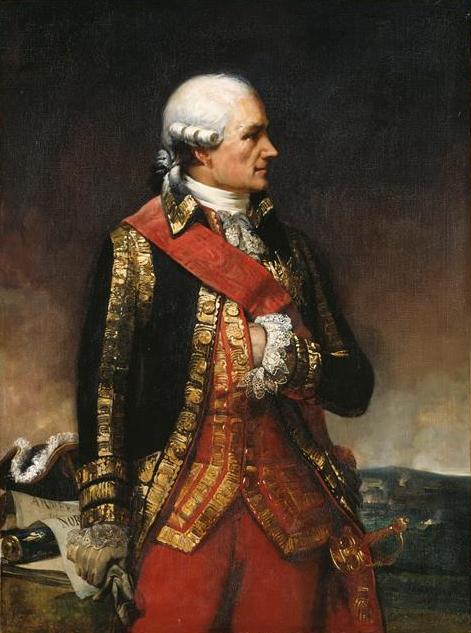
Back in Episode 257, I talked about the arrival of the French Army in America.  General Jean-Baptiste Donatien de Vimeur, comte de Rochambeau, led an army of about 5500 soldiers,   With them were seven ships of the line and five smaller frigates under the command of Admiral Charles-Henri-Louis d'Arsac, chevalier de Ternay.  Upon arrival, much of the army and navy was sick from the journey, and also had to scramble to build a defensible position at Newport Rhode Island.

French Navy in West Indies

The French had come to America with far fewer soldiers than originally planned. There were not enough ships to transport all of the soldiers that Rochambeau expected to bring with him. Rochambeau had to cram his 5500 soldiers onto 36 transports, leaving behind much of his equipment, horses, and another 2500 soldiers.  Those who could not get on the ships remained in Brest, waiting for available transport ships to carry them to America.

Washington & Rochambeau
More importantly, Rochambeau wanted a larger French naval presence to gain superiority of the seas.  As long as the British controlled the water off their coast, the French army was little more than a supplement to the Continentals.

French naval priorities, however, remained elsewhere.  With only seven ships of the line, the French had enough to defend against a British naval attack on Newport, but could not go on the offensive.

Recall that Admiral d’Estaing had commanded a French Fleet in America for two years prior.  Most of it was spent in the West Indies.  Admiral d’Estaing had bailed out of a joint assault on British occupied Newport in 1778 after a storm wrecked most of his fleet.  He then spent months in Boston getting repairs.  After that, his fleet sailed to the West Indies where he failed to prevent the British from capturing St. Lucia.  After receiving more ships under the Comte de Grasse, d’Estaing captured St. Vincent and Grenada.  He then sailed north to Savannah, hoping to assist the Americans in retaking that town from the British.  The attack failed and d’Estaing returned once again to the West Indies.

In March of 1780, d’Estaing returned to France, still recovering from wounds he received at Savannah. Command of the fleet in the West Indies fell to Luc Urbain du Bouëxic, comte de Guichen.  The Admiral was in his late 60s.  I won’t go into his lengthy record, but he was an experienced officer with a long record going back to the War of Austrian Succession and the Seven Years War.  He had been commander of the Channel fleet in 1778 and 1779 before heading to the West Indies with another squadron of ships to reinforce the French presence there.

French and Naval forces near Martinque
In April, shortly after his arrival, Guichen went on the offensive taking a fleet of 23 ships of the line and 3000 soldiers in hopes of capturing British-held Jamaica.  Britain had also recently replaced its commander in the West Indies.  Admiral George Brydges Rodney, who I discussed when he led the relief of Gibraltar back in Episode 243, assumed command.  Admiral Rodney was alerted immediately to the French fleet under Guichen taking to sea, and led his own fleet of 20 ships of the line to intercept them.

On April 17, the two fleets made contact, and spent the first few hours jockeying for position.  Rodney had hoped to take advantage of Guichen’s position which had left the French fleet strung out in a fairly loose formation.  Robert Carkett, the commander of the lead British ship, the Stirling Castle, ignored instructions and simply charged directly at the French fleet.  The British commanders behind him followed.  

Another French officer, the third in command comte de Grasse, managed to get most of the French fleet into a tighter position and fight off the attack.  No ships were lost in the battle, which was considered a draw.  But the French suffered 222 killed and 537 wounded in the fierce fighting that day.  The British suffered 120 killed and 354 wounded.

A month later, the two fleets engaged again over several days between May 15 and May 20th.  The fighting was once-again indecisive.  By July, with hurricane season approaching, Admiral Guichen left the West Indies, taking the bulk of his fleet back to France.  British Admiral Rodney took the bulk of the British fleet up to New York to assist with the effort there.  It’s not clear to me why Guichen did not sail up to Newport to assist Rochambeau, but whatever his motivation, he made no attempt to support the French expeditionary force in New England.  French priorities were in the West Indies.

Settling In

Meanwhile, General Rochambeau had arrived in Newport in July and was desperately short-handed.  His immediate concern had been a British attack just after his arrival.  When the immediate threat of an attack dissipated, the French settled in to await the arrival of their reinforcements and an opportunity to attack.  While the British Navy was unwilling to attack Newport, the British ships of the line remained off the coast, keeping the French Navy bottled up in Newport Harbor.  Rochambeau came to realize that no additional support seemed to be on its way, and had to plan to make due with what he had for the foreseeable future.

French Regulars

The French Army made a good impression on the locals, paying hard money for everything they needed.  A local populace who was used to being looted and robbed by both the enemy and desperate Continentals, was pleasantly surprised by French soldiers who did not steal their chickens or strip their orchards, but rather paid for rations with gold and silver. The French rented buildings, which they repaired at their own expense.  The officers rented rooms in the finest homes in Newport and soon intermingled with local society.

If anything, the French army was even more stratified between nobles and commoners than the British Army.  France required an commissioned officer to have at least four generations of nobility in his family tree.  Even wealthy commoners could not become officers, except through the very rare instance of promotion through the ranks.  The enlisted men came from the poorest of the poor in France.  Even so, the effective military discipline and good provisioning by the quartermaster kept most of Rochambeau’s soldiers from engaging in the looting and theft that plagued most other armies.

Because the British had destroyed many of the homes in Newport, Rochambeau made arrangements to have his soldiers repair and rebuild the homes at French expense.  In compensation, the owners would allow soldiers to live in the homes rent free during the time of the French occupation.  This was a win-win, since it permitted the French soldiers to obtain free housing, while the American owners had their ruined properties restored and would receive them back after the French departed.

The discipline and good behavior of the French army soon won over the locals.  Just to be sure, Rochambeau forbade his army from holding Catholic masses out in public in anti-papist New England, and issued orders that the soldiers should not try to attend Protestant services.

The French also spread out their army, setting soldiers not just in Newport but also in Providence and Popasquash, where they also established hospitals for their sick and wounded.  The illness from the poor food and conditions during the sea voyage continued to take its toll.  About 30 soldiers died of disease during the voyage from France.  Another 18 died in July, in the two weeks after the army landed.  By the end of the year, 265 French soldiers had died from disease, most the result of conditions suffered on the voyage across the Atlantic.

Rochambeau maintained tight discipline.  Not only was the smallest theft punished harshly with floggings, officers were even forbidden from hunting during the harvest period to prevent any potential disruptions.  When officers did go riding,, they were ordered to respect fenced land and remain on public paths.  Soldiers were held in isolated camps and needed a pass to go into town. Even then, they had to be accompanied by a non-commissioned officer who was responsible for their behavior.  Fraternization was so strictly blocked that there are no records of venereal diseases or unexpected pregnancies caused by French soldiers.  

French officers, on the contrary, did mingle with the locals, but still remained on best behavior.  They lived with local families and encouraged social gatherings.  Even so, it appears that Rochambeau’s prohibition on sexual relationships seems to have kept the officers from such attempts.  Even officers who had reputations in Europe both before and after Newport, managed to keep it in their pants while in Rhode Island.  One of Rochambeau’s top officers, the Duc de Biron, had multiple affairs in Europe.  He was billeted with a widow and her three daughters in Newport.  The ladies later noted that they grew quite fond of him, but that he never acted inappropriately, and always  treated them as if they were his own sisters.

There were, of course, some isolated incidents.  A French corporal killed an American in August, and was rather quickly tried and shot by firing squad.

French payment in specie for everything then needed made them even more popular with the locals.  It got to the point where the Continentals had to send aides with French purchasing agents to prevent locals from overcharging them.  The only ones complaining were American purchasing agents who could not compete with the French buyers.

Several dozen French soldiers attempted to desert in 1780 while in Newport.  In hopes of maintaining good relations, the Americans passed laws treating French deserters the same as American deserters, to be returned to their units to face punishment.

As it turned out, it was not the enemy, but boredom that would become the primary concern for Rochambeau’s first year in America.  The Continentals were in no condition to go on the offensive, and the British seemed content to keep the French bottled up in Newport. 

It would be several months before Rochambeau and Washington would even meet.  For most of the spring and summer of 1780, Washington was trying, unsuccessfully, to get Congress to provide him with the men and supplies he needed for an offensive.  Making the five day trip to Newport would have taken Washington out of contact with Congress for several weeks, at a time when negotiations over everything were pretty intense.  Washington also was probably reluctant to meet with Rochambeau and admit that he lacked the men and resources to do much of anything.  

Instead, Washington relied on General Lafayette to serve as a go-between for the two armies. Lafayette used the opportunity to try to get Rochambeau to launch an offensive against New York, with the army that Lafayette had originally hoped to command himself.  In late July, Lafayette wrote to Washington that the French army was eager to go on the offensive, that they “detest even the thought of remaining at Newport, and are burning with the desire of joining you. They curse any one who talks to them of waiting for the second division, and are furious at remaining blockaded here.”

At this same time, Lafayette was pressing Rochambeau to launch an immediate offensive against the British in New York. Rochambeau thought this plan was foolhardy.  He complained to the French Minister Luzerne that Lafayette was trying to dictate an extremely risky strategy, and that although Lafayette was representing General Washington, it was not clear that even Washington approved of Lafayette’s plans.

A frustrated Rochambeau finally wrote a letter to Lafayette essentially saying very nicely that the young and inexperienced officer would not become a successful and experienced officer if he tried to lead an army on a highly risky attack that could result in the destruction of that army.  He indirectly accused Lafayette of trying to satisfy his personal ambition by putting the lives of French soldiers at great risk.  Lafayette could have taken great offense at the letter, but decided to back off and accept General Rochambeau’s experience-backed advice.  

From Rochambeau’s perspective though, he had landed in a strange country, had his small navy bottled up and unable to move, had a third of his army still in France awaiting transport, had not yet even met the American commander after nearly two months in America, and was getting all of strategic advice from Lafayette, an officer with almost no experience and still in his early 20’s.  No experienced officer in his right mind would launch an offensive against a superior enemy in those circumstances.  Certainly, before anything could happen, Rochambeau needed to meet and confer with General Washington in person.

It did not help when word reached both Rochambeau and Washington that the Americans suffered the loss of a Continental Army in the south, this time under General Gates at Camden. This further threatened the American claims of independence in the southern states, and put even greater demands on Washington to send a third army to the south.  Doing so would mean his depleted army in the north would get even smaller.  Also news that the French General de Kalb, who had joined the Continental Army, was killed in the battle at Camden.  That certainly did nothing to inspire the French. 

Hartford Conference

By September, Rochambeau had been in Newport for nearly two months and still had not met with Washington.  He was fed up with communicating through Lafayette, who Rochambeau still thought was trying to set his own agenda.  Washington finally agreed to meet with Rochambeau in Hartford, Connecticut, about half-way between the French and Continental camps.

French & American Troops at Hartford
As I said, Washington had been reluctant to meet because he was focused on building up his own army after its decimation during the previous winter at Morristown.  He only had a few thousand Continentals under arms.  Most of his attention over the summer was writing to Congress and to various state leaders trying to impress upon them  how important it was to send him soldiers and supplies so that he could make use of the newly arrived French Army to launch an offensive.  Until the Continental army reached a respectable size, Washington would not be able to convince the French to join him on any offensive.

Washington’s headquarters at Morristown was a five day ride from Newport.  The American commander had no time to travel that distance, spend time conferring with the French commander, then returning to New Jersey, all during the summer fighting season when the British might launch another attack from New York against his tiny army.

Finally, by September, Washington decided he could no longer put off a meeting with Rochambeau.  The two leaders agreed to meet at a half-way point, in Hartford, Connecticut, about a two and a half day’s ride for each group.

Traveling with Washington to Hartford was General Henry Knox, his chief of artillery, Lt. Colonel Jean Baptist de Gouvion, an French officer who had become Washington’s chief of engineers, and of course General Lafayette.  Also attending were several of Washington’s aides, including Colonel Alexander Hamilton.

General Rochambeau brought Admiral Ternay, several of his other top generals, and his son, the Vicomte de Rochambeau.  The conference had been scheduled for September 20th, but the French delegation was late due to their coach breaking an axle during the trip.  

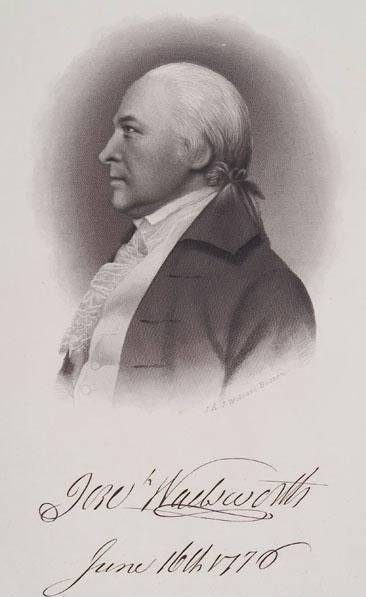
Jeremiah Wadsworth
The leaders met at the home of Jeremiah Wadsworth.  He was a Hartford merchant who had been a commissary officer with the Continental Army.  He was a friend of General Nathanael Greene, and was also now serving as a local commissary for the French Army.

The leaders finally sat down together on September 21st to discuss strategy.  Washington was in the embarrassing position of not even knowing exactly how many soldiers he commanded at the moment, as the number was always changing.  He also noted that a large portion of his army would have its enlistments expire at the end of the year.  Even so, he managed to make a positive personal impression on the French officers.

Rochambeau was still awaiting the second half of his expeditionary force to arrive.  Ternay’s naval fleet was still blockaded in Newport Harbor.  They hoped, in vain, that naval reinforcements under Admiral de Grasse might sail up from the West Indies.  Until more French ships and soldiers arrived, the generals agreed they did not have enough resources to launch a successful attack on New York City.  The two leaders agreed that they would need a combined army of 30,000 as well as naval superiority before they could consider such an attack.  

At the time, it was not clear when, if ever, they would have those numbers.  The entire Continental and French expeditionary army in America probably did not total 10,000 soldiers combined.  The only thing that was clear was that there would not be a decisive battle in 1780.  The armies would have to go into winter quarters.  Washington would spend the winter in New Jersey, again.  Rochambeau and his army would spend the winter in Newport.

All Washington could do was ask Rochambeau to pass along more requests for more French soldiers and ships, and also to see if France could spare more money to help the Continentals to keep going.  Hopefully France would fulfill those requests in time for the beginning of the fighting season in the spring of 1781.

After two days of meetings, the leaders agreed that New York City should remain their goal, but at present they could do nothing. Rochambeau would send his son back to Versailles to beg for more money and supplies.  Traveling with Rochambeau’s son would be Colonel John Laurens who had recently been released from parole after his capture at Charleston. Washington would continue to beg Congress to come up with the resources that he needed.

The meeting wrapped up rather quickly after word arrived that the British fleet under Admiral Romney had arrived in New York with thirteen additional ships of the line.  Rochambeau, concerned that this would mean a British attack on Newport was once again imminent, wanted to get back to his army as quickly as possible.

On September 23rd, the two delegations returned to their camps.  Rochambeau would end up spending an entire year in Newport, with pretty much nothing to do.  Washington headed back to New Jersey, stopping in West Point along the way to meet with General Benedict Arnold.  When he arrived, Arnold was nowhere to be found.  But the reason for Arnold’s absence will have to wait for next time.

Next time: General Arnold decides to trade in his blue uniform for a red one.

- - -

Next Episode 264 Arnold Commits treason (Available January 22, 2023)


 Contact me via email at mtroy.history@gmail.com

 Follow the podcast on Twitter @AmRevPodcast

 Join the Facebook group, American Revolution   Podcast: https://www.facebook.com/groups/132651894048271

 Join American Revolution Podcast on Quora 


American Revolution Podcast Merch!

T-shirts, hoodies, mugs, pillows, totes, notebooks, wall art, and more.  Get your favorite American Revolution logo today.  Help support this podcast.  http://tee.pub/lic/AmRevPodcast


American Revolution Podcast is distributed 100% free of charge. If you can chip in to help defray my costs, I'd appreciate whatever you can give.  Make a one time donation through my PayPal account. You may also donate via Venmo (@Michael-Troy-20), Zelle, or popmoney (send to mtroy1@yahoo.com)


Click here to see my Patreon Page
You can support the American Revolution Podcast as a Patreon subscriber.  This is an option making monthly pledges.  Patreon support will give you access to Podcast extras and help make the podcast a sustainable project.

An alternative to Patreon is SubscribeStar.  For anyone who has problems with Patreon, you can get the same benefits by subscribing at SubscribeStar.

Help Support this podcast on "BuyMeACoffee.com"


Visit the American Revolution Podcast Bookshop.  Support local bookstores and this podcast!


Signup for the AmRev Podcast Mail List

* indicates required

Further Reading

Websites

“Conference at Hartford, [22 September 1780],” Founders Online, National Archives, https://founders.archives.gov/documents/Hamilton/01-02-02-0866

“Conference at Hartford: George Washington’s Answers to Queries by the Comte de Rochambeau and the Chevalier de Ternay, [22 September 1780],” Founders Online, National Archives, https://founders.archives.gov/documents/Hamilton/01-02-02-0865

Letter from Rochambeau to Lafayette: https://docs.google.com/document/d/1r3IncAiPsTt5PkUje9PImIQFHlrOCUK_bhoJDpczseA

Free eBooks
(from archive.org unless noted)

Balch, Thomas The French in America During the War of Independence of the United States 1777-1783, Philadelphia: Porter & Coates, 1891. 

Lomask, Milton Rochambeau and Our French Allies, New York, P.J. Kenedy, 1965 (borrow only) 

Rice, Howard C. (ed) The American Campaigns of Rochambeau's Army, 1780, 1781, 1782, 1783, Princeton University Press, 1972 (borrow only) 

Winfield, Charles “The Affair at Block House Point, 1780” The Magazine of American History, Vol 5, pp. 161-186 (Google Books) 

Wright, M. W. E. “What France Did for America: Memoirs of Rochambeau” The North American Review Part 1 May 1, 1917 , Part 2, June 1, 1917   & Part 3,  July 1, 1917 

Books Worth Buying
(links to Amazon.com unless otherwise noted)*

Ferreiro, Larrie D. Brothers At Arms : American independence and the Men of France and Spain Who Saved It, Alfred A. Knopf, 2016  (borrow on Archive.org

Kennett, Lee The French Forces in America, 1780-1783, Praeger, 1977. 

Scott, Samuel F. From Yorktown to Valmy: The Transformation of the French Army in an Age of Revolution, Univ. Press of Colo. 1998 (borrow on archive.org). 

Vail, Jini Jones Rochambeau: Washington’s Ideal Lieutenant, Word Association Publishers, 2020.

Weelen, Jean E. Rochambeau, Father and Son, H. Holt and Company, 1936 (reprint 2016) (borrow on Archive.org). 

Whitridge, Arnold Rochambeau: America’s Neglected Founding Father, Macmillan, 1965.  (borrow on Archive.org

* As an Amazon Associate I earn from qualifying purchases.