Showing posts with label 1770. Show all posts

Sunday, March 4, 2018

Episode 034: Massacre Fallout, Townshend Repealed


I ended last week with British Regulars having opened fire on a crowd leaving five colonists dead or dying.  The small squad of soldiers then hurried back to their barrack to await the consequences.

Soldiers Leave Boston

As soon the threat of continued imminent violence ended, officials moved to arrest those responsible.  By 2 AM that night, the Sheriff had arrested Captain Preston.  He arrested the other soldiers the following morning.

On the morning of March 6, 1770 about 3500 Bostonians met at Faneuil Hall to discuss the next steps.  A group of radical leaders, including Samuel Adams and John Hancock, met with Gov. Hutchinson to demand the removal of all soldiers from Boston.  Hutchinson did not want to remove the soldiers and leave Boston in the hands of mob rule.  At the same time, he did not want to be the one responsible for keeping the standing army in town.  Hutchinson simply punted, saying he had no authority to order the troops anywhere.

Col. Dalrymple, the military commander in Boston, offered to remove the entire 29th Regiment to Castle William, the island out in the harbor.  On this, Adams pounced, saying if he had authority to order one regiment out of town, he also had the authority to order both of them out.

Dalrymple, however, did not want to take sole responsibility for removing all troops from Boston.  He demanded that the Governor at least provide him with a written request to remove the troops.  Eventually, Hutchinson submitted the request.  All British troops in Boston moved out to the Castle Island.

Gen. Gage, still in New York, tried to prevent the evacuation.  But due to the days it took for communications, the troops had moved before he could rescind the order.  Once complete, Gage decided trying to return the troops would only cause more problems.  In May, the 29th Regiment, which included the men responsible for the Massacre left Boston to a new post in New Jersey.  Of course, Captain Preston and the eight accused soldiers remained behind in a Boston jail awaiting trial.

The PR Campaign

Almost immediately after the shooting, both loyalists and patriots began trying to spin events in their favor.  Both sides immediately accused the other of an organized conspiracy - either a loyalist conspiracy to cow the radicals into submission by killing a few of them - or a patriot conspiracy to provoke a shooting in order to get rid of the soldiers.

The Boston Gazette published this
image representing the four victims
who were killed.  A fifth died a week
later.  (from Crispus Attucks Museum)
Loyalists portrayed the soldiers as defending their lives against an out of control mob.  Patriots portrayed the soldiers as wantonly shooting down innocent civilian engaged in simple protest of military occupation.  The Patriots also tried to bring the customs officials into it by claiming several shots came from windows in the Customs House, though there has never been any good evidence of that.  Paul Revere produced a famous engraving, published in papers throughout the colonies, showing the soldiers mowing down innocent civilians in volley fire.

Both sides also took depositions.  A town committee  headed by Samuel Adams, John Hancock William Molineaux and Joseph Warren sent witness accounts to former governor Thomas Pownall, now sitting in Parliament.  The Tory’s side, however, arrived first in London.  Customs Commissioner John Robinson boarded a ship for London on March 11.  He carried with him a series of military depositions and other information blaming the incident on the radicals.  In London someone published the accounts as a pamphlet.  In response the Patriots had their version and depositions published in London in another pamphlet.

The Patriots made the most of the funeral of the four dead (a fifth would die a few days later).  Estimates of the parade of mourners were 10 to 12 thousand, not bad for a town with a population of 16,000.   Samuel Adams and others spoke of the martyred victims and the ongoing struggle against British tyranny.  The anniversary of the massacre would continue as a public event with similar speeches until the outbreak of war.

The Trials

In addition to indicting Captain Preston and the eight soldiers present at the massacre, a grand jury indicted four civilians in the customs house, accusing them of firing from the windows.  Shortly after the indictments, the prosecutor, the Colony’s Attorney General, simply left town.  Apparently, he had Tory leanings and had little desire to prosecute the case against the soldiers.  This began a series of delaying actions, where judges also began leaving town or having illnesses or injuries that delayed trial.  As spring turned into summer and then fall, radicals grew frustrated at the delays.  Many of the witnesses were sailors who could not remain in port for months at a time waiting for a trial that seemed to take forever to get underway.

Samuel Quincy, Solicitor General for the colony, became the new prosecutor.  Despite most of the Quincy family supporting the Patriot cause, Samuel was a loyalist who supported the government.

Samuel Quincy
(from Museum of Fine Arts, Boston)
Given his limited experience as a criminal prosecutor, Quincy brought in Robert Treat Paine as senior counsel for the prosecution. Paine, had a better reputation as a Patriot and would ensure a zealous prosecution.  Paine would also go on to play a more significant role in the patriot cause during the war.

Finally, on September 7th, Preston and his men were arraigned, entering pleas of “not guilty”.  Then came another delay.  On the day following the arraignments, the Court suddenly and without explanation adjourned until the end of October.  Both sides opposed this.  The Radicals had been fighting delays for months.  Hutchinson and the Loyalists believed that tempers had cooled as much as they were going to, and wanted time to send a pardon request after the trial before the winter weather stopped all shipping traffic to London.

Robert Auchmuty served as senior counsel for the defendants.  Auchmuty served as a judge on the Vice Admiralty Court.  He knew though that any chance of winning required some attorneys who had some credibility with the people of Boston.  He reached out to John Adams and Josiah Quincy, Samuel’s brother, to represent the accused soldiers.  Some may find it surprising that two ardent patriots would defend the alleged murderers of their fellow Boston Patriots.  Years later, Adams would say he simply wanted them to have a fair trial, and that politics should not enter into that.  Quincy, however, admitted speaking with key Patriot leaders, including Hancock, Molineaux, and Warren, before taking the clients.  Clearly neither of them was defying the Patriot leadership in defending the soldiers.

Robert Auchmuty
(from museums.fivecolleges.edu)
I have mentioned John Adams a few times now, and clearly he goes on to bigger things later in the Revolution.  But a brief background might be helpful here.  John Adams was a second cousin of Samuel Adams.  The two got along well, but were not particularly close growing up.  They did not have a strong familial bond.  John lived outside of Boston in Braintree.  As a lawyer, he found himself in Boston on a regular basis.  He associated and clearly seemed to align himself with the radicals.  But he did not attend most of the political rallies or events of the time.  He had represented clients in some high profile trials, including his defense of Michael Corbett for murder of the press gang officer two years earlier (see, Episode 30).

Despite his patriot leanings, Adams considered himself a lawyer first.  He threw himself into the defense with all the zeal of a good defense counsel.

As Chief Justice of the Massachusetts Superior Court, Gov. Hutchinson could have presided over the trial. He had no intention though, of going anywhere near that political mess.  Four other judges would preside.

Trial of Captain Preston

First, the defense moved to separate the trial of Captain Preston from those of the other soldiers.  Preston’s defense relied on the argument that he had not ordered the men to fire.  The defense of the soldiers was that they obeyed Preston’s command to fire.  Clearly the two defenses were not compatible.  Today legal ethics would prevent the same lawyer from representing both parties.  But colonial standards were not as strict.  Adams and Quincy represented both parties, but did succeed in getting their trials separated.

At trial, the defense challenged the wording of the indictments (overruled) and the selection of the jury.  They effectively used the jury selection to empanel a jury that had at least some very pro-soldier jurors, ensuring a unanimous conviction virtually impossible from the beginning.

Trials in this era rarely lasted for more than a day.  This trial became a rare exception, mostly because of the number of witnesses.  There was no system for sequestering juries

The prosecution presented 15 witnesses over two days.  They gave conflicting testimony about whether Preston ordered the men to fire.  Some were sure of it, others not so much.  Others admitted they heard people in the crowd shouting “fire.”  Many witnesses indicated Preston was standing in front of the soldiers, which is not where you want to be when ordering your men to fire.

The defense produced even more witnesses, including one who had been standing next to Preston during the events in question.  He testified that he never heard Preston order the soldiers to fire and saw Preston try to stop the firing by hitting the barrels of the soldiers’ muskets.  Preston himself could not testify according to the criminal rules of evidence at the time.

Finally, closing arguments finished around 5 PM on October 29.  The jury reached a verdict several hours later, but the court did not reconvene until 8AM the next day to hear the verdict: not guilty.  Once released, Preston quickly fled to Castle Island to avoid any potential lynching or other mob violence.  Soon thereafter, he resigned his commission and settled in Ireland.

Trial of the Soldiers

Robert Auchmuty declined to participate in the second trial, making John Adams the lead counsel.  He and Josiah Quincy brought in Sampson Salter Blowers, a young attorney with loyalist leanings, to round out the defense team. Blowers and Quincy were classmates at Harvard and had worked together a few months earlier on the defense of Ebenezer Richardson for the murder of Christopher Seider.  Samuel Quincy and Robert Treat Paine, continued to handle the prosecution.
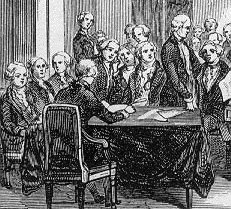
Trial of Soldiers (artist's conception)
(from famous trials)
The case against the soldiers was a little trickier.  Typically, a group of men acting in concert are all criminally liable for any crimes committed.  However, that is only the case if the group is acting as an illegal conspiracy.  The soldiers were not acting illegally when standing on the street as ordered.  Therefore, they could only be held accountable for their individual actions.  It was nearly impossible for the prosecution to establish which soldier shot which victim.  Of course, there was no scientific evidence at that time that could match a bullet to a particular weapon.  Therefore the prosecution had to rely on eyewitness testimony that could establish a particular shot killing a particular victim.

The other legal question to answer was whether the soldiers fired out of self-defense, in other words, an immediate fear for their lives.  In such a case, they would be not guilty.  Another possibility was a finding that they fired after being attacked but not in immediate danger of death.  In that case, they would be guilty of manslaughter rather than murder. Finally, if they fired out of malice, the could be found guilty of murder.  Since the traditional penalty for both murder and manslaughter was death, it might appear not to make much difference.  But manslaughter could result in a lesser sentence in most cases.

Following Preston’s acquittal on October 30, the court adjourned yet again, leaving the soldiers to sit in jail for another month.  Finally on November 20, the court reconvened with the same four judge panel who had heard the Preston trial.  Again, both sides fought over the jury.  In the end, all twelve jurors came from outside Boston.

Opening arguments began on November. 27.  Like the Preston trial, the large number of witnesses meant that the trial would last far longer than one day.  Dozens of witnesses took weeks to testify.  The prosecution made every effort to provide witness testimony to specific soldiers firing.  The defense made the most of the confused and often contradictory testimony.  It also painted the mob as a dangerous threat to the soldiers.  Adams called them “a motley rabble of saucy boys, negroes, and mulattoes, Irish teagues and outlandish jack tars.”  In his closing argument, Adams famously told the jury “Facts are stubborn things; and whatever may be our wishes, our inclinations, or the dictates of our passions, they cannot alter the state of facts and evidence.”  Even though the jury might not like the soldiers, it could not ignore the fact that the men were under attack.
In the end, the jury found two soldiers, Privates Kilroy and Montgomery, guilty of manslaughter rather than murder.  In both cases the jury found compelling eyewitness testimony that both men fired their guns into the crowd, killing victims.  The jury found the other six soldiers not guilty, with lack of credible proof that they had even fired their guns.

The court gave Kilroy and Montgomery the benefit of clergy - a legal term to avoid the death penalty.  Instead the court ordered their thumbs branded as punishment.  The six soldiers found not guilty rejoined their regiment in New Jersey.  It appears that Kilroy and Montgomery also rejoined their unit, though it is possible they were assigned to another unit.  Both men appeared before a British Pension Board in 1776 seeking to be discharged.

Trial of the Customs Officials

The court impaneled the same jury for the soldiers to sit again in December to hear the charges against the four civilians in the customs house.  The witnesses in this case proved rather weak and pathetic.  The jury did not even leave to deliberate after the close of arguments before delivering a verdict of “not guilty.”  The court ordered the arrest of one of the prosecution’s witnesses, a 14 year old boy named Charles Bourgate arrested for perjury.  A court later convicted him and sentenced the boy to 25 lashes.

Parliament Repeals Townshend Duties (mostly)

Even before word of the Boston Massacre reached London, Lord North began pushing through Parliament a partial repeal of the Townshend duties.

North rejected proposals for a full repeal.  He believed that backing down would not solve anything.  During the 1769 debates on repeal, North allegedly said “America must fear you before she can love you …. I will never think of repealing it until I see America prostrate at my feet.”  Clearly he fell into the camp that required Parliament establish its dominance over the colonies before they could reach any resolution.

Lord North
(from Wikimedia)
For this reason, North adamantly opposed a full repeal.  He did, however, agree that the tax on manufactured goods, made little sense.  Over the three years the Townshend Acts had been in force, the total duties collected among all colonies on manufactured goods was less than £5000.  By comparison, the tea taxes had raised over £16,000.  That was true even though British tea imports to the colonies fell to less than half of what they were prior to the implementation of the Townshend Acts.

If a partial repeal could break the already wavering resolve on colonial nonimportation agreements, revenues overall would likely increase.  Britain benefited by promoting export of manufactured goods.  It created jobs in England and produced local revenue that was subject to taxation.

At the same time, North insisted on maintaining the tea tax.  This was the largest revenue producer by far of all the taxes.  It was not a locally manufactured good.  Most importantly, it would force the colonists once and for all to accept that they were subject to taxation.  Parliament had to establish that precedent through an actual tax, not some vague declaration of its authority.

As with many such proposals, members of Parliament attacked North’s proposal from both sides.  Radical Whigs like Isaac BarrĂ© and Henry Conway still called for full repeal.  Thomas Pownall, former Governor of Massachusetts and now member of Parliament also joined them in calling for full repeal.  On the other side Welbore Ellis, a member of the Grenville faction, argued that there should be no repeal of anything.  Regardless of any financial issues, any repeal would only show weakness to colonial temper tantrums.

Pownall offered an amendment to North’s bill, essentially making it a full repeal.  Parliament rejected that 204 to 142.  After that vote, North’s bill sailed through the Houses of Commons and Lords with voice votes.  The partial repeal became law on April 12, 1770.

Colonists End Non-Importation Agreements (mostly)

Word of North’s repeal had its intended effect in America.  Non-importation agreements had already faltered. Radical patriots still wanted complete non-importation of anything until all Townshend duties, and in some cases all duties including older sugar act and others, were repealed.

The problem was that these non-importation agreements affected different regions differently.  New England made up much of its trade through smuggled goods, which could continue despite non-importation agreements.  Many of the southern colonies were cheating on the agreements so much that they were not feeling much pain.  New York, however, had seen a massive drop in imports as a result of the agreements, now in their third year.

New York merchants sent around a circular letter calling for the agreements to be revised, so that they would only refuse to import items that were being taxed, at this point, primarily tea and sugar.  When other colonies rejected this change, New York decided in July 1770 to amend their own agreements anyway.  Over the next few months, Philadelphia, Boston, Baltimore, and others made similar revisions.  After all, if New York would import these items, merchants in other colonies could not be put at a disadvantage.  With the agreements collapsing, it appeared as if North’s gambit had been a success.  Yes, the colonists would still refuse to drink tea, but that would not impact any businesses in England, other than the East India Company.  Atlantic trade could get back to normal.

To ease tensions even further, North allowed the Quartering Act, which had to be reauthorized every year, to expire in 1770.  That was one less thing to remain a sticking point between Britain and her colonies.  North was well on his way to returning things to calm, normal, and profitable trade.

The radicals tried to point out that accepting these small taxes would set a precedent that meant Britain might levy greater taxes later.  But others argued that the colonies were still boycotting the taxed items.  They just didn’t want to continue boycotting everything they needed from Britain, whether it was taxed or not.

Through much of 1771 and 1772, things seemed to return to normal.  Governors once again allowed colonial legislatures to meet.  The fact that Massachusetts Assembly had to meet in Cambridge rather than Boston still irked the radicals, but it was not exactly a rallying point to set the colony aflame.  Peace returned, the economy improved and everyone seemed to relax.  It short, it looked like North’s strategy was succeeding.

Next week, We will look at regulator movements in the Carolinas as colonists along the western frontier fight for their rights.

Next Episode 35: Carolina Regulators and the Battle of Alamance

Previous Episode 33: The Boston Massacre

Visit the American Revolution Podcast (https://amrev.podbean.com) for free downloads of all podcast episodes.

Further Reading:

Web Sites

The Boston Massacre Trials: http://www.john-adams-heritage.com/boston-massacre-trials
Boston Massacre Trial Resources: http://www.bostonmassacre.net/trial/index.htm

Boston Massacre Trial: http://law2.umkc.edu/faculty/projects/ftrials/bostonmassacre/bostonmassacre.html

Boston Massacre Trials: http://www.famous-trials.com/massacre/196-home

The Adams Papers: http://founders.archives.gov/search/Project%3A%22Adams%20Papers%22

What happened to Privates Montgomery and Kilroy?  http://boston1775.blogspot.com/2013/03/don-hagist-on-pvts-montgomery-and-kilroy.html

Free eBooks
(from archive.org unless noted)

The trial of the British soldiers of the 29th regiment of foot, (1824) (detailed trial notes of the Boston Massacre Trials).

The trial of the British soldiers, of the 29th regiment of foot, (1807) (different version of Boston Massacre Trial notes).

A Fair account of the late unhappy disturbance at Boston in New England, London: B. White, 1770 Loyalist account of the Boston Massacre, written in the days following the event.

Boston Registry Dept. Records Relating to the Early History of Boston, Vol.  18, Boston: Rockwell and Churchill, 1887.

Orations, delivered at the request of the inhabitants of the town of Boston, to commemorate the evening of the fifth of March, 1770, Boston: Wm. T. Clapp, 1807 (collection of annual speeches remembering the Massacre on its Anniversary, 1771-1783)

Bowdoin, James; Warren, Joseph; & Pemberton, Samuel A Short Narrative of the Horrid Massacre in Boston, New York: John Doggett, Jr., 1849 (this is a reprint of the original 1770 pamphlet produced in London by Patriot citizens of Boston).

Chandler, Peleg W. American criminal trials, Vol. 1, Boston: Charles Little & James Brown, 1844 (Boston Massacre Trials).

Cushing, Harry (ed) The Writings of Samuel Adams, Vol. 2, New York: GP Putnam's Sons, 1906.

Hosmer, James Samuel Adams, Boston: Houghton-Mifflin Co. 1913.

Hutchinson, Thomas & Hutchinson, John (ed) The History of the Province of Massachusetts Bay, from 1749 to 1774,  London: John Murray 1828 (This book was edited and published using Gov. Thomas Hutchinson’s personal papers.  The editor was his grandson).

Hutchinson, Thomas & Hutchinson, Peter Orlando (ed) The Diary and Letters of His Excellency Thomas Hutchinson, Boston: Houghton-Mifflin Co. 1884 (Editor is Thomas Hutchinson’s great-grandson).

Kidder, Frederic History of the Boston Massacre, March 5, 1770, Albany: Joel Munsell, 1870.

Miller, John Origins of the American Revolution, Stanford, Stanford University Press 1943 (Based on date, I am not sure about the copyright status of this book.  Since it may get pulled, I have also included a link to Amazon below).

Books Worth Buying

(links to Amazon.com unless otherwise noted)*

Archer, Richard As If an Enemy's Country: The British Occupation of Boston and the Origins of Revolution, Oxford: Oxford  University Press 2010.

Fowler, William The Baron of Beacon Hill: A Biography of John Hancock, Boston: Houghton Mifflin Co. 1980.

Galvin, John Three Men of Boston, Potomac Books, 1976.

Knollenberg, Bernhard Growth of the American Revolution 1766-1775,  Indianapolis: Liberty Fund 1975.

Miller, John Origins of the American Revolution, Stanford, Stanford University Press (1943) (also available as a free eBook, see above).

Smith, Page A New Age Now Begins, Vol. 1, New York: McGraw-Hill 1976.

Zobel, Hiller The Boston Massacre, New York: WW Norton & Co. 1970.


* (Book links to Amazon.com are for convenience.  They are not an endorsement of Amazon, nor does this site receive any compensation for any links). 

Sunday, February 25, 2018

Episode 033: The Boston Massacre


Despite the ongoing street riots in various colonies during 1768 and 1769, no one had been killed as a result.  In 1770, that would change.

The Death of Christopher Seider

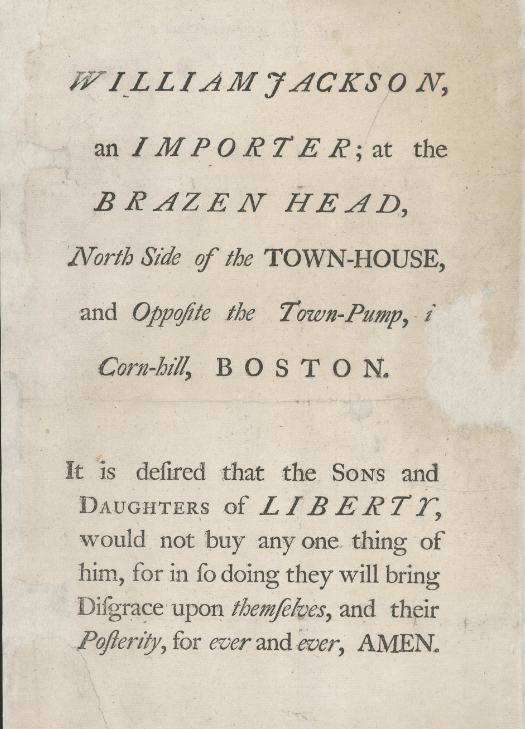
By the end of 1769, merchants began to waver in their resolve of the non-importation agreements.  These were the agreements to to protest the Townshend acts, which had been in place for two years.  The agreements were hurting merchants in Britain, but they were also hurting the colonials.  Some had always cheated, and some loyalist merchants had refused to participate.  As a result, the cheats and loyalists were benefiting at the expense of patriot merchants who upheld the agreements.  Eventually, more and more merchants would have to give up their resolve and resume trade.

Broadside attacking a Boston merchant for
violating the non-importation agreement
(from Mass. Historical Society)
For the radicals, the only answer was to coerce the merchants into continuing the agreements.  Many agreements were due to expire at the end of 1769.  Most merchants opposed an extension.  Samuel Adams and other radicals used public shaming and threats of mob action to compel most of the merchants to remain on board.

Eight prominent Boston merchants, however, refused to sign any extension.  The eight holdouts found themselves named as traitors in a broadside published all over town.  One tactic the Sons of Liberty used was to post signs in front of the stores that had refused, in order to keep customers away.  On February 22, 1770 a group of boys posted a sign in front of one of the holdouts’ store.  Another man, Ebenezer Richardson attempted to run over the sign with a horse and carriage he had borrowed.

Richardson already had a bad reputation.  He had been a customs informer and was now working for the Customs Board.  Many thought he had been the informant on Daniel Malcom that I discussed in Episode 25. Richardson immediately found himself a target as the boys pelted him with rocks and chased him into his house.  They continued to throw rocks, smashing his windows and hitting people inside.  The size of the mob increased as men joined the mob, threatening to kill Richardson.

Richard showed his face several times, threatening the growing mob.  But that only seemed to enrage the mob even more.  At some point, Richardson decided it was a good idea fire a musket full of bird shot into the assembled crowd in front of his home.  His shot, and wounded two young boys.  One of them, Christopher Seider (sometimes reported as Snider), a boy about 11 or 12 years old, died from his wounds later that evening.  Some historians argue that Seider should be considered the first casualty of the American Revolution.

Sketch of Richardson firing from his house into the
crowd, killing Seider (from Boston 1775)
After the shot fire, the crowd stormed his house and captured everyone inside.  Amazingly, the crowd did not kill Richardson.  Some tried to lynch him, but the mob leaders convinced them otherwise.  Instead, they took him to the sheriff’s office, where he was charged with murder.  Several months later, a Boston court convicted him and sentenced him to death.  Richardson languished in jail for a year as London considered a royal pardon.  There really was not much doubt that he would get one, but the bureaucratic delays and the slow pace of transatlantic communications stretched out the proceedings.  Hutchinson announced the pardon only after freeing Richardson and giving him a chance to get out of town before the mob came after him.  Richardson at first fled to Philadelphia where he continued to work for the Customs Board.  Soon though, he appears to have had to leave the colonies altogether.

The death of a child only made the situation worse.  Christopher Seider’s funeral on February 26 drew thousands of mourners.  It soon turned into a rally where Samuel Adams and others spoke to the crowds about British tyranny and the occupation by British Regulars.

Boston Fights with the Soldiers

This may be a good time to address the question, what the heck were the soldiers doing?  Weren’t they supposed to be in Boston to maintain law and order?  Why were mobs of thousands roaming the streets without military opposition?

Although soldiers were in Boston, they did not do law enforcement unless the Governor requested their help.  Like his predecessor, Gov. Hutchinson feared the consequences of calling on the army to do anything.  Even as his two sons, who were tea importers, suffered ruthless harassment throughout 1769, he knew that calling in soldiers would only enrage the people and probably lead to a mob trashing his house again, or perhaps worse.

The soldiers maintained a guard on the customs house.  As we saw with the George Gailer tar and feather incident a couple of weeks ago, the soldiers did not get involved in violence even when it happened right in front of them.

Town of Boston, 1770s (from Wikimedia)
The soldiers had a few other stations around town, including a check point at Boston neck.  At that time, the neck was the only land that allowed people to pass in and out of Boston to the rest of the colony.  The Boston we know today looks very different as engineering projects filled in much of the water and swamp land that surrounded Boston in the colonial era.

The townspeople did their best to make the soldiers feel unwelcome, but typically limited attacks to name calling, or other minor incidences.  There are a few reports of fights between off duty soldiers and locals.  Newspapers exploited every minor incident they could find.  One example from July 19, 1769 when a soldier named John Riley was being taunted by the local butcher.  Riley knocked the man down.  The butcher complained to to commanding officer who said he was glad Riley had taught him a lesson.  The butcher then had Riley arrested, after which he was convicted of assault and fined.  Riley then refused to pay the fine and attacked a constable who tried to arrest him.

Bostonians resented the British occupation for a whole range of reasons I already discussed.  These included having to pay for the soldiers’ living costs and their use in enforcing the hated customs laws.

Beyond those reasons, there were the inevitable disputes related to almost any military occupation.  Within weeks of arriving in Boston, dozens of soldiers deserted their posts and left to start a new life in the colonies.  As a result, a big part of military duties involved posting guards to keep deserters from leaving Boston, and sending search parties into the countryside looking for deserters.

Of course, Bostonians did not like being stopped at military checkpoints all the time.  After dark, drunken Bostonians, at times, assaulted guards at checkpoints.  Similarly, many civilians filed complaints over overzealous guards who threatened or assaulted them.

Boston had its own civilian night watch.  Night watchmen stopped anyone on the streets after dark.  British officers and soldiers took offense at being stopped by civilians to answer their questions.  Military protests that their people were above the law and did not have to answer to civilian law enforcement remained a continuing source of tension at night.  Both night watchmen and soldiers were attacked and beaten on multiple occasions.

Soldiers tend to be young single men, who get into trouble with drinking and womanizing.  Drunk soldiers frequently got into brawls with civilians in taverns.  Soldiers would also hit on local women, or just make lewd comments at them.  This also led to fights as local pounced to defend the honor of their women.  There is one account of drunk officers encouraging slaves to rise up against their masters, telling them that the soldiers were there to bring them freedom if they would only fight for it.  Encouraging slave insurrection, was of course a serious crime.  So this incident got a fair amount of attention at the time.  It’s not so much remembered now as later generations wanted to forget about Massachusetts’ history of slavery.

There were also accounts of soldiers committing petty crimes, burglarizing homes, stealing property at checkpoints, and other minor matters.  Newspapers even reported an attempted rape, although this does not seem to be true.

Even when soldiers were doing their duty properly, they still managed to annoy the locals.  Many complained about interruption of church services on Sunday as soldiers shouted out orders on the streets outside.

At the same time, civilians regularly picked fights with the soldiers, levied numerous complaints about exaggerated or even clearly invented wrongdoing.  Soldiers on or off duty were regularly taunted.  Children would often throw rocks or snowballs at soldiers and then run away.

Col. Dalrymple, commander of British troops in Boston put it this way: “I don’t suppose my Men are without fault, but twenty of them have been knocked down in the Streets and got up and scratched their heads and run to their Barracks and no more has been heard of it whereas if one of the Inhabitants meets with no more than a Kick for an Insult to a Soldier, the Town is immediately in an Alarm and not one word the Soldier says in his justification can gain any credence.

Both sides developed a bunker mentality.  Complaints against soldiers often went ignored or received extremely minor punishment.  Similarly, legal actions in local courts by soldiers against civilians who wronged them, regularly found their cases dismissed, or summary findings for the defendant.  Both sides came to realize that legal remedies were impossible.  Only street justice would provide satisfaction for wrongs.

Workmen though, had yet another reason to dislike the soldiers.  Many of the poorly paid soldiers took odd jobs while off duty.  They were willing to work for lower rates, thus reducing wages for all laborers.  So the competition for jobs increased rivalries and friction between soldiers and civilians.

The same week as Christopher Seider’s funeral on Feb. 22, Boston newspapers reported accounts of the Battle of Golden Hill in New York.  This news only served to increas tensions on both sides.  Everyone remained on edge, looking for a fight.

Rumbles with the Regulars

On March 2, Private Thomas Walker, a British regular walked down the street past John Gray’s Ropewalk, a rope making enterprise.  A rope maker named William Green called out to Walker, asking if he wanted to work.  Walker responded yes, to which Green retorted “then go and clean my shit house.”  The exact wording of the retort is a matter of dispute, but it clearly angered Walker.

Exactly what happened next is also a matter of dispute.  Walker claims that the workmen then jumped him and beat him up unprovoked.  Green claimed that Walker came over and struck him, resulting in the fight that left Walker badly beaten.  He also claimed Walker dropped a sword during the fight, which he kept.

A short time later Walker returned with 30 or 40 soldiers from his regiment, and called out Green and his fellow rope makers.  Both sides were armed with nothing more than clubs or sticks, but a massive street brawl ensued.  The soldiers quickly became outnumbered as more local workers joined the brawl.  The soldiers eventually retreated. Several of them had to be hospitalized for their wounds.  Fighting continued for the next two days with both soldiers and civilian workers attacking others on site.  Fighting finally seemed to subside on Sunday March 4.  Tension and ill-will between the two groups remained at an all time high.

The Massacre

Monday March 5, 1770 started out with this tense foreboding.  Most of the day passed with little violence.  However, large numbers of Bostonians roamed the streets. Rumors swirled that British soldiers might attempt to burn some buildings that evening.  Both sides expected another street brawl.  Gangs of armed civilians were alert and ready for action, just in case the soldiers decided to make more trouble.

Even after sundown, the frozen streets remained alive with activity.  Boston did not yet have lighting for its streets, so groups of soldiers and civilians either had to carry a candle or make their way through the darkness.

Around 8 PM, Captain John Goldfinch walked down King Street, near the Customs House.  A young wig maker's apprentice named Edward Garrick, commented loudly to his friends that the officer was a deadbeat who had not paid his master for a hair treatment.  His exact words, like much of the evening’s events, are a matter of dispute.

State St., (formerly King St.) Boston, painting from 1801.
The red building on the right is the Customs House, where
the Massacre occurred.  (from Rev. War and Beyond)
Captain Goldfinch had the good sense to ignore the comment and walk away.  Private Hugh White, a British soldier on sentry duty in front of the Customs House, overheard the comments and decided not to ignore it.

He confronted the boy and said something about the officer being an honorable gentleman who paid his debts.  Garrick then made some insulting comment directly at White.  We don't know exactly what he said, but some accounts say it was something like there are no gentlemen in your regiment.

White approached Garrick and said “let me see your face”.  Garrick stood up to him and said “I am not ashamed to show my face.”  White then hit Garrick on the ear with the butt of his rifle, knocking him to the ground.

The boy's screams quickly caused a group of mostly boys and young men in the area to confront the lone sentry.   Within minutes, White found at least a dozen apprentices, mostly teenagers, surrounding his post, calling him names and daring him to come fight them.  Garrick's cries and the boys’ shouts only caused the crowd to grow quickly.  Those roaming bands of civilians moved toward White’s guard house, surrounding him.

After a few more minutes, the crowd grew to over 50 people.  Someone rang the bells in a nearby church (taken as an alarm bell) which drew even more people.  Private White backed up to the top of the stairs in front of the Customs House so that he was elevated and no one could get behind him.  He fixed the bayonet on his musket and loaded it.

There were several customs officials still in the Customs House.  White banged on the door with the butt of his gun to be let in.  No one dared open the locked door for him though.  He remained alone on the stairs facing the mob in the dark.

A local bookseller named Henry Knox, who would go on to bigger things in the revolution, warned White not to fire on the crowd, or they would kill him.  White responded angrily, “if they molest me, I will kill them.”  The crowd began pelting White with snow and ice.  Finally White yelled to “call out the guard.”  The main guard was only about a block away from White and the Customs House.

At the same time, there were several other fights between soldiers and civilians around the town.  The officers were making every effort to get the soldiers into barracks to prevent a fight.  The soldiers were in no mood to retreat and wanted a confrontation.  So getting them into barracks while mobs of men and boys harassed them remained difficult.

At the main guard. Captain Thomas Preston served as officer of the day.  Civilians reported to him about White’s situation and the danger that the mob might carry him off.  Preston delayed doing anything for about a half hour, perhaps hoping the mob would eventually disperse on its own.  Taking more soldiers into the mob might only make things worse.  Eventually he assembled a corporal and six privates to relieve Private White.  The squad’s lieutenant, a twenty year old boy, could have led them, but Cap. Preston decided to lead the squad himself.

Preston marched the soldiers with fixed bayonets and unloaded muskets through the crowd to the Customs House.  He ordered Private White to fall in with the squad and attempted to march everyone back to the main guard.  However, the mob, now numbering in the hundreds by some accounts, pressed around the squad, preventing them from leaving.

The soldiers formed a defensive semi-circle line with Captain Preston in front of them.  The mob continued to yell and throw snowballs, ice, and rocks, daring the soldiers to fire.  Perhaps hoping to intimidate the mob, Preston ordered his men to load their muskets.  This only seemed to enrage the crowd.

The Boston Massacre by Paul Revere, 1770
(from Boston Discovery Guide)
Preston and his men left the main guard only about 15 minutes earlier.  Someone threw a club that hit Private Montgomery in the head, knocking him to the ground.  Angrily, he stood up and fired his weapon.  Seconds later, a member of the mob struck Captain Preston with a club.  The attacker slipped on the ice at the last second, causing the attempted blow to the head to glance off Preston’s arm.

After the first shot, there were several seconds, some witnesses say a minute or two, as some in the crowd attempted to run, while others pressed forward.  The others soldiers also fired their weapons into the crowd.  Preston, having recovered from his fall, angrily asked why they had fired.  They said they thought they had heard him order them to fire.

By this time the entire 29th Regiment was in formation under arms.  They turned out in a defensive formation.  A few hundred soldiers would not fare well against an angry and armed mob of thousands.  Fortunately the mob opted not to wage a full scale attack against the regiment and retreated.

The situation remained tense though, until Gov. Hutchinson arrived on the scene.  He promised that the soldiers responsible would be tried for murder. The soldiers returned to their barracks and the crowd dispersed.  Groups of armed civilians, however, continued to patrol the streets.

The Casualties

As a result of the fire, three men died instantly.  Crispus Attucks, a sailor of African and Native American descent, was in his late 40s and had been at the front of the mob taunting the soldiers.  He had been active with the Sons of Liberty. Samuel Gray, age 52, a rope maker who had been involved the fights with soldiers over the previous few days, also died .  James Caldwell, age 17, served as a sailor.  He had no family in Boston so little is known of his background.

Eight others suffered wounds.  One of them, Samuel Maverick, died the following morning.  A 17 year old carpenter’s apprentice, Maverick had been at the front of the mob daring the soldiers to fire.  The final fatality, Patrick Carr died nine days later.  Carr was a 30 year old Irish immigrant.  He had lived long enough to testify about the incident that night.  Because he said the soldiers had shown great restraint and that he forgave them, the radicals tried to discount his testimony as that of a Papist who did not appreciate liberty.

Next Week: we will discuss the fallout from the Massacre, as well as the long awaited repeal of most of most of the Townshend Duties.

Next Episode 34: Massacre Fallout & Townshend Acts Repealed

Previous Episode 32: The Battle of Golden Hill

Visit the American Revolution Podcast (https://amrev.podbean.com) for free downloads of all podcast episodes.

Further Reading:

Web Sites

Christopher Seider (aka Snider) murder:
http://www.celebrateboston.com/biography/christopher-snider-murder.htm

More on Christopher Seider (aka Snider):
http://boston1775.blogspot.com/2006/05/christopher-seider-shooting-victim.html
(You may want to explore this blog further.  Lots of good articles on Boston just before the Revolution).

A traitor in my family tree (Ebenezer Macintosh) https://nutfieldgenealogy.blogspot.com/2018/02/a-traitor-in-my-family-tree.html

Two good blog articles on the March 2, encounter that led to fighting between the soldiers and citizens of Boston:
http://boston1775.blogspot.com/2007/03/brawl-at-grays-ropewalks.html
http://boston1775.blogspot.com/2006/11/colonial-boston-vocabulary-little.html

Scene of the Boston Massacre: http://boston1775.blogspot.com/2013/03/charles-bahne-on-scene-of-massacre.html

The Boston Massacre
https://historicaldigression.com/2010/10/26/pvt-hugh-white-and-the-boston-massacre       

To learn more about how Boston expanded its land mass, check out this HUBhistory podcast episode: http://www.hubhistory.com/episodes/episode-61-annexation-making-boston-bigger-150-years

Tour guide covering key historical and other sites in Massaschusetts:
https://www.your-rv-lifestyle.com/best-things-to-do-in-massachusetts


Free eBooks
(from archive.org unless noted)

A Fair account of the late unhappy disturbance at Boston in New England, London: B. White, 1770 Loyalist account of the Boston Massacre, written in the days following the event.

Boston Registry Dept. Records Relating to the Early History of Boston, Vol.  18, Boston: Rockwell and Churchill, 1887.

Orations, delivered at the request of the inhabitants of the town of Boston, to commemorate the evening of the fifth of March, 1770, Boston: Wm. T. Clapp, 1807 (collection of annual speeches remembering the Massacre on its Anniversary, 1771-1783)

Bowdoin, James; Warren, Joseph; & Pemberton, Samuel A Short Narrative of the Horrid Massacre in Boston, New York: John Doggett, Jr., 1849 (this is a reprint of the original 1770 pamphlet produced in London by Patriot citizens of Boston).

Chandler, Peleg W. American criminal trials, Vol. 1, Boston: Charles Little & James Brown, 1844 (Boston Massacre Trials).

Cushing, Harry (ed) The Writings of Samuel Adams, Vol. 2, New York: GP Putnam's Sons, 1906.

Hosmer, James Samuel Adams, Boston: Houghton-Mifflin Co. 1913.

Hutchinson, Thomas & Hutchinson, John (ed) The History of the Province of Massachusetts Bay, from 1749 to 1774,  London: John Murray 1828 (This book was edited and published using Gov. Thomas Hutchinson’s personal papers.  The editor was his grandson).

Hutchinson, Thomas & Hutchinson, Peter Orlando (ed) The Diary and Letters of His Excellency Thomas Hutchinson, Boston: Houghton-Mifflin Co. 1884 (Editor is Thomas Hutchinson’s great-grandson).

Kidder, Frederic History of the Boston Massacre, March 5, 1770, Albany: Joel Munsell, 1870.

Miller, John Origins of the American Revolution, Stanford, Stanford University Press 1943 (Based on date, I am not sure about the copyright status of this book.  Since it may get pulled, I have also included a link to Amazon below).

Books Worth Buying
(links to Amazon.com unless otherwise noted)*

Archer, Richard As If an Enemy's Country: The British Occupation of Boston and the Origins of Revolution, Oxford: Oxford  Univserity Press 2010.

Fowler, William The Baron of Beacon Hill: A Biography of John Hancock, Boston: Houghton Mifflin Co. 1980.

Galvin, John Three Men of Boston, Potomac Books, 1976.

Knollenberg, Bernhard Growth of the American Revolution 1766-1775,  Indianapolis: Liberty Fund 1975.

Miller, John Origins of the American Revolution, Stanford, Stanford University Press (1943) (also available as a free eBook, see above).

Smith, Page A New Age Now Begins, Vol. 1, New York: McGraw-Hill 1976.

Zobel, Hiller The Boston Massacre, New York: WW Norton & Co. 1970.

* (Book links to Amazon.com are for convenience.  They are not an endorsement of Amazon, nor does this site receive any compensation for any links). 
Sunday, February 18, 2018

Episode 032: The Battle of Golden Hill


Boston seemed to be the hotbed for colonial resistance in the years leading up to war.  In and around Boston is where most of the major conflicts occurred and where the shooting war eventually began.  But radical sentiment spread beyond New England.

I continue to call the movement opposing British Tax laws “radicals” because at the time, they probably were a relatively small radical faction within the colonial population.  The term the people used at the time to describe themselves was usually “whig.” Later, the term “patriot” comes into fashion to describe these people.  But that term does not seem to be used to describe those opposing British tax policies until around 1773.

New York Politics

Some colonies had more radicals than others, but there were Sons of Liberty chapters in all the colonies.  New York colony had a pretty conservative government, but also had a large radical faction, primarily in New York City.

New York also had to deal with a British troop presence.  Although troops had been in New York much longer, clashes between the local Sons of Liberty and the soldiers grew increasingly violent.  North American Military Commander Thomas Gage had moved several regiments of regulars to New York from Canada a few years earlier, greatly increasing the number of soldiers in the colony.  New Yorkers did not want them around, and certainly did not want to pay for their upkeep.  You may recall back in Episode 25, I discussed New York’s refusal in 1766 to authorize tax funds for the soldiers, leading to Parliament’s attempt to suspend legislative authority for New York’s assembly until it raised the money.  New York had come up with the money since them, but it was always contentious.  In late 1769, the fight over British regulars quartered in New York increased in intensity.

In December 1769, the assembly authorized a new tax to pay for the soldiers which upset both sides.  The British military thought the funds insufficient to support the troops.  Most New Yorkers were upset about having to pay more money to support a presence they did not want in the first place.

Since I haven’t discussed New York politics much so far, I thought now might be a good time to introduce some of the key players.

Cadwallader Colden

Cadwallader Colden was an old man by the time period I’ll be talking about today.  Born in 1688, he was in his eighties during his stint as acting Governor of New York from 1769-1770.  He had been born in Ireland to Scottish parents and went to Edinborough to study to become a minister.  By the time he finished, his interest had turned to science and medicine which he studied in London.  He then moved to Philadelphia to start a medical practice, but after a few years, moved to New York where he would spend the rest of his life.

Cadwalader Colden
(from Wikimedia)
Colden must have had good political connections in New York since he received an appointment as Surveyor General and joined the Provincial Council the first year he was there.  He spent a life active with many interests, including a correspondence with Benjamin Franklin on scientific issues, and writing a book on the Iroquois Confederacy after serving as the colony’s representative to the Five Nations.

In 1760 on the death of James DeLancey, father of the man I’m going to discuss next, Colden received an appointment at Lieutenant Governor.  He would serve as acting governor on at least three different occasions.  As a representative of the Crown, Colden was not always popular.  Stamp Act protesters had carried an effigy of him during a protest march on November 1, 1765, the day the Stamp Act was supposed to take effect.  Protesters also stole his coach and burned it.  Colden had most recently incurred the wrath of the Sons of Liberty by demanding the colonial assembly pay for funds required under the Quartering Act to support regulars stationed in the colony.

James DeLancey

James DeLancey (sometimes spelled De Lancey) came from one of New York’s most prominent families.  His father, of the same name, had been Lieutenant Governor, and for several years, acting Governor of New York.  James was born in New York City but spent many of his formative years in England going to boarding school.  He studied law at Cambridge before returning to New York as an adult.

James De Lancey
(from americanrevolution.org)
Just about the same time he returned to the colonies, the French and Indian War broke out.  DeLancey served as a militia captain, seeing combat on several occasions.  He resigned his commission and returned home in 1760, after the death of his father.  DeLancey then became one of the wealthiest men in the colony, running his family’s merchant trading company and also engaged in land speculation.

His father’s political influence left DeLancey with control of a powerful political party that controlled the colony.  His main rival was the Livingston family.  DeLancey was a conservative, but as with just about everyone else in the colonies, he strongly opposed the Stamp Act, leading New York’s opposition.  Like most wealthy merchants, he objected to the rioting and destruction of property, but his support of protests and non-importation agreements maintained his popularity with most New Yorkers.

Despite his opposition to British taxes, though, he was a moderate and a wealthy member of the establishment.  When the British made clear that New York would have to pay costs under the Quartering Act, and Gov. Coldon called on the New York Assembly to act, DeLancey led the fight in the Assembly to implement a tax that would cover the costs of quartering British regulars.  This drew the wrath of some of the more radical elements of New York politics.  Even so, most people saw DeLancey as a supporter of colonial rights before the outbreak of war.  That would change over time as DeLancy would eventually have to flee New York for his loyalist sentiments.

Isaac Sears

Isaac Sears was born in Massachusetts and raised in Connecticut.  At the age of 16, he took a job on a ship and within a few years was serving as captain of merchant vessel.  He commanded a privateer vessel during the French and Indian War but lost his ship in 1761.  After the war, he settled in New York City, running a fairly successful merchant trading company.  He lived in a mansion on Broadway and settled into a comfortable life.  Over time, he became involved in political issues, particularly those involving trade.

In some ways, Sears became the Samuel Adams of New York.  After the Stamp Act, he helped found the local chapter of the Sons of Liberty, joined in Committees of Correspondence, and helped organize the New York protests against British taxes.  As a respected and prosperous merchant, he could socialize with other elite merchants and city leaders, but was also comfortable in working class circles, allowing him influence over much of the city’s working population.  Politically, at least at this time, he had aligned himself with DeLancey.  That said, the two men had disagreed and fought over the Quartering Act funding in 1769.

Alexander Mcdougall

Another important Son of Liberty was Alexander McDougall (sometimes spelled MacDougall).  He came to New York as a child when his family moved from Scotland.  His family came as part of a large group that had planned to settle in upstate New York.  The guy who organized the immigration, however, tried to force all of the members of the group to become tenant farmers on his land.  These immigrants did not sell everything to escape being tenant farmers in Scotland to become tenant farmers in America.  They wanted to be land owners. The whole land scheme is an interesting topic in itself, but not one I can cover here.  Several aristocrats attempted to recreate the tenant farming system that greatly profited the aristocracy in Europe.  But land in America was simply too available and cheap to force commoners into such an exploitative position.  The whole scheme fell apart.  McDougall’s father ended up abandoning that plan and began work delivering milk for a dairy farmer on Manhattan.

Alexander McDougall
(from findagrave)
At age 14, McDougall signed onto a merchant vessel and began a life a sea.  He captained two small privateer vessels during the French and Indian War.  He amassed a small fortune through these efforts.  When his wife died in 1763, he gave up his life at sea to raise his three children.  He began working as a merchant in New  York, and began to get involved in politics.  Having some property gave McDougall entry into politics, but he was uneducated and had the manners of a commoner, which would keep him out of any elite circles.

He joined the Sons of liberty and was active in New York protests.  In December 1769, McDougall wrote a broadside entitled To the Betrayed Inhabitants of the City and Colony of New York, which attacked the colonial assembly and De Lancey specifically for caving on providing Quartering Act funds to house British soldiers in the colony.  Eventually, MaDougall would go to jail for this publication, convicted of seditious libel.  This would only greatly increase his reputation among the radicals in the colonies.  Some called him the Wilkes of America.  His controversial writing was circulating among New Yorkers, and MacDougall was still free and walking the streets as the incidents below unfolded in January 1770.

The Liberty Pole

During this era, many towns in the colonies had erected liberty poles to celebrate victories in the protection of their rights.  Many say the practice of a liberty pole dates back to Roman times when the assassins of Caesar erected a small pole with the cap of a freed slave on it to symbolize how they had freed Rome from the tyranny of slavery.  The poles also bear a similarity to victory columns that many European cities and towns installed after winning great military victories, or some other memorable event.

New Yorkers had erected the first Liberty Pole on June 4, 1766 in honor of the King’s birthday and also to celebrate the repeal of the Stamp Act.  It was not meant to be a symbol of rebellion.  Rather, it was a celebration of the fact that the government in London had acted to protect colonial liberties.  The pole bore the inscription: “King, Pitt, and Liberty.”  But the pole became a focal point for radical whigs to hold rallies.  When New York refused to come up with money to house British soldiers under the Quartering Act that year, soldiers in the city cut down the pole in August.

New Yorkers erected a second pole within days, and again soldiers almost immediately cut it down. The acts of destruction, on top of raw feelings over the Quartering Act dispute, raised tensions.  But the Governor permitted New Yorkers to erect a third pole in September, and gave strict instructions to the soldiers not to mess with it.  That one lasted about six months.

NYC Liberty Pole, 1770 (from Wikipedia)
In March 1767, colonists gathered at the pole to celebrate the anniversary of the repeal of the Stamp Act.  Following the celebration, the soldiers once again cut down the pole overnight.  The Sons of Liberty erected a fourth pole the following day.  This one had iron bands around the lower part of the pole to prevent anyone from cutting through the wood.  Soldiers attempted to destroy this pole as well, but the iron bands along with the vigilance of the Sons of Liberty to protect it, prevented any more successful vandalism.  The pole remained in place for nearly three years.

In December 1769, New York allocated a mere £1800 for the quartering of troops, far too little for adequate housing.  Once again angry soldiers decided to take out their frustrations on the pole.

On January 13, 1770, a group of soldiers attempted to tear down the Liberty Pole in New York.  This was actually the fourth Liberty Pole in New York.  Because the iron bands prevented them from cutting the pole, the soldiers drilled a hole, filled it with gunpowder and attempted to blow it up.  A passerby saw the soldiers messing with the pole and alerted others in nearby Montayne’s Tavern, which served as the unofficial NY headquarters of the Sons of Liberty.  Men from the tavern ran to the pole and confronted the soldiers.

One soldier held them at bayonet point as the others attempted to finish their attempt to destroy the pole.  The explosion did not work.  The fuse did not ignite the powder they had put inside the pole. The frustrated soldiers then invaded the Tavern. They held everyone at bayonet point as they destroyed the tavern and beat up a waiter.

Defense of Liberty Pole, 1770 (artist's conception 1879)
(from Richland Source)
On the night of January 16-17, a group succeeded destroying the pole.  They managed to ignite the powder in the pole, explode it, and knock it down.  Then they chopped up the pole, leaving the pieces in front of Montayne’s Tavern.  In response, the New York Sons of Liberty issued two resolves.  The first said that no soldier would be hired for any work in the city.  The second said that any armed soldiers found armed after dark and not on duty would be treated as criminals.

Soldiers, who were poorly paid, often did odd jobs around town to earn extra cash.  Essentially the sons were calling for a boycott on hiring any soldiers in order to make them feel more unwelcome.  The treatment of armed soldiers as criminals would almost certainly lead to violence.  Remember, the NYPD did not exist in 1770.  Civilians helped to make arrests when the Sheriff needed help.  A civilian could forcibly take a criminal to authorities for arrest.  Civilians attempting to subdue armed soldiers at night seems like a recipe for violence.

The Battle

A few days later, on January 19, the soldiers began posting handbills denying responsibility for the destruction of the pole, but also mocking the Sons of Liberty. Isaac Sears, and a group of men grabbed two of the soldiers while they were posting the bills.  The mob dragged the soldiers the Mayor’s House to lodge a complaint.  Other soldiers with them rushed to get reinforcements.

Twenty armed soldiers soon arrived on the scene, but were still far outnumbered by the growing mob.  Sears had already gotten the two soldiers taken into custody into the Mayor’s house. Their comrades threatened to storm the home and remove them force.  They had swords drawn and bayonets fixed, clearly ready for a fight. A militia Captain named Richardson ordered them to stop and to return to their barracks.  He told them the matter would be resolved peacefully by the Mayor.

Battle of Golden Hill (artist conception 1920)
(from Journal of the American Revolution)
After a short confrontation, the soldiers began marching back to their barracks.  Much of the mob followed them.  At some point another group of soldiers joined with those retreating, thus increasing their numbers.  Yet another group of soldiers moved behind the mob, effectively surrounding them.

As the soldiers reached the top of Golden Hill, they decided they had sufficient numbers and had taken enough abuse.  With swords drawn and bayonets fixed, they attempted to force their way back through the mob, wounding dozens of people.  Many in the mob fought back, wounding several of the soldiers.  Accounts of the fighting differ greatly depending on who was doing the writing.  The Sons of Liberty portrayed the fight as out of control officers slashing at civilians, even those just standing around and not part of the mob.  The Loyalist press painted a picture of soldiers defending themselves against a riotous mob.  Later, people referred to the fight as the battle of Golden Hill.

Golden Hill was a location in what is today lower Manhattan, around the corner of John and William Streets.  If you happen to be familiar with the area, you might note there is no hill there.  It is pretty flat.  That is because in the 19th Century, New York flattened out most of the area, leveling hills and filling in gullies, to make the city flatter and easier to travel.  So while there is no hill there now, it was there in 1770.

The fight resulted in quite a few injuries but no one was killed.  One newspaper reported a death a few days later, but this appears to be an error.  If anyone had died, the Sons of Liberty would have held him up as a martyr to the cause.  Several people though, did suffer serious bayonet and sword wounds.

Battle of Golden Hill, 1770
drawn 1884 (from Wikimedia)
British officers arrived, forcing the soldiers to stand down, while civilian leaders were able to contain the civilian mob. Over the next few days, fighting broke out several more times between soldiers and civilians, resulting in a few more injuries.

There do not seem to have been any trials or other legal consequences resulting from the battle, which probably involved around 100 soldiers and a mob of about 3000 civilians.  Newspapers hyped the story over the next few weeks, and word of the incident spread across the continent.

The Sons of LIberty attempted to erect a fifth Liberty Pole on the same site.  They Mayor, however, denied them a permit.  Instead they erected the new pole on private property nearby, which Sears owned.  The new one was even bigger, 80 feet tall, with metal bands covering the lower two-thirds of the pole.  The new pole would remain in place until British troops invaded the city in 1776.  Unlike the first pole, which celebrated the King, this one simply said “Liberty and Property.”

Next Week, another deadlier clash between civilians and soldiers takes place in what becomes known as the Boston Massacre.

Next Episode 33: The Boston Massacre

Previous Episode 31: Wilkes and Liberty & Tar and Feathers

Visit the American Revolution Podcast (https://amrev.podbean.com) for free downloads of all podcast episodes.

Further Reading:

Web Sites

Cadwallader Colden: http://www.nndb.com/people/322/000163830

Isaac Sears: https://www.geni.com/people/Capt-Isaac-Sears/6000000025122525762

Alexander MacDougall: http://www.ileach.co.uk/glasgow-islay/connections/liberty.html

Minty, Christopher F. The Importance of Partisanship in New York City, ca. 1769–1775: https://earlyamericanists.com/2015/06/05/partisanship_nyc_minty

Collins, Charles Fredrick “The Artisans' Battle Against Political Subordination in Colonial New York City” UCLA Historical Journal, 1981 (PDF): https://escholarship.org/uc/item/1sc776n5

The Liberty Pole Struggle and Riot 1766-1776: http://thehistorybox.com/ny_city/riots/riots_article6a.htm

Ruppert, Bob “The Battle of Golden Hill - Six Weeks Before The Boston Massacre” Journal of the American Revolution, 2014: https://allthingsliberty.com/2014/10/the-battle-of-golden-hill-six-weeks-before-the-boston-massacre

The Lost Plaque of the Battle of Golden Hill: https://untappedcities.com/2013/07/04/daily-what-lost-plaque-first-battle-american-revolution

Bell, J.L. “The Non-Fatal Battle of Golden Hill” Boston 1775 Blog, 2013: http://boston1775.blogspot.com/2013/01/the-non-fatal-battle-of-golden-hill.html

Free eBooks
(from archive.org unless noted)

Keys, Alice Mapelsden Cadwallader Colden; a representative eighteenth century official, New York: Columbia Press, 1906.

Dawson, Henry B. The Sons of Liberty in New York, Poughkeepsie: Platt & Schram, 1859

Stevens, John Austin Colonial New York; sketches biographical and historical, 1768-1784, New York: John F. Trow & Co., 1867

Books Worth Buying
(links to Amazon.com unless otherwise noted)*

Carp, Benjamin L. Rebels Rising: Cities and the American Revolution, Oxford: Oxford University Press, 2007.

Champagne, Roger J. Alexander McDougall and the American Revolution in New York, Union College Press, 1975.

Ketchum, Richard M. Divided Loyalties: How the American Revolution Came to New York, New York: Henry Holt & Co., 2002

Knollenberg, Bernhard Growth of the American Revolution 1766-1775, Indianapolis: Liberty Fund, 1975.

Macdougall, William American Revolutionary: A Biography of General Alexander McDougall, Westport: Praeger, 1977.

Smith, Page A New Age Now Begins, Vol. I, New York: McGraw-Hill Book Co. 1976.

* (Book links to Amazon.com are for convenience.  They are not an endorsement of Amazon, nor does this site receive any compensation for any links).