Sunday, October 16, 2022

ARP257 French Army in America


Back in Episode 246 we discussed Lafayette’s return to America from France.  Lafayette arrived in Boston in late April 1780 and made it down to General Washington’s Headquarters in Morristown New Jersey by early May.  The young general from France was pleased to announce that a French Army would soon arrive to support the Continentals in a final push to defeat Britain.

Washington, of course, was elated with the news, but also concerned since his army had fallen to only a few thousand men.  The southern army had been captured at Charleston and the states seemed in no hurry to send new soldiers.  Further, the army did not have the food or supplies to take care of the few soldiers that they did have. 

Washington spent the next few months desperately trying to build up his army for a major campaign with French cooperation during the summer of 1780. But the men and resources simply were not there.  The news of the arrival of the French Army spurred him to do whatever he could to prepare, but there was not much he could do.

Comte de Rochambeau

Leading the French army was Jean-Baptiste Donatien de Vimeur, better known as the comte de Rochambeau.  Lafayette had requested command of the army, but the Continental major general had left France as a captain in the French Army.  The King of France was not going to turn over an entire army to a kid still in his twenties, no matter how impressive an impact he had made in America.

General Rochambeau was an older, experienced officer.  Like most officers of the era, Rochambeau came from aristocracy.  He was the third son of the Marquis de Rochambeau, who came from a prominent military family that could trace its ancestry back to officers who had led in the crusades.  His mother came from an important naval family.  Although his father had some physical handicap that had prevented military service, he nevertheless served the King and was honored as a Knight of the Holy Sepulchre, among his titles.
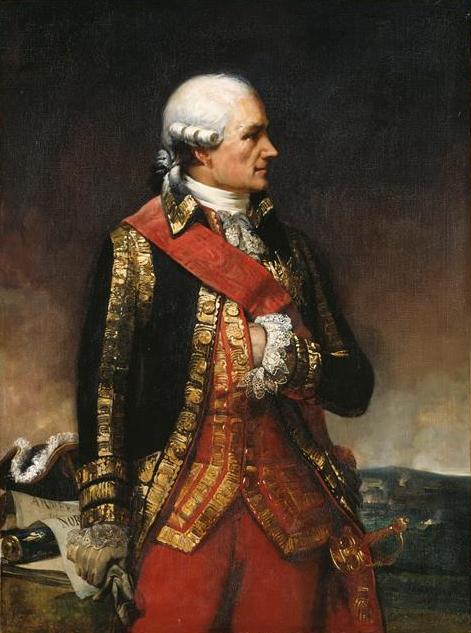
comte de Rochambeau
Both of Rochambeau’s older brothers died in childhood.  So, from a young age, he was destined to carry his family’s title.  Born in 1725, he attended Catholic boarding schools where he received educational and military training beginning at age five.  At 15, he received his first commission as a cornet of horse and began service in the Army of the Rhine during the War of Austrian Succession.  The young teenager learned the rigors of combat at an early age and managed to thrive and impress his superiors.  He was wounded in battle several times, and suffered the same deprivations that the rest of his men faced during the war.  

By 1747, the 22 year old found himself a colonel leading a regiment.  A couple of years later, the 25 year old Colonel Rochambeau accepted his mother’s arrangement for his marriage into another wealthy family. 

By the outbreak of the Seven Years War, Rochambeau had risen to brigadier general.  He distinguished himself at the battle of Minorca, and was wounded in battle in the German states during the war.  By the end of that war, Rochambeau found himself serving as inspector-general of infantry and mixing with the top ministers at the court of Versailles.

Since France had entered its latest war with Britain, much of Rochambeau’s time was spent planning for the invasion of England in 1779.  After that plan fell apart due to problems and delays by their Spanish allies and an unfortunate smallpox outbreak in the invasion fleet, Rochambeau was looking for something else to do.  In 1780 Rochambeau was a 55 year old military commander with nearly 40 years of military experience.  According to his writings, he was contemplating retirement.  The thought of another major military campaign far from home did not seem to be something that he particularly wanted.

Unlike many other officers, we don’t really know Rochambeau’s personal views on the American fight for liberty, or other political issues of the day.  He did not speak English, and knew rather little about America.  Rochambeau was a professional soldier, who followed orders and fought whatever battles his superiors thought appropriate.  The King’s decision to appoint him the head of an expeditionary force to America would be his first independent command.

French Expeditionary Force

The King's commission directed Rochambeau to command his army separately from the Continental Army. The French army in America would not serve as auxiliaries.  His orders directed him to work closely with General Washington and to coordinate military actions that would assist the success of the American cause.  At the same time he was to use his own military judgment in the use of his army.  Initially, the king had granted Rochambeau a force of only 4000 soldiers.  After some negotiation, the King increased the number to 7500, out of the 32,000 men who had been assembled for the aborted invasion of Britain.

French Regulars
Lafayette had advised Rochambeau to bring all the supplies that they would need while in the field in America.  He noted that the Americans had almost nothing and that the French could not really rely on local supplies while in the field.

By March of 1780, Rochambeau was ready to embark on his transatlantic voyage.  Unfortunately, the French Navy was not ready.  All the troop transport ships had been used to ship another army to the West Indies.  After a few weeks of scrambling, the ministry managed to find enough ships to cram about 5500 soldiers aboard.  They had to leave behind another nearly 2500 men who would have to join them on a second voyage later.  They also had to give up the transport of any horses.

The fleet set off for America at the beginning of May.  The winds and weather forced the fleet to take a longer route, so that they were still at sea after two months.  Along the way, the fleet encountered ships that brought the news that the Continental Army had fallen at Charleston and the entire southern army had been taken prisoner.  The Americans had lost almost as many soldiers in South Carolina as Rochambeau was bringing to America.  The French also learned that General Clinton had returned to New York and was preparing a greeting of his own when the French fleet arrived.  

While the officers knew of their destination, the French soldiers were not informed until about seven weeks into the voyage.  The men cheered when they heard the news.  In part this may have been because of the French feeling toward American liberty.  A fair amount of the celebration may have been because they were not headed to the West Indies, where tropical diseases were known to decimate European regiments.

Newport

On July 11, 1780, the French fleet arrived in Newport, Rhode Island.  The British did not contest the landing.  They had abandoned Newport in late 1779 in order to consolidate forces in New York ahead of the Charleston offensive.

The people of Newport at first greeted the French fleet a bit tentatively.  No one was really sure what an occupying army would bring, even if it was allied with the US.  Even Continental soldiers and militia were known for taking what they needed from the locals out of necessity.  Although the French were now allies, the people of New England had been fighting them as long-time enemies only twenty years prior.  Only two years before, in 1778, the French had abandoned the attempt to recapture Newport from the British.  This had threatened to create a deep hostility between the two armies, which Washington and Lafayette had to work overtime to patch up.

The locals also had little to offer their French guests.  The town population had been less than 10,000 before the war, and the years of British occupation had caused it to fall to less than 5000, hardly enough to support 5500 French soldiers and thousands more sailors.  The British had largely destroyed Newport on their way out in 1779, and the town had few resources to rebuild.  Many buildings were still burned-out shells. 

Many of Rochambeau’s soldiers were sick with scurvy from a difficult 70 day journey to America aboard overpacked cramped vessels.  Rochambeau received reports that 2300 of the French soldiers and sailors required hospital rest following the voyage.

French Map of Newport 1780
Rochambeau proved that he was not just a career military officer.  He also knew how to act as a politician.  He began meeting with local leaders and ensuring them that the French Army would not abandon them again, that they were ready to pay in specie (gold and silver) for whatever they needed, and that they would remain good guests while stationed in the city. The men set about repairing buildings for use.  They brought much-welcomed hard money to pay locals for what they needed.

Within days, local support began to show.  The Town Council called for a night of illumination of candles in all the houses to celebrate the arrival of their allies.  With local support, the French army of 5500 men settled in and around Newport.  General Rochambeau, however, still had to worry about a British attack.  The main British army at New York was only 150 miles away.  A short sail up the coast could have the enemy upon them in days.  Newport’s defenses were a mess and a large portion of the French army was in hospital following the difficult sea voyage.

Rochambeau began writing letters to Versailles noting the difficulties he encountered.  The American economy was in freefall, with the Continental dollar virtually worthless.  The Continental Army appeared to consist of only a few thousand men who were starving and in rags.  General Washington seemed unable to draw in new recruits, and part of the American army needed to move south in order to replace the army that had been captured at Charleston.

British forces were in control of Georgia and South Carolina, and seemed on the brink of taking North Carolina.  George Washington had not yet traveled to meet with Rochambeau.  Many historians have argued that this delay was because Washington was embarrassed that he had no army to fight alongside the French.  At this same time, Washington was writing letters to officials in Virginia saying that they need to be aware of the “totally deranged situation of our affairs—of our distresses—of the utter impracticability of availing ourselves of this generous aid [that is, the French support], unless the States would rouse from the Torpor that had siezed them.”

The New England militia turned out in force to supplement the French forces, commanded by General William Heath.  But Rochambeau saw them as an army of beggars. The militia needed guns, tents, clothing, provisions, etc. Everyone was looking to the French army to serve as quartermaster for all the Americans.

Rochambeau’s letters to French officials back home essentially said that they need to send more soldiers, ships, arms, and money to win this fight, and that the Americans could be counted on for almost no military support.  But those were longer term issues.  Right in front of him, was the danger of a British attack before the French were prepared to defend themselves.

Bull’s Ferry

To take some of the pressure off his new French allies, Washington was eager to engage in some activity to distract the British.  He did not have the resources for a full scale attack, but did order General Anthony Wayne to launch a raid on Bull’s Ferry in New Jersey

Wayne took two regiments of Continentals from the Pennsylvania Line, along with the 10th Regiment, as well as a company of dragoons and four pieces of field artillery.  Their goal was to capture a blockhouse at Bull’s Ferry, on the New Jersey coast, just across the Hudson River from New York City.  A small unit of 70 loyalists held the heavily-defended spot, which kept open a river passage into New Jersey from Manhattan.  The guard also protected an area to the south where the British grazed cattle and horses.  While Wayne’s force attacked the blockhouse, he sent Major Light Horse Harry Lee’s cavalry to round up the cattle and horses.

Bulls Ferry
Wayne’s force attacked the outpost on the morning of July 21.  The battle began with the Continentals using their artillery against defenders who had no canons to return fire.  The defenders did put up a defense with muskets.  After about an hour of no real progress. Wayne’s frustrated attackers wanted to storm the defenses.  Wayne and the officers saw that the defenders had built up considerable defenses, creating a tangle of abatis that would take considerable time to break through.  

Eventually, the soldiers charged despite efforts by the officers to hold them back.  As the officers feared, the attackers got caught up in the abatis and were forced to withdraw after taking heavy casualties.  With that, the Continentals gave up the fight and withdrew.  The 70 loyalist defenders suffered 5 dead and 16 wounded.  The Americans suffered 15 dead and 49 wounded.  British reports estimate the attacking force at over 2000 soldiers.  The American records don’t give a number, but if it really was just the two or three regiments, and the artillery, it was probably more like 700 to 900 attackers.  Even so, that should have been more than enough to overwhelm 70 defenders.  The Continentals did return with a herd of captured cattle, but failed to capture the block house.

That’s probably why the Americans wanted to forget about the failed attack.  Instead, we remember it because British Major John AndrĂ© wrote a poem called “The Cow Chace” making fun of the failed American attack, despite the lopsided numbers.

British Threat

Back in New York City, British General Clinton largely ignored the raid.  He was focused on launching an attack on the new French garrison at Newport.  Two days after the French landed at Newport, Admiral Samuel Graves arrived in New York with six more British ships of the line.  Combined with Admiral Marriot Arbuthnot’s existing fleet, the British had enough firepower to overwhelm the French naval fleet, which consisted of seven ships of the line and a few smaller ships.

Graves had hoped to intercept the French fleet at sea.  He had left port at Plymouth around the same time as the French fleet under Admiral Arsac de Ternay had left Brest.  But a storm had slowed up the fleet, and then Graves had gotten distracted trying to capture prizes along the way.  By contrast, French Admiral Ternay had passed up the opportunity to capture any British prizes that he had encountered, instead focusing on getting his troop transports to America.

In truth, the British probably could have taken Newport in the days or weeks following the French landing. The French had no time to construct defenses, and half their men were sick following the long voyage.

Adm. Samuel Graves

British General Clinton wanted to attack quickly, but Admiral Arbuthnot opposed it.  First, the fleet that had arrived under Admiral Graves was also sick from the long journey and either needed time to recuperate, or had to have much of its crew replaced with locals in New York.  This led to a delay of more than a week before the British fleet could leave for Newport.  

By the time the British fleet reached sight of Newport on July 22, the French fleet had had time to anchor into a defensive position in the harbor, where its cannons were supplemented by artillery batteries on land. Admirals Arbuthot and Graves discussed the matter, and decided they would not attack until Clinton had brought up his army to supplement that naval attack with a combined land assault.  Clinton had been ready to move, but the navy had not supplied him with the necessary troop transports to cross Long Island Sound into New England.

It would be another five days until General Clinton had his ships and was getting ready to embark an army of 6000 men at Throg’s Neck on July 27.  As Clinton prepared to load his army aboard the transports, he received word that the Continentals were massing an army of 15,000, presumably to attack Manhattan from the north.  It was the perfect time to attack, with the bulk of the British Navy up at Newport and with more than half the army prepared to join them. Clinton had to call off the troop transports and redeploy his soldiers to defend against the possible American attack.  

Of course, Washington had nowhere near 15,000 men at this time. Clinton’s intelligence about the American attack was a ruse.  The Culper Ring in New York had gotten word to Washington that Clinton was preparing to move on Newport.  

Washington made a pretense of massing a large force and moving it across the Hudson and into a position where it could attack the British in northern Manhattan.  He made sure word got back to Clinton of this new threat, while greatly exaggerating his numbers.  Members of the Culper ring helped to spread disinformation to British agents who informed Clinton of the imminent attack.  

By doing so, the Continentals bought more valuable time for the French at Newport to dig in, reinforce their defenses, and convalesce their soldiers and sailors.  Washington had also ordered General Heath to bring 5000 New England militia to Newport to support the French Army.  This militia army appeared quickly and was ready to assist within days. By the time the British were ready to attack, the French were ready to defend, meaning the British saw a pretty fair risk that they could be defeated.  

In letters back to London, Clinton blamed the failure to attack on the fact that Admiral Graves had arrived too late, that Admiral Arbuthnot had failed to get intelligence of the arrival of the French fleet, and that the navy had failed to provide timely access to the troop transports.

By mid-August, Rochambeau felt confident enough to send home the New England militia.  Although they had turned out quickly, the Americans did not have food or tents for a sustained presence.  Rochambeau decided these men would best serve the cause by returning home to bring in their harvests.

Instead of a decisive conflict, the British in New York had hunkered down into a defensive posture.  The French in Newport also began to settle in for what appeared to be a long term encampment.  As of the end of August, two months after the French arrived, Washington remained in New Jersey, with what little army he had, still not finding the time to meet his new ally in the war.  

Next time: we head south, as General Horatio Gates is tasked with building a new army in the south to confront General Cornwallis.

- - -

Next Episode 258 Gates Takes Command 


 Contact me via email at mtroy.history@gmail.com

 Follow the podcast on Twitter @AmRevPodcast

 Join the Facebook group, American Revolution   Podcast: https://www.facebook.com/groups/132651894048271

 Join American Revolution Podcast on Quora 


American Revolution Podcast Merch!

T-shirts, hoodies, mugs, pillows, totes, notebooks, wall art, and more.  Get your favorite American Revolution logo today.  Help support this podcast.  http://tee.pub/lic/AmRevPodcast


American Revolution Podcast is distributed 100% free of charge. If you can chip in to help defray my costs, I'd appreciate whatever you can give.  Make a one time donation through my PayPal account. You may also donate via Venmo (@Michael-Troy-20), Zelle, or popmoney (send to mtroy1@yahoo.com)


Click here to see my Patreon Page
You can support the American Revolution Podcast as a Patreon subscriber.  This is an option making monthly pledges.  Patreon support will give you access to Podcast extras and help make the podcast a sustainable project.

An alternative to Patreon is SubscribeStar.  For anyone who has problems with Patreon, you can get the same benefits by subscribing at SubscribeStar.

Help Support this podcast on "BuyMeACoffee.com"


Visit the American Revolution Podcast Bookshop.  Support local bookstores and this podcast!


Signup for the AmRev Podcast Mail List

* indicates required

Further Reading

Websites

JONES, T. COLE. “‘Displaying the Ensigns of Harmony’: The French Army in Newport, Rhode Island, 1780-1781.” The New England Quarterly, vol. 85, no. 3, 2012, pp. 430–67. JSTOR, http://www.jstor.org/stable/23251387

WHITRIDGE, ARNOLD. “TWO ARISTOCRATS IN ROCHAMBEAU’S ARMY.” The Virginia Quarterly Review, vol. 40, no. 1, 1964, pp. 114–28. JSTOR, http://www.jstor.org/stable/26444997

French Encampment in Newport: https://w3r-us.org/french-encampment-newport-11-july-1-november-1780

Why Newport Scorned the French in 1780: http://smallstatebighistory.com/why-newport-scorned-the-french-in-1780

Comte de Rochambeau: https://www.battlefields.org/learn/biographies/rochambeau

Charles Henri d’Ternay http://www.biographi.ca/en/bio/arsac_de_ternay_charles_henri_louis_d_4E.html

“From George Washington to Joseph Jones, 22 July 1780,” Founders Online, National Archives, https://founders.archives.gov/documents/Washington/03-27-02-0211

Wayne Loses Battle of Bull’s Ferry: https://www.revolutionary-war-and-beyond.com/general-wayne-loses-battle-of-bulls-ferry.html

Piecuch, Jim "Antony Wayne's Repulse at Bull's Ferry, July 21, 1780" Journal of the American Revolution, Oct. 4, 2022. https://allthingsliberty.com/2022/10/anthony-waynes-repulse-at-bulls-ferry-july-21-1780

Andre, John The Cow Chace https://www.americanrevolution.org/war_songs/warsongs78.php

McBurney, Christian “The Culper Spy Ring Was Not the First to Warn the French at Newport” Journal of the American Revolution, Dec. 9, 2014. https://allthingsliberty.com/2014/12/the-culper-spy-ring-was-not-the-first-to-warn-the-french-at-newport

Free eBooks
(from archive.org unless noted)

Balch, Thomas The French in America During the War of Independence of the United States 1777-1783, Philadelphia: Porter & Coates, 1891. 

Lomask, Milton Rochambeau and Our French Allies, New York, P.J. Kenedy, 1965 (borrow only) 

Rice, Howard C. (ed) The American Campaigns of Rochambeau's Army, 1780, 1781, 1782, 1783, Princeton University Press, 1972 (borrow only) 

Winfield, Charles “The Affair at Block House Point, 1780The Magazine of American History, Vol 5, pp. 161-186 (Google Books) 

Wright, M. W. E. “What France Did for America: Memoirs of Rochambeau” The North American Review

Books Worth Buying
(links to Amazon.com unless otherwise noted)*

Ferreiro, Larrie D. Brothers At Arms: American Independence and the Men of France and Spain Who Saved It, Alfred A. Knopf, 2016  (borrow on Archive.org

Kennett, Lee The French Forces in America, 1780-1783, Praeger, 1977. 

Vail, Jini Jones Rochambeau: Washington’s Ideal Lieutenant, Word Association Publishers, 2020 

Weelen, Jean E. Rochambeau, Father and Son, H. Holt and Company, 1936 (reprint 2016).  (borrow on Archive.org

Whitridge, Arnold Rochambeau: America’s Neglected Founding Father, Macmillan, 1965. (borrow on Archive.org

* As an Amazon Associate I earn from qualifying purchases.


Sunday, October 2, 2022

ARP256 Hanging Rock


Last time, we went over several skirmishes in both North and South Carolina.  The British under General Cornwallis claimed to have taken all of South Carolina, and had demanded that all colonists, even patriot militia who had been released on parole, join loyalist militia forces or be treated as traitors.  Cornwallis had deployed Major Patrick Ferguson to the backcountry, where he was tasked with organizing regiments of patriot militia.  Ferguson used Fort Ninety-Six as his base of operations, and as a POW camp for patriots who refused to cooperate.  Further to the north, Colonel Banastre Tarleton used his loyalist cavalry, mostly raised among loyalists from New York and Philadelphia, to compel obedience to British edicts, and to punish anyone who refused to comply.

Thomas Sumter

Also a few episodes back, I gave some background on two local leaders who emerged at this time.  Colonel Francis Marion, the Swamp Fox, was a Continental officer who was not in Charleston when it fell to the British.  General Thomas Sumter, the Gamecock, had given up participation in the war, only to be drawn back in after British forces targeted him and burned his plantation.

By July of 1780, Marion had brought his men into North Carolina to supplement the forces being organized by Continental General Johan DeKalb.  Sumter, however, remained in South Carolina, trying to avoid attacks on his small outfit, but striking at smaller encampments of British or loyalists when the opportunity presented itself.  

As I noted in an earlier episode, most of the skirmishing was relatively disorganized and involved only a few dozen men on each side.  The British were trying to cover the entire state with only a few thousand men, and the patriots had surrendered almost all organized forces in the state when Charleston had fallen in May.

Green Spring

One of the larger skirmishes in early August happened at Green Spring. There seems to be some dispute over the date of the attack, some saying August 1, others say August 8.  British Major Patrick Ferguson was out in the field commanding an army of hundreds of loyalists whom he had raised locally.  He received word that a regiment of rebel militia under the command of  Georgia Colonel Elijah Clarke was camped nearby. 

Elijah Clarke
Elijah Clarke lived on the Georgia frontier when the war began, but had grown up in North Carolina.  He had led soldiers against the loyalists at Kettle Creek in 1779, shortly after the British captured Savannah.  He had assumed command after loyalists attacked the home of his regimental commander and killed Colonel John Dooly.  Clarke had been upset that South Carolina militia had accepted parole and dropped out of the fight after the British captured Charleston.  He took his force of about 140 Georgia militia into South Carolina to continue the fight against the British.  After Clinton’s proclamation forced parolees to take up arms again, either as loyalists or patriots, Clarke found many in South Carolina willing to join up with his Georgians.

Ferguson deployed over two hundred loyalist militia to attack Clarke’s camp in a pre-dawn raid.  The loyalists had camped for the night on the plantation of patriot Captain James Dillard, who was with the patriot force at this time.  Dillard’s wife, Mary, served dinner to the British officers and overheard that they intended to attack her husband’s camp early the following morning. Mrs. Dillard managed to steal away on a horse and warn the patriot camp of the imminent attack.

The loyalists had about 210 men assigned to attack, while the patriot force was believed to be 196 men.  Although this was a pretty evenly-matched force, the loyalists hoped to catch their prey still asleep.  They did not necessarily need overwhelming numbers.  However, when they arrived at the camp, the enemy was lined up and ready for them, unleashing a volley on the surprised attackers.

The attack lasted about 15 minutes before the attackers realized this was not going to be the massacre they had hoped, and withdrew with heavy losses.  There is no record of exact casualty numbers, but the patriots considered it a success.

Hanging Rock & Rocky Mount

Colonel Sumter continued his organization efforts, while trying to undermine the enemy’s efforts to do the same.  In late July, Sumter wrote to Continental General Johann de Kalb in North Carolina, providing the general with the positions of the loyalist forces in South Carolina, totaling the enemy at about 3500 men.  He also warned de Kalb that Cornwallis was getting ready to concentrate his forces at Camden, and recommended that de Kalb strike first before the enemy could gather.  De Kalb, however, opted to wait as he had received word a few days prior that he was to turn over military command to the new commanding General Horatio Gates.

George Turnbull
In the meantime, Sumter was looking for outposts within South Carolina that he could target.  He found one at a place called Rocky Mount.  There, an outpost of about 300 loyalists commanded by Lieutenant Colonel George Turnbull, were relatively isolated from any support..  The commander was a former British officer who had retired as a captain and moved to New York shortly before the war began.  In January of 1776, he raised a regiment of New York loyalists, and soon received a commission as a lieutenant colonel.  His men saw action in several campaigns in the north before sailing south to participate in the capture of Savannah in late 1778.  He spent over a year in Georgia, gaining experience in dealing with rebel guerilla units.  

After the British captured Charleston, Turnbull was deployed into the South Carolina backcountry to help subdue the rebel elements.  He had established his headquarters at Hanging Rock, near the North Carolina border, just south of Charlotte.  There, Turnbull had built a fort of sorts, mostly two cabins on the top of a hill, surrounded by abatis.

General Sumter had gathered a force of about between 500 and 600 militia, which he hoped would be enough to overrun the garrison.  Sumter deployed another force of dragoons to attack a nearby smaller outpost as a diversion, while he brought his larger militia army against Rocky Mount.

The diversionary force under Major William Davie attacked the larger enemy outpost about 15 miles from Rocky Mount, called Hanging Rock.  The larger loyalist outpost there consisted of about 500 men, being attacked by about 40 dragoons and riflemen.  The goal was not to take the position but to occupy the defenders in order to prevent them from coming to the aid of the smaller garrison at Rocky Mount

Once he arrived at Hanging Rock though, Davie noted that there was a smaller group of three companies of loyalists outside the main encampment.  Since both Davie’s patriot militia and the enemy  loyalist militia were both dressed in civilian clothes, Davie simply had his men ride into the camp, past the sentries, as if they belonged there, and then suddenly opened fire.  When the loyalists ran from the field, Davie had predicted where they would run and had sent another detachment to fire on the fleeing loyalists.

Before the main encampment could mount a counter attack, Davie’s patriot militia mounted their horses, along with taking another 60 horses of the enemy, and rode back to support Sumter in his attack on Rocky Mount the following day, July 31.

Sumter had no artillery, but thought that his rifles could penetrate the wooden walls of the buildings where the enemy was located.  The British commander, however, had reinforced the walls with clay to make them essentially bullet proof.  Sumter called on the enemy to surrender, but they refused.  

The patriots mounted three attacks to break through the abatis.  The defenders inflicted casualties and drove back the attackers each time.  Sumter then instructed a couple of volunteers to climb atop a large boulder near the houses, and throw firebrands onto the roofs to set them on fire.

The loyalist defenders sent out a company of men with bayonets to drive off these volunteers before they could set fire to the houses.  Sumter then tried to send the volunteers back, reinforced by a company of riflemen.  This time, the men finally managed to set the houses on fire.

As things were looking bleak for the defenders, a rainstorm suddenly opened up and doused the flames.  After eight hours of attempting to take the defenses, Sumter withdrew.  The defenders reported two officers and ten men killed or wounded.  Sumter reported only three killed, six wounded, and two captured.

On hearing that the outpost at Rocky Mount was under attack, the British deployed relief forces to assist them.  While none of the relief columns arrived in time for the battle, they did encounter Sumter’s retreating militia.  This resulted in more skirmishing, in which Sumter claimed to have lost 20 men, but killed 60 of the enemy.

Battle of Hanging Rock
A few days later, Sumter decided to try his luck directly against the larger outpost as Hanging Rock.  Davie had reported that the defenses there were not great, and that with surprise, they could overrun the enemy encampment. 

Sumter’s militia did just that.  On August 6, Sumter's militia surprised the British at Hanging Rock and captured the encampment.  The loyalists either fled into the woods or were captured trying to make a stand against overwhelming numbers.  The fighting was over rather quickly.  The victorious militia offered parole to the loyalist officers and removed the soldiers to Charlotte, North Carolina to be held as prisoners of war.  

The victorious militia then looted the camp. Finding a sizable stash of liquor, the men started drinking heavily.  In the meantime, a detachment of Tarleton’s cavalry came within sight of the camp.  They were only a small number, and their commander Colonel Tarleton was not with them, so they did not attack.  Sumter, however, decided it was time to go, and withdrew his men from the camp.

The result was about 25 loyalists killed, another 175 wounded, and 73 captured. The Americans lost 20 killed and 40 wounded. After the attack, the British did not try to re-occupy the camp, even after the Americans had abandoned it.

Wofford’s Iron Works

Sumter’s raids were taking a toll on the British efforts to pacify the region.  The success of the raids told South Carolinians that the British did not really control the region and that things were still in contention.  Those who favored the cause of independence but who had begun to feel like it had become inevitable that British colonial rule would be restored, could still hold out hope that the patriot militia would prevail.  This impacted British efforts to recruit more loyalist militia.

The British commander for the region, Major Patrick Ferguson, knew that he would have to crush this growing threat before it only grew larger.  Ferguson took his forces into the field, hoping to find and defeat the rebel militia once and for all.  Sumter’s militia was further north of Ferguson's headquarters near Fort Ninety-six.  His immediate problem was the growing force of militia under the joint command of Colonel Elijah Clarke of Georgia, and Colonel Isaac Shelby of North Carolina.  

In the last episode, I talked about a raid where Ferguson had attempted to capture some local militia at Cedar Spring and that the militia, tipped off to the raid, managed to defeat the attacking loyalists.  Such victories encourage more men to join Clarke.  After joining up with Shelby and continuing to take on more recruits, these officers had built a growing force of Georgia, South Carolina, and North Carolina militia that had grown to over one thousand men by early August.  

This group began shadowing Ferguson’s loyalist army, both looking for opportunities to strike at the other.  On August 7, Ferguson’s loyalists were almost on top of Colonel Clarke’s patriots.  The loyalists attempted a pre-dawn raid, but Clarke received word and evacuated his camp before they arrived around 4:00 AM.  

One of Clarke’s officers, Captain Josiah Culbertson, had been out on a scouting mission.  He returned to camp, not realizing that the patriots had left and that the men milling around camp that morning were loyalists.  After realizing his situation, Culbertson simply rode through the camp.  The loyalists simply assumed he was one of them, and ignored him.  After gaining intelligence on the enemy numbers, Culbertson simply rode out of camp and went to find his own army near Wofford’s Iron Works.

While Culbertson was making his escape, Ferguson learned that the enemy supply wagons were only a few miles away.  He sent a division of 130 loyalists under Captain James Dunlap to capture them. Colonel Clarke personally led a patriot ambush which decimated the loyalists.  Clarke received two saber wounds and was captured by the loyalists, but then managed to knock down his captors and escape.  The patriots managed to capture about 50 loyalist prisoners during the encounter.

Dunlap managed to make it back to the main loyalist camp.  Ferguson then assembled a larger attack force to capture the enemy.  But by the time they arrived back at Wofford’s Iron Works, the patriots had withdrawn into the hills.  The patriots taunted the enemy, trying to get them to attack into the hills where the patriots held the high ground, but the loyalists did not attempt such a dangerous maneuver.

Wateree Ferry 

Just over a week later, Sumter’s militia struck again.  This time at Wateree Ferry.  The British had built a redoubt named Fort Cary near the ford.  Colonel Sumter got word that a British supply train was crossing the ferry and dispatched about three hundred militia to capture the wagons.  They were joined by about 100 Continentals.  The force of several hundred overwhelmed Fort Cary, capturing its commander, Colonel James Cary and his garrison of about thirty loyalists.

They also captured 36 wagons full of supplies.  As the patriots were still organizing their prizes, another British train of 56 wagons, with more supplies, and baggage, as well as seventy invalid British soldiers and a herd of cattle, attempted to cross the ferry.  The patriots captured the even larger prize as well.  Initially Sumter wanted to hold the ferry, but after hearing of the American loss at Camden, he moved his army and prisoners further north.

Merchant Fleet

Before we get to the Battle of Camden, which is a major battle for South Carolina, I want to touch on one other event that happened about this same time, thousands of miles away from the Carolinas.  

At the beginning of August, a large merchant fleet left Portsmouth, England, headed for the West Indies.  The fleet of 63 merchant vessels contained massive amounts of food, clothing, ammunition and even several regiments of infantry, being deployed to the West Indies.

The merchants were escorted out of the English Channel by the Channel Fleet.  Once they got out into the Atlantic though, the Channel Fleet allowed them to continue on their own, escorted only by a single ship of the line and two frigates.  Officials in London believed that sending their supply ships over in a large convoy protected by a ship of the line would protect them from the privateer ships that were becoming an ever-increasing problem for these supply ships.

 JosĂ© de Mazarredo Salazar
There were more than just privateers lurking though.  The Spanish fleet was also in the Atlantic, looking to do battle.  On the evening of August 8, Spanish frigates spotted unknown sails.  The Spanish were not sure if they would encounter the British Channel fleet or a merchant convoy.  The Spanish commander, JosĂ© de Mazarredo, believed it was the merchant fleets and threw everything he had at the target.

Captain John Moutray who commanded the Ramillies, the one ship of the line escorting the fleet, also saw enemy sails.  His ships could fight off a few privateers but were no match for an enemy fleet.  The British might be able to outrun their pursuers.  Moutray signaled all the ships to alter course and follow him into the wind in order to maximize speed.  The two navy frigates and eight of the merchant ships followed him.  Those ships were able to slip away from the Spanish.  Since the ships received the signal at night, though, many got confused. Moutray put out a signal lantern on his ships for the fleet to follow.

A Spanish frigates also heard the signal. Since it was still dark, it put out its own signal lantern and got the rest of the fleet to follow.  The Spanish frigate then led the British fleet back toward the Spanish ships of the line.  By morning, the British merchants found themselves intermingled with the Spanish Navy.  Almost all the British ships surrendered without a shot fired.  A few tried to make a run for it, but Spanish canons quickly convinced them to strike their colors and surrender.  The Spanish led 55 captured prizes back to Cadiz.

Not only did the Spanish manage to capture over 3000 soldiers and sailors, they converted many of the captured ships into Spanish naval vessels.  The captured supplies, which had been intended to supply the British forces in the West Indies for the rest of the year, were all lost to the enemy.

The loss felt in London was massive.  It was the largest single loss for the British East India Company in the entire history of its existence.  Many marine insurance companies went bankrupt as a result of the incident, and already high insurance rates for British merchant ships went through the roof.  It was a devastating blow for British logistics.

The capture of supply ships doesn't always make the history books, but the capture of this fleet had a devastating blow on British logistics and its ability to wage war in the Americas over the coming months.

Next time: the British suffer another less surprising blow when the French Army arrives in America.

- - -

Next Episode 257 French Army in America 


 Contact me via email at mtroy.history@gmail.com

 Follow the podcast on Twitter @AmRevPodcast

 Join the Facebook group, American Revolution   Podcast: https://www.facebook.com/groups/132651894048271

 Join American Revolution Podcast on Quora 


American Revolution Podcast Merch!

T-shirts, hoodies, mugs, pillows, totes, notebooks, wall art, and more.  Get your favorite American Revolution logo today.  Help support this podcast.  http://tee.pub/lic/AmRevPodcast


American Revolution Podcast is distributed 100% free of charge. If you can chip in to help defray my costs, I'd appreciate whatever you can give.  Make a one time donation through my PayPal account. You may also donate via Venmo (@Michael-Troy-20), Zelle, or popmoney (send to mtroy1@yahoo.com)


Click here to see my Patreon Page
You can support the American Revolution Podcast as a Patreon subscriber.  This is an option making monthly pledges.  Patreon support will give you access to Podcast extras and help make the podcast a sustainable project.

An alternative to Patreon is SubscribeStar.  For anyone who has problems with Patreon, you can get the same benefits by subscribing at SubscribeStar.

Help Support this podcast on "BuyMeACoffee.com"


Visit the American Revolution Podcast Bookshop.  Support local bookstores and this podcast!


Signup for the AmRev Podcast Mail List

* indicates required

Further Reading

Websites

Hanging Rock https://carolana.com/SC/Revolution/revolution_battle_of_hanging_rock.html

Rocky Mount: https://carolana.com/SC/Revolution/revolution_battle_of_rocky_mount.html

Green Spring: https://carolana.com/SC/Revolution/revolution_green_springs.html

Wofford’s Iron Works: https://www.carolana.com/SC/Revolution/revolution_woffords_iron_works.html

Battle of Wofford’s Iron Works: https://www.myrevolutionarywar.com/battles/800808-woffords-iron-works

Wateree Ferry: https://www.encyclopedia.com/history/encyclopedias-almanacs-transcripts-and-maps/wateree-ferry-south-carolina

Action of 9 August, 1780: https://www.revolutionary-war-and-beyond.com/action-of-9-august-1780.html

Hiscocks, Richard The Loss of Captain Moutray’s Convoy: https://morethannelson.com/loss-captain-moutrays-convoy-9-august-1780

Free eBooks
(from archive.org unless noted)

Holbrook, Stewart Hall The Swamp Fox of the Revolution, Random House 1959. (borrow only) 

McCrady, Edward The History of South Carolina in the Revolution, 1780-1783, New York: The Macmillan Co. 1902.

Ramsay, David The History of the Revolution of South-Carolina, from a British province to an independent state, Vol. 2, Trenton: Isaac Collins, 1785.

Simms, William G. The Life of Francis Marion, New York, Derby, 1854. 

Weigley, Russell Frank The Partisan War: The South Carolina Campaign of 1780-1782, Columbia: Univ of South Carolina Press, 1970 (borrow only). 

Books Worth Buying
(links to Amazon.com unless otherwise noted)*

Bass, Robert D. Gamecock: The Life And Campaigns Of General Thomas Sumter, Holt, Rinehart and Winston, 1961 (Read on Archive.org).

Buchanan, John The Road to Guilford Courthouse: The American Revolution in the Carolinas, Wiley, 1999. 

Edgar, Walter B. Partisans and Redcoats: The southern conflict that turned the tide of the American Revolution, New York: Morrow, 2001 (borrow on archive.org).

Ferling, John Winning Independence: The Decisive Years of the Revolutionary War, 1778-1781, Bloomsbury Publishing, 2021. 

Lumpkin, Henry From Savannah to Yorktown: the American Revolution in the South, Univ of SC Press, 1981 (borrow on archive.org). 

Oller, John The Swamp Fox: How Francis Marion Saved the American Revolution, Da Capo Press, 2016 (borrow on archive.org). 

Russell, David Lee. The American Revolution in the Southern Colonies. McFarland & Company, 2000 (borrow on archive.org).

Syrett, David The Royal Navy in European waters during the American Revolutionary War, Univ of SC Press, 1998.

(borrow on archive.org) https://archive.org/details/royalnavyineurop00syre
Wickwire, Franklin B. Cornwallis and the War of Independence, Houghton Mifflin, 1971 (borrow on archive.org). 


* As an Amazon Associate I earn from qualifying purchases.


Sunday, September 18, 2022

ARP255 Ramsour’s Mill


When we last left the south in Episode 251, British General Henry Clinton had departed with most of the army to return to New York.  Clinton had received word that the French Army would be arriving soon and wished to contend with that.  He left Lieutenant General Charles Cornwallis in command at Charleston, South Carolina.

Cornwallis 

General Cornwallis has been a part of our story in many earlier episodes. But since this is his first really big independent command, and since he plays such a key role in the southern theater, I thought a refresher was in order.

Lord Cornwallis

Cornwallis came from the top of British aristocracy.  He was the son of the 5th Baron Cornwallis.  His mother was the daughter of a Viscount.  His uncle was the Archbishop of Canterbury.  As a boy, Cornwallis attended Eton.  He purchased his first military commission as an ensign at the age of 17. Rather than go into service as most young officers learned their profession, Cornwallis traveled to Europe where he enrolled in the military academy at Turin.  After that, he toured central Europe.

When the Seven Years War began, Cornwallis’ regiment shipped out for America before he could reach it.  Instead, he attached himself as an aide to Lord Granby, commander in chief of British forces in Europe.  He fought at the battle of Minden and shortly afterwards purchased a captaincy.  Before long he had been brevetted to lieutenant colonel.  

While he was still fighting in Europe, his family got Cornwallis elected to Parliament.  He only spent a little over a year as a member of the House of Commons before his father died, and he took up his father’s seat in the House of Lords.  In Parliament, Cornwallis showed a strong sympathy for the colonies.  He voted against the Stamp Act, the Declaratory Act, and the Intolerable Acts.  Yet, by the time the war began, Cornwallis, a major general, volunteered to go to war, and even proposed a campaign to retake the southern colonies.  He received promotion to lieutenant general in America in 1776, shortly before shipping off with General Clinton to retake the Carolinas.

I won’t go through all the details of Cornwallis’ leadership in the war, but I will note that he frequently wanted to return home to be with his ailing wife.  He had planned to leave for London in late 1776, when he was called back from his ship to go fight Washington at Trenton. In late 1777, after the fighting season had ended, he returned home.  He did the same at the end of the 1778 fighting season.  While in Britain, his wife became much sicker.

During one visit home, Cornwallis had an audience with the king, in which he told George III that the war’s  success was hopeless.  Despite his assessment, he received a permanent promotion to lieutenant general and became second in command to General Clinton.  The following year, he returned to England once again and resigned his commission to be by his wife’s side as she lay on her deathbed.  After her death in 1779, Cornwallis once again offered his services to the king.

He returned to service in America, not because he thought he could win the war, but simply because he was too depressed to remain in Britain following his wife’s death, and wanted to be back with his army buddies in America.  When he returned, everyone, including General Clinton, thought that Cornwallis would shortly replace Clinton as commander in North America, following Clinton’s resignation.

Clinton and Cornwallis had their personal disagreements, but Clinton seemed ready to bring Cornwallis up to speed on everything so that Clinton could go home and be rid of this war.   When word came from London that Clinton’s letter of resignation had been rejected and that he would continue in command, things seemed to fall apart. Cornwallis basically left headquarters and told Clinton to consult with other officers.  Clinton was offended that Cornwallis had basically checked out after learning he would not succeed to command.  

Despite this falling out, Clinton took Cornwallis to Charleston.  Their personal relationship seemed to get even worse during the siege of Charleston, when Clinton came to believe Cornwallis was undermining him with the other officers, by spreading rumors that Clinton was about to resign.  Cornwallis refused to provide Clinton with any advice and asked that Clinton not consult with him on strategy. Clinton saw this as a way of distancing himself in case the campaign failed.  During this time, Cornwallis wrote to London asking to be reassigned to any other theater in the world where Clinton was not in command.  During the siege, Cornwallis took command of a corps that separated from Clinton’s main army.  Both men were happy when Clinton returned to New York, leaving Cornwallis with his own command in the south.

Pacification Strategy

As I already outlined in Episode 251, the British pacification strategy hinged on the assumption that there were a great many southern colonists who could be coaxed into serving the king by joining loyalist militias.  Clinton had relied on that when he issued his edict in June, 1780, just before leaving for New York, that all colonists, even rebels on parole, would be expected to join loyalist militias or be considered traitors.

Fort Ninety-Six
Relying on the growth of these loyalist militias, Clinton left Cornwallis with a rather small force of a little over 3000 soldiers - a mix of regulars, Hessians, and loyalist regiments raised in the north.  Brigadier General James Patterson took command of Charleston, while General Cornwallis took the bulk of his army into the backcountry.  

By the time Clinton left for New York on June 5, the British had moved into the backcountry, setting up outposts that covered most of the state.  These included Georgetown, a little over 50 miles up the coast from Charleston, then extending inland northwest to Camden, near the North Carolina border, across to Fort Ninety-Six, which had been a center of rebel activity, and then down to August, Georgia.  Spreading out the army was designed to facilitate recruiting loyalist militia, and keeping troops of soldiers close to any area where small groups of rebels might try to organize or fight back.

In the backcountry, Clinton had given primary responsibility to Major Patrick Ferguson, who you may remember played some key roles in several northern battles before sailing south with Clinton.  Ferguson had received an appointment as Inspector of Militia in South Carolina.  His primary mission was to organize loyalist militia groups in the backcountry to supplement Cornwallis’ army, and to put down any rebel activity.  

Ferguson has a reputation for honor and gallantry, exemplified by his refusal to shoot an American officer in the back at Brandywine, who may have been George Washington.  He noted in South Carolina that they were not there to harm women and children, but to relieve their distress.  Ferguson was not afraid to use force and violence against rebels, but also saw the need to win the hearts and minds of the civilian population.

To Ferguson’s north in the backcountry, Colonel Banastre Tarleton’s legion took a rather different approach.  I already discussed Tarleton’s massacre at Waxhaws.  His legion also roamed the countryside, killing suspected rebels, and burning their homes.  They were not above roughing up civilians, including women and children, whom they suspected of aiding the rebels.  At one point, Ferguson wanted to shoot several of Tarleton’s men who had raped Tory women.

Despite their very different methods, both Ferguson and Tarleton managed to recruit and organize large numbers of loyalist militia, while at the same time forcing unrepentant rebels to flee into the swamps or into North Carolina.

Ramsour’s Mill

As the British pacification plan in South Carolina was taking hold, it inspired loyalists in North Carolina to organize more openly, with the expectation that a British army would soon enter North Carolina.

Cornwallis had sent representatives into North Carolina, to spread the word that the British would arrive soon, but that loyalists should continue to lay low so that the patriots would not take them out before the British army arrived in force.  Instead, Cornwallis wanted the loyalists to harvest and store their crops, which the British army would need when it moved into North Carolina.

Lieutenant Colonel John Moore of the North Carolina Loyalist Militia, had been fighting under Cornwallis in South Carolina.  He rode into North Carolina to known Tory strongholds around Ramsour’s Mill, about 30 miles northwest of Charlotte, to pass along Cornwallis’ instructions.  Another officer from Moore’s loyalist regiment, Major Nicholas Welch also began speaking to local loyalists, spreading word of the British victory at Waxhaws and began gathering up volunteers for a Tory regiment, despite the orders against it. By June 20, about 1300 loyalist volunteers from the region had assembled on a ridge near Ramsour’s Mill.  Many had brought their own arms, but about one-quarter did not have weapons.  They expected the Regulars would provide them with arms when they arrived.

A few miles away in Charlotte, North Carolina militia General Griffith Rutherford received news of the Tory gathering.  Since he did not have soldiers on-hand to challenge this growing threat, he ordered Colonel Francis Locke to raise the local patriot militia and disperse the loyalists.  On June 13, Locke had about 200 militia volunteers assembled at Ramsour’s Mill. Within a few days, the arrival of other militia units doubled his numbers to about 400.  Locke planned to meet up with additional reinforcements being gathered by General Rutherford, and launch a night attack on the loyalists.  On the appointed night, Rutherford was a no-show.  His forces had gotten lost somewhere on the back roads in the North Carolina countryside.

Ramsour's Mill
Locke called a council of war with his fellow militia officers to decide what to do.  His group of 400 militia could not attack an enemy more than three times their size and holding the defensible high ground.  Rather than risk a counterattack against his own camp, Locke suggested they pull back and await Rutherford’s reinforcements.  Some of the less experienced officers, however, wanted to go forward with the attack anyway.  They suggested that pulling back would not be an act of military prudence.  It would be an act of cowardice.  

With the “c” word out there, none of the officers could support pulling back.  They agreed to launch an attack at daybreak.  Since almost all the militia on both sides were wearing civilian clothes, the loyalists put twigs in their hats to identify themselves.  The patriots put scraps of white paper in their hats.  Just before dawn, the patriots were within a mile of the enemy lines.  

They marched forward, driving in loyalist pickets, who fired warning shots and alerted the loyalist camp.  The loyalists scrambled from their tents and were still trying to form a line when the patriot horseman had gotten within about thirty yards.

Despite the confusion, the loyalists realized that there were only a few enemy cavalry, and managed to drive off the attackers. The horseman turned and retreated.  As they did, some of the approaching infantry believed this was an all-out retreat and turned around before even getting to the battlefield.  Loyalist riflemen began picking off the advancing patriot militia who had to cross a flat open field to engage with the enemy.  No patriot officers were really in charge, but the men kept advancing anyway.  Several small units made their way against both loyalist flanks and began to turn them.

Amazingly, the militia advance continued, despite taking heavy casualties.  They reached the enemy lines about the same time the flanking companies attacked on both sides.  The fight devolved into brutal hand to hand combat by the former neighbors in both militias.  Despite having far greater numbers, the stunned Tories fled the field.  Some of them simply removed the twigs from their hats and pretended to be patriot militia until they had a chance to escape safely.

Some distance away, the fleeing loyalists reassembled and viewed their opponents from a distance.  They realized they far outnumbered the enemy and prepared for a counterattack.  The patriots prepared to defend against a counter attack but had just over 100 men.  They had taken about 170 casualties in the initial assault.  The remainder had fled the field.

Locke ordered two of his officers to ride hard and see if they could find Rutherford’s reinforcements.  The general was still about seven miles away from the sound of the fighting when the officers reached him.  He immediately deployed his 65 dragoons on horseback to ride at a gallop and support Lock’s militia.

As the patriot militia awaited the counterattack by overwhelming numbers, a loyalist came forward under a flag of truce.  He asked for a suspension of hostilities so that they could care for their wounded on the field and bury their dead.  The patriot major sent out to speak with them sensed a tone of defeatism and countered with a demand that they surrender within ten minutes or be attacked.  

As it turned out, no one wanted to attack. Colonel Moore had used the negotiation time to tell his loyalists to scatter and find safety wherever they could.  By the time the officer who had ridden out under a flag of truce returned to his camp, the loyalist army of over 1000 men had dwindled to about 50, and those soon fled as well.  In total, about 140 men were killed and over 200 wounded, with about equal casualties on both sides.

Colonel Moore returned to the British base at Camden with only about thirty men, and news of the disaster.  British officers, apoplectic that he had disobeyed orders and allowed the large group of loyalist militia to rise and gather before they were ready, considered a court martial.  In the end, they decided against it, realizing that punishing well-meaning but incompetent loyalist volunteers might have a negative impact on future recruiting efforts.

Cedar Springs

Back in South Carolina, patriot militia were still organizing and hiding from mostly loyalist militia who were assigned to crush any such gatherings.  They needed to prevent these smaller outfits from moving north to combine with the gathering army of militia and Continentals that would inevitably mount some attack at some point. 

One of the militia officers that the British had arrested was Colonel John Thomas who commanded the Spartan militia regiment from the area around Spartanburg, South Carolina.  They had taken him to be held at the prison at Fort Ninety-Six, under the command of Major Patrick Ferguson. 

Thomas’ capture, however, did nothing to dissuade his regiment from continuing to organize.  His son, Colonel John Thomas, Jr. simply took his father’s position in commanding the regiment.  The younger Colonel Thomas continued to keep his men, four companies totaling about 60 men, in the field near Cedar Springs. They hoped to join up with the gathering patriot militia army under Thomas Sumter.0

Ninety-Six Jail
When the British learned of the position of the patriot militia, Major Ferguson deployed about 150 loyalists to kill or capture this rebel force.  The loyalists planned a pre-dawn attack on the rebel camp in the early hours of July 12.  They crept toward the camp in the dark, seeing the enemy’s campfires.  The loyalists stormed the camp, expecting to bayonet the sleeping soldiers in a Paoli-style massacre.  Instead, they found empty bedrolls and no one in camp.  Then, shots rang out from the forest nearby.  The patriot militia let loose a volley against the attackers, causing the surprised loyalists to flee the field.  

The patriots had been tipped off.  News of the attack became a topic of discussion among some of the loyalist wives camped at Fort Ninety-Six.  Presumably many of their husbands were with the loyalists who had been deployed to contend with these rebels.  One of the wives who overheard these discussions was not a loyalist.  Jane Thomas was the wife of Col. John Thomas, and had been at the fort to visit her husband in prison.

Upon hearing that the British planned to attack her son’s regiment, Mrs. Thomas mounted her hours and rode at a brisk pace, covering the sixty mile distance in one day.  She managed to beat the loyalists back to Cedar Springs, and warned her son that night, July 11.  Colonel Thomas then ordered his men to stoke the fires but then move into position in the forest near the camp.  When the loyalists struck the camp, his men were ready to ambush them.

The battle was over almost before it started.  The surprised loyalists immediately fled despite still outnumbering the patriots.  The patriots did not have the numbers to pursue and engage them, so they simply packed up and moved on before the loyalists could strike again.

Throughout July, there were many of these little raids back and forth.  Another group of patriots attacked a loyalist force at Stallions Plantation the same night the loyalists at Cedar Spring.  I already mentioned the attack on Christian Huck’s men in an earlier episode, which happened also around this time.  A day later, a group of about 35 Georgia patriots attacked a loyalist camp at Gowen’s Fort.  A few days later a loyalist force hit a group of patriots at Earle’s Ford.  There were probably another then or so incidents over the next couple of weeks, all involving no more than a few dozen men. 

The fighting was relatively uncoordinated and involved small units on both sides, both intent on obstructing the enemy from doing whatever they were trying to do.  Although the British claimed to be in control of South Carolina, these many skirmishes told another story.

I will continue my discussion of these skirmishes next time.  But much like the British in New Jersey during the forage wars of 1777, the British in South Carolina were quickly discovering that defeating a large army and claiming control of a region would not end the resistance.

- - -

Next Episode 256 Hanging Rock


 Contact me via email at mtroy.history@gmail.com

 Follow the podcast on Twitter @AmRevPodcast

 Join the Facebook group, American Revolution   Podcast: https://www.facebook.com/groups/132651894048271

 Join American Revolution Podcast on Quora 


American Revolution Podcast Merch!

T-shirts, hoodies, mugs, pillows, totes, notebooks, wall art, and more.  Get your favorite American Revolution logo today.  Help support this podcast.  http://tee.pub/lic/AmRevPodcast


American Revolution Podcast is distributed 100% free of charge. If you can chip in to help defray my costs, I'd appreciate whatever you can give.  Make a one time donation through my PayPal account. You may also donate via Venmo (@Michael-Troy-20), Zelle, or popmoney (send to mtroy1@yahoo.com)


Click here to see my Patreon Page
You can support the American Revolution Podcast as a Patreon subscriber.  This is an option making monthly pledges.  Patreon support will give you access to Podcast extras and help make the podcast a sustainable project.

An alternative to Patreon is SubscribeStar.  For anyone who has problems with Patreon, you can get the same benefits by subscribing at SubscribeStar.

Help Support this podcast on "BuyMeACoffee.com"


Visit the American Revolution Podcast Bookshop.  Support local bookstores and this podcast!


Signup for the AmRev Podcast Mail List

* indicates required

Further Reading

Websites

Runyan, Conner “Did the first Cedar Springs Skirmish Really Happen?” Journal of the American Revolution, May 12, 2016. https://allthingsliberty.com/2016/05/did-the-first-cedar-springs-skirmish-really-happen

Battle of Ramsour's Mill: https://amrevnc.com/battle-ramsours-mill

Battle of Ramsour’s Mill: https://www.ncpedia.org/ramsours-mill-battle

Battle of Ramsour’s Mill: http://www.lincolncountyhistory.com/ramsours-mill-battleground

Battle of Ramsour’s Mill: https://revolutionarywar.us/year-1780/battle-ramsours-mill

Free eBooks
(from archive.org unless noted)

Fanning, David Col. David Fanning’s Narrative of his Exploits and Adventures as a Loyalist of North Carolina in the American Revolution, Toronto: (reprint form The Canadian Magazine) 1908. 

McCrady, Edward The History of South Carolina in the Revolution, 1780-1783, New York: The Macmillan Co. 1902.  

Millspaugh, Arthur Loyalism in North Carolina during the American Revolution, University of Illinois, Master’s Thesis, 1910: 

Moultrie, William Memoirs of the American Revolution, so far as it related to the states of North and South Carolina, and Georgia, Vol 1 and Vol 2, New York: Printed by D. Longworth, 1802.

Ramsay, David The History of the Revolution of South-Carolina, from a British province to an independent state, 1749-1815, Vol. 2, Trenton: Isaac Collins, 1785. 

Simms, William G. The Life of Francis Marion, New York, Derby, 1854. 

Weigley, Russell Frank The Partisan War: The South Carolina Campaign of 1780-1782, Columbia: Univ of South Carolina Press, 1970 (borrow only). 

Books Worth Buying
(links to Amazon.com unless otherwise noted)*

Bass, Robert D. Gamecock: The Life And Campaigns Of General Thomas Sumter, Holt, Rinehart and Winston, 1961 (borrow on Archive.org).

Buchanan, John The Road to Guilford Courthouse: The American Revolution in the Carolinas, Wiley, 1999. (borrow on Archive.org). 

Edgar, Walter B. Partisans and Redcoats: The southern conflict that turned the tide of the American Revolution, New York: Morrow, 2001 (borrow on archive.org).

Ferling, John Winning Independence: The Decisive Years of the Revolutionary War, 1778-1781, Bloomsbury Publishing, 2021. 

Lumpkin, Henry From Savannah to Yorktown: the American Revolution in the South, Univ of SC Press, 1981 (borrow on archive.org).

Oller, John The Swamp Fox: How Francis Marion Saved the American Revolution, Da Capo Press, 2016 (borrow on archive.org).

Russell, David Lee. The American Revolution in the Southern Colonies. McFarland & Company, 2000 (borrow on archive.org).

Wickwire, Franklin B. Cornwallis and the War of Independence, Houghton Mifflin, 1971 (borrow on archive.org). 

* As an Amazon Associate I earn from qualifying purchases.


Sunday, September 11, 2022

AR-SP16 History Daily on Princeton


This week, we have a special episode.  Podcaster Lindsay Graham of the History Daily Podcast gives us his take on the battles of Trenton and Princeton. 

This fighting is often known as the "ten crucial days" when the Continental Army began its counter-attack against the British and Hessian invaders in December, 1776 and continuing into January, 1777.

For more details on the History Daily Podcast, part of the Noiser Network, please visit their website: https://www.noiser.com/history-daily

If you enjoy their work, you can subscribe to them on your favorite podcast platform.

- - -


As always, I welcome your feedback.

 Contact me via email at mtroy.history@gmail.com

 Follow the podcast on Twitter @AmRevPodcast

 Join the Facebook group, American Revolution   Podcast: https://www.facebook.com/groups/132651894048271

 Join American Revolution Podcast on Quora