Showing posts with label French Army. Show all posts

Sunday, January 8, 2023

ARP263 Hartford Conference


Back in Episode 257, I talked about the arrival of the French Army in America.  General Jean-Baptiste Donatien de Vimeur, comte de Rochambeau, led an army of about 5500 soldiers,   With them were seven ships of the line and five smaller frigates under the command of Admiral Charles-Henri-Louis d'Arsac, chevalier de Ternay.  Upon arrival, much of the army and navy was sick from the journey, and also had to scramble to build a defensible position at Newport Rhode Island.

French Navy in West Indies

The French had come to America with far fewer soldiers than originally planned. There were not enough ships to transport all of the soldiers that Rochambeau expected to bring with him. Rochambeau had to cram his 5500 soldiers onto 36 transports, leaving behind much of his equipment, horses, and another 2500 soldiers.  Those who could not get on the ships remained in Brest, waiting for available transport ships to carry them to America.

Washington & Rochambeau
More importantly, Rochambeau wanted a larger French naval presence to gain superiority of the seas.  As long as the British controlled the water off their coast, the French army was little more than a supplement to the Continentals.

French naval priorities, however, remained elsewhere.  With only seven ships of the line, the French had enough to defend against a British naval attack on Newport, but could not go on the offensive.

Recall that Admiral d’Estaing had commanded a French Fleet in America for two years prior.  Most of it was spent in the West Indies.  Admiral d’Estaing had bailed out of a joint assault on British occupied Newport in 1778 after a storm wrecked most of his fleet.  He then spent months in Boston getting repairs.  After that, his fleet sailed to the West Indies where he failed to prevent the British from capturing St. Lucia.  After receiving more ships under the Comte de Grasse, d’Estaing captured St. Vincent and Grenada.  He then sailed north to Savannah, hoping to assist the Americans in retaking that town from the British.  The attack failed and d’Estaing returned once again to the West Indies.

In March of 1780, d’Estaing returned to France, still recovering from wounds he received at Savannah. Command of the fleet in the West Indies fell to Luc Urbain du Bouëxic, comte de Guichen.  The Admiral was in his late 60s.  I won’t go into his lengthy record, but he was an experienced officer with a long record going back to the War of Austrian Succession and the Seven Years War.  He had been commander of the Channel fleet in 1778 and 1779 before heading to the West Indies with another squadron of ships to reinforce the French presence there.

French and Naval forces near Martinque
In April, shortly after his arrival, Guichen went on the offensive taking a fleet of 23 ships of the line and 3000 soldiers in hopes of capturing British-held Jamaica.  Britain had also recently replaced its commander in the West Indies.  Admiral George Brydges Rodney, who I discussed when he led the relief of Gibraltar back in Episode 243, assumed command.  Admiral Rodney was alerted immediately to the French fleet under Guichen taking to sea, and led his own fleet of 20 ships of the line to intercept them.

On April 17, the two fleets made contact, and spent the first few hours jockeying for position.  Rodney had hoped to take advantage of Guichen’s position which had left the French fleet strung out in a fairly loose formation.  Robert Carkett, the commander of the lead British ship, the Stirling Castle, ignored instructions and simply charged directly at the French fleet.  The British commanders behind him followed.  

Another French officer, the third in command comte de Grasse, managed to get most of the French fleet into a tighter position and fight off the attack.  No ships were lost in the battle, which was considered a draw.  But the French suffered 222 killed and 537 wounded in the fierce fighting that day.  The British suffered 120 killed and 354 wounded.

A month later, the two fleets engaged again over several days between May 15 and May 20th.  The fighting was once-again indecisive.  By July, with hurricane season approaching, Admiral Guichen left the West Indies, taking the bulk of his fleet back to France.  British Admiral Rodney took the bulk of the British fleet up to New York to assist with the effort there.  It’s not clear to me why Guichen did not sail up to Newport to assist Rochambeau, but whatever his motivation, he made no attempt to support the French expeditionary force in New England.  French priorities were in the West Indies.

Settling In

Meanwhile, General Rochambeau had arrived in Newport in July and was desperately short-handed.  His immediate concern had been a British attack just after his arrival.  When the immediate threat of an attack dissipated, the French settled in to await the arrival of their reinforcements and an opportunity to attack.  While the British Navy was unwilling to attack Newport, the British ships of the line remained off the coast, keeping the French Navy bottled up in Newport Harbor.  Rochambeau came to realize that no additional support seemed to be on its way, and had to plan to make due with what he had for the foreseeable future.
French Regulars

The French Army made a good impression on the locals, paying hard money for everything they needed.  A local populace who was used to being looted and robbed by both the enemy and desperate Continentals, was pleasantly surprised by French soldiers who did not steal their chickens or strip their orchards, but rather paid for rations with gold and silver. The French rented buildings, which they repaired at their own expense.  The officers rented rooms in the finest homes in Newport and soon intermingled with local society.

If anything, the French army was even more stratified between nobles and commoners than the British Army.  France required an commissioned officer to have at least four generations of nobility in his family tree.  Even wealthy commoners could not become officers, except through the very rare instance of promotion through the ranks.  The enlisted men came from the poorest of the poor in France.  Even so, the effective military discipline and good provisioning by the quartermaster kept most of Rochambeau’s soldiers from engaging in the looting and theft that plagued most other armies.

Because the British had destroyed many of the homes in Newport, Rochambeau made arrangements to have his soldiers repair and rebuild the homes at French expense.  In compensation, the owners would allow soldiers to live in the homes rent free during the time of the French occupation.  This was a win-win, since it permitted the French soldiers to obtain free housing, while the American owners had their ruined properties restored and would receive them back after the French departed.

The discipline and good behavior of the French army soon won over the locals.  Just to be sure, Rochambeau forbade his army from holding Catholic masses out in public in anti-papist New England, and issued orders that the soldiers should not try to attend Protestant services.

The French also spread out their army, setting soldiers not just in Newport but also in Providence and Popasquash, where they also established hospitals for their sick and wounded.  The illness from the poor food and conditions during the sea voyage continued to take its toll.  About 30 soldiers died of disease during the voyage from France.  Another 18 died in July, in the two weeks after the army landed.  By the end of the year, 265 French soldiers had died from disease, most the result of conditions suffered on the voyage across the Atlantic.

Rochambeau maintained tight discipline.  Not only was the smallest theft punished harshly with floggings, officers were even forbidden from hunting during the harvest period to prevent any potential disruptions.  When officers did go riding,, they were ordered to respect fenced land and remain on public paths.  Soldiers were held in isolated camps and needed a pass to go into town. Even then, they had to be accompanied by a non-commissioned officer who was responsible for their behavior.  Fraternization was so strictly blocked that there are no records of venereal diseases or unexpected pregnancies caused by French soldiers.  

French officers, on the contrary, did mingle with the locals, but still remained on best behavior.  They lived with local families and encouraged social gatherings.  Even so, it appears that Rochambeau’s prohibition on sexual relationships seems to have kept the officers from such attempts.  Even officers who had reputations in Europe both before and after Newport, managed to keep it in their pants while in Rhode Island.  One of Rochambeau’s top officers, the Duc de Biron, had multiple affairs in Europe.  He was billeted with a widow and her three daughters in Newport.  The ladies later noted that they grew quite fond of him, but that he never acted inappropriately, and always  treated them as if they were his own sisters.

There were, of course, some isolated incidents.  A French corporal killed an American in August, and was rather quickly tried and shot by firing squad.

French payment in specie for everything then needed made them even more popular with the locals.  It got to the point where the Continentals had to send aides with French purchasing agents to prevent locals from overcharging them.  The only ones complaining were American purchasing agents who could not compete with the French buyers.

Several dozen French soldiers attempted to desert in 1780 while in Newport.  In hopes of maintaining good relations, the Americans passed laws treating French deserters the same as American deserters, to be returned to their units to face punishment.

As it turned out, it was not the enemy, but boredom that would become the primary concern for Rochambeau’s first year in America.  The Continentals were in no condition to go on the offensive, and the British seemed content to keep the French bottled up in Newport. 

It would be several months before Rochambeau and Washington would even meet.  For most of the spring and summer of 1780, Washington was trying, unsuccessfully, to get Congress to provide him with the men and supplies he needed for an offensive.  Making the five day trip to Newport would have taken Washington out of contact with Congress for several weeks, at a time when negotiations over everything were pretty intense.  Washington also was probably reluctant to meet with Rochambeau and admit that he lacked the men and resources to do much of anything.  

Instead, Washington relied on General Lafayette to serve as a go-between for the two armies. Lafayette used the opportunity to try to get Rochambeau to launch an offensive against New York, with the army that Lafayette had originally hoped to command himself.  In late July, Lafayette wrote to Washington that the French army was eager to go on the offensive, that they “detest even the thought of remaining at Newport, and are burning with the desire of joining you. They curse any one who talks to them of waiting for the second division, and are furious at remaining blockaded here.”

At this same time, Lafayette was pressing Rochambeau to launch an immediate offensive against the British in New York. Rochambeau thought this plan was foolhardy.  He complained to the French Minister Luzerne that Lafayette was trying to dictate an extremely risky strategy, and that although Lafayette was representing General Washington, it was not clear that even Washington approved of Lafayette’s plans.

A frustrated Rochambeau finally wrote a letter to Lafayette essentially saying very nicely that the young and inexperienced officer would not become a successful and experienced officer if he tried to lead an army on a highly risky attack that could result in the destruction of that army.  He indirectly accused Lafayette of trying to satisfy his personal ambition by putting the lives of French soldiers at great risk.  Lafayette could have taken great offense at the letter, but decided to back off and accept General Rochambeau’s experience-backed advice.  

From Rochambeau’s perspective though, he had landed in a strange country, had his small navy bottled up and unable to move, had a third of his army still in France awaiting transport, had not yet even met the American commander after nearly two months in America, and was getting all of strategic advice from Lafayette, an officer with almost no experience and still in his early 20’s.  No experienced officer in his right mind would launch an offensive against a superior enemy in those circumstances.  Certainly, before anything could happen, Rochambeau needed to meet and confer with General Washington in person.

It did not help when word reached both Rochambeau and Washington that the Americans suffered the loss of a Continental Army in the south, this time under General Gates at Camden. This further threatened the American claims of independence in the southern states, and put even greater demands on Washington to send a third army to the south.  Doing so would mean his depleted army in the north would get even smaller.  Also news that the French General de Kalb, who had joined the Continental Army, was killed in the battle at Camden.  That certainly did nothing to inspire the French. 

Hartford Conference

By September, Rochambeau had been in Newport for nearly two months and still had not met with Washington.  He was fed up with communicating through Lafayette, who Rochambeau still thought was trying to set his own agenda.  Washington finally agreed to meet with Rochambeau in Hartford, Connecticut, about half-way between the French and Continental camps.

French & American Troops at Hartford
As I said, Washington had been reluctant to meet because he was focused on building up his own army after its decimation during the previous winter at Morristown.  He only had a few thousand Continentals under arms.  Most of his attention over the summer was writing to Congress and to various state leaders trying to impress upon them  how important it was to send him soldiers and supplies so that he could make use of the newly arrived French Army to launch an offensive.  Until the Continental army reached a respectable size, Washington would not be able to convince the French to join him on any offensive.

Washington’s headquarters at Morristown was a five day ride from Newport.  The American commander had no time to travel that distance, spend time conferring with the French commander, then returning to New Jersey, all during the summer fighting season when the British might launch another attack from New York against his tiny army.

Finally, by September, Washington decided he could no longer put off a meeting with Rochambeau.  The two leaders agreed to meet at a half-way point, in Hartford, Connecticut, about a two and a half day’s ride for each group.

Traveling with Washington to Hartford was General Henry Knox, his chief of artillery, Lt. Colonel Jean Baptist de Gouvion, an French officer who had become Washington’s chief of engineers, and of course General Lafayette.  Also attending were several of Washington’s aides, including Colonel Alexander Hamilton.

General Rochambeau brought Admiral Ternay, several of his other top generals, and his son, the Vicomte de Rochambeau.  The conference had been scheduled for September 20th, but the French delegation was late due to their coach breaking an axle during the trip.  
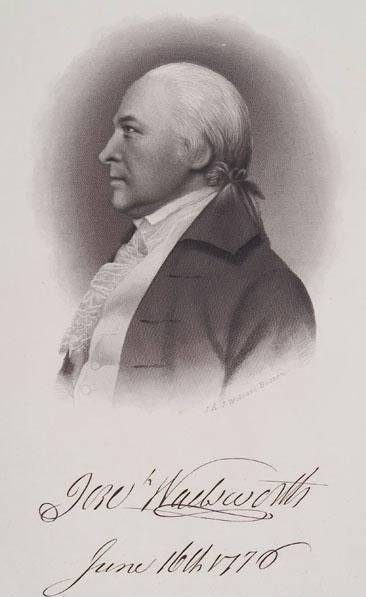
Jeremiah Wadsworth
The leaders met at the home of Jeremiah Wadsworth.  He was a Hartford merchant who had been a commissary officer with the Continental Army.  He was a friend of General Nathanael Greene, and was also now serving as a local commissary for the French Army.

The leaders finally sat down together on September 21st to discuss strategy.  Washington was in the embarrassing position of not even knowing exactly how many soldiers he commanded at the moment, as the number was always changing.  He also noted that a large portion of his army would have its enlistments expire at the end of the year.  Even so, he managed to make a positive personal impression on the French officers.

Rochambeau was still awaiting the second half of his expeditionary force to arrive.  Ternay’s naval fleet was still blockaded in Newport Harbor.  They hoped, in vain, that naval reinforcements under Admiral de Grasse might sail up from the West Indies.  Until more French ships and soldiers arrived, the generals agreed they did not have enough resources to launch a successful attack on New York City.  The two leaders agreed that they would need a combined army of 30,000 as well as naval superiority before they could consider such an attack.  

At the time, it was not clear when, if ever, they would have those numbers.  The entire Continental and French expeditionary army in America probably did not total 10,000 soldiers combined.  The only thing that was clear was that there would not be a decisive battle in 1780.  The armies would have to go into winter quarters.  Washington would spend the winter in New Jersey, again.  Rochambeau and his army would spend the winter in Newport.

All Washington could do was ask Rochambeau to pass along more requests for more French soldiers and ships, and also to see if France could spare more money to help the Continentals to keep going.  Hopefully France would fulfill those requests in time for the beginning of the fighting season in the spring of 1781.

After two days of meetings, the leaders agreed that New York City should remain their goal, but at present they could do nothing. Rochambeau would send his son back to Versailles to beg for more money and supplies.  Traveling with Rochambeau’s son would be Colonel John Laurens who had recently been released from parole after his capture at Charleston. Washington would continue to beg Congress to come up with the resources that he needed.

The meeting wrapped up rather quickly after word arrived that the British fleet under Admiral Romney had arrived in New York with thirteen additional ships of the line.  Rochambeau, concerned that this would mean a British attack on Newport was once again imminent, wanted to get back to his army as quickly as possible.

On September 23rd, the two delegations returned to their camps.  Rochambeau would end up spending an entire year in Newport, with pretty much nothing to do.  Washington headed back to New Jersey, stopping in West Point along the way to meet with General Benedict Arnold.  When he arrived, Arnold was nowhere to be found.  But the reason for Arnold’s absence will have to wait for next time.

Next time: General Arnold decides to trade in his blue uniform for a red one.

- - -

Next Episode 264 Arnold Commits treason (Available January 22, 2023)


 Contact me via email at mtroy.history@gmail.com

 Follow the podcast on Twitter @AmRevPodcast

 Join the Facebook group, American Revolution   Podcast: https://www.facebook.com/groups/132651894048271

 Join American Revolution Podcast on Quora 


American Revolution Podcast Merch!

T-shirts, hoodies, mugs, pillows, totes, notebooks, wall art, and more.  Get your favorite American Revolution logo today.  Help support this podcast.  http://tee.pub/lic/AmRevPodcast


American Revolution Podcast is distributed 100% free of charge. If you can chip in to help defray my costs, I'd appreciate whatever you can give.  Make a one time donation through my PayPal account. You may also donate via Venmo (@Michael-Troy-20), Zelle, or popmoney (send to mtroy1@yahoo.com)


Click here to see my Patreon Page
You can support the American Revolution Podcast as a Patreon subscriber.  This is an option making monthly pledges.  Patreon support will give you access to Podcast extras and help make the podcast a sustainable project.

An alternative to Patreon is SubscribeStar.  For anyone who has problems with Patreon, you can get the same benefits by subscribing at SubscribeStar.

Help Support this podcast on "BuyMeACoffee.com"


Visit the American Revolution Podcast Bookshop.  Support local bookstores and this podcast!


Signup for the AmRev Podcast Mail List

* indicates required

Further Reading

Websites

“Conference at Hartford, [22 September 1780],” Founders Online, National Archives, https://founders.archives.gov/documents/Hamilton/01-02-02-0866

“Conference at Hartford: George Washington’s Answers to Queries by the Comte de Rochambeau and the Chevalier de Ternay, [22 September 1780],” Founders Online, National Archives, https://founders.archives.gov/documents/Hamilton/01-02-02-0865

Letter from Rochambeau to Lafayette: https://docs.google.com/document/d/1r3IncAiPsTt5PkUje9PImIQFHlrOCUK_bhoJDpczseA

Free eBooks
(from archive.org unless noted)

Balch, Thomas The French in America During the War of Independence of the United States 1777-1783, Philadelphia: Porter & Coates, 1891. 

Lomask, Milton Rochambeau and Our French Allies, New York, P.J. Kenedy, 1965 (borrow only) 

Rice, Howard C. (ed) The American Campaigns of Rochambeau's Army, 1780, 1781, 1782, 1783, Princeton University Press, 1972 (borrow only) 

Winfield, Charles “The Affair at Block House Point, 1780” The Magazine of American History, Vol 5, pp. 161-186 (Google Books) 

Wright, M. W. E. “What France Did for America: Memoirs of Rochambeau” The North American Review Part 1 May 1, 1917 , Part 2, June 1, 1917   & Part 3,  July 1, 1917 

Books Worth Buying
(links to Amazon.com unless otherwise noted)*

Ferreiro, Larrie D. Brothers At Arms : American independence and the Men of France and Spain Who Saved It, Alfred A. Knopf, 2016  (borrow on Archive.org

Kennett, Lee The French Forces in America, 1780-1783, Praeger, 1977. 

Scott, Samuel F. From Yorktown to Valmy: The Transformation of the French Army in an Age of Revolution, Univ. Press of Colo. 1998 (borrow on archive.org). 

Vail, Jini Jones Rochambeau: Washington’s Ideal Lieutenant, Word Association Publishers, 2020.

Weelen, Jean E. Rochambeau, Father and Son, H. Holt and Company, 1936 (reprint 2016) (borrow on Archive.org). 

Whitridge, Arnold Rochambeau: America’s Neglected Founding Father, Macmillan, 1965.  (borrow on Archive.org

* As an Amazon Associate I earn from qualifying purchases.


Sunday, October 16, 2022

ARP257 French Army in America


Back in Episode 246 we discussed Lafayette’s return to America from France.  Lafayette arrived in Boston in late April 1780 and made it down to General Washington’s Headquarters in Morristown New Jersey by early May.  The young general from France was pleased to announce that a French Army would soon arrive to support the Continentals in a final push to defeat Britain.

Washington, of course, was elated with the news, but also concerned since his army had fallen to only a few thousand men.  The southern army had been captured at Charleston and the states seemed in no hurry to send new soldiers.  Further, the army did not have the food or supplies to take care of the few soldiers that they did have. 

Washington spent the next few months desperately trying to build up his army for a major campaign with French cooperation during the summer of 1780. But the men and resources simply were not there.  The news of the arrival of the French Army spurred him to do whatever he could to prepare, but there was not much he could do.

Comte de Rochambeau

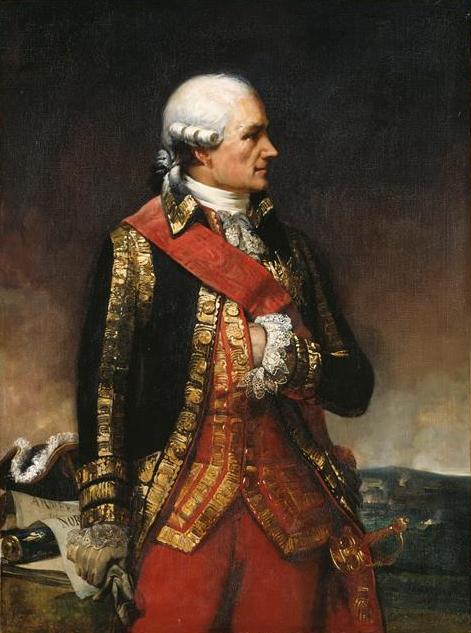
Leading the French army was Jean-Baptiste Donatien de Vimeur, better known as the comte de Rochambeau.  Lafayette had requested command of the army, but the Continental major general had left France as a captain in the French Army.  The King of France was not going to turn over an entire army to a kid still in his twenties, no matter how impressive an impact he had made in America.

General Rochambeau was an older, experienced officer.  Like most officers of the era, Rochambeau came from aristocracy.  He was the third son of the Marquis de Rochambeau, who came from a prominent military family that could trace its ancestry back to officers who had led in the crusades.  His mother came from an important naval family.  Although his father had some physical handicap that had prevented military service, he nevertheless served the King and was honored as a Knight of the Holy Sepulchre, among his titles.

comte de Rochambeau
Both of Rochambeau’s older brothers died in childhood.  So, from a young age, he was destined to carry his family’s title.  Born in 1725, he attended Catholic boarding schools where he received educational and military training beginning at age five.  At 15, he received his first commission as a cornet of horse and began service in the Army of the Rhine during the War of Austrian Succession.  The young teenager learned the rigors of combat at an early age and managed to thrive and impress his superiors.  He was wounded in battle several times, and suffered the same deprivations that the rest of his men faced during the war.  

By 1747, the 22 year old found himself a colonel leading a regiment.  A couple of years later, the 25 year old Colonel Rochambeau accepted his mother’s arrangement for his marriage into another wealthy family. 

By the outbreak of the Seven Years War, Rochambeau had risen to brigadier general.  He distinguished himself at the battle of Minorca, and was wounded in battle in the German states during the war.  By the end of that war, Rochambeau found himself serving as inspector-general of infantry and mixing with the top ministers at the court of Versailles.

Since France had entered its latest war with Britain, much of Rochambeau’s time was spent planning for the invasion of England in 1779.  After that plan fell apart due to problems and delays by their Spanish allies and an unfortunate smallpox outbreak in the invasion fleet, Rochambeau was looking for something else to do.  In 1780 Rochambeau was a 55 year old military commander with nearly 40 years of military experience.  According to his writings, he was contemplating retirement.  The thought of another major military campaign far from home did not seem to be something that he particularly wanted.

Unlike many other officers, we don’t really know Rochambeau’s personal views on the American fight for liberty, or other political issues of the day.  He did not speak English, and knew rather little about America.  Rochambeau was a professional soldier, who followed orders and fought whatever battles his superiors thought appropriate.  The King’s decision to appoint him the head of an expeditionary force to America would be his first independent command.

French Expeditionary Force

The King's commission directed Rochambeau to command his army separately from the Continental Army. The French army in America would not serve as auxiliaries.  His orders directed him to work closely with General Washington and to coordinate military actions that would assist the success of the American cause.  At the same time he was to use his own military judgment in the use of his army.  Initially, the king had granted Rochambeau a force of only 4000 soldiers.  After some negotiation, the King increased the number to 7500, out of the 32,000 men who had been assembled for the aborted invasion of Britain.

French Regulars
Lafayette had advised Rochambeau to bring all the supplies that they would need while in the field in America.  He noted that the Americans had almost nothing and that the French could not really rely on local supplies while in the field.

By March of 1780, Rochambeau was ready to embark on his transatlantic voyage.  Unfortunately, the French Navy was not ready.  All the troop transport ships had been used to ship another army to the West Indies.  After a few weeks of scrambling, the ministry managed to find enough ships to cram about 5500 soldiers aboard.  They had to leave behind another nearly 2500 men who would have to join them on a second voyage later.  They also had to give up the transport of any horses.

The fleet set off for America at the beginning of May.  The winds and weather forced the fleet to take a longer route, so that they were still at sea after two months.  Along the way, the fleet encountered ships that brought the news that the Continental Army had fallen at Charleston and the entire southern army had been taken prisoner.  The Americans had lost almost as many soldiers in South Carolina as Rochambeau was bringing to America.  The French also learned that General Clinton had returned to New York and was preparing a greeting of his own when the French fleet arrived.  

While the officers knew of their destination, the French soldiers were not informed until about seven weeks into the voyage.  The men cheered when they heard the news.  In part this may have been because of the French feeling toward American liberty.  A fair amount of the celebration may have been because they were not headed to the West Indies, where tropical diseases were known to decimate European regiments.

Newport

On July 11, 1780, the French fleet arrived in Newport, Rhode Island.  The British did not contest the landing.  They had abandoned Newport in late 1779 in order to consolidate forces in New York ahead of the Charleston offensive.

The people of Newport at first greeted the French fleet a bit tentatively.  No one was really sure what an occupying army would bring, even if it was allied with the US.  Even Continental soldiers and militia were known for taking what they needed from the locals out of necessity.  Although the French were now allies, the people of New England had been fighting them as long-time enemies only twenty years prior.  Only two years before, in 1778, the French had abandoned the attempt to recapture Newport from the British.  This had threatened to create a deep hostility between the two armies, which Washington and Lafayette had to work overtime to patch up.

The locals also had little to offer their French guests.  The town population had been less than 10,000 before the war, and the years of British occupation had caused it to fall to less than 5000, hardly enough to support 5500 French soldiers and thousands more sailors.  The British had largely destroyed Newport on their way out in 1779, and the town had few resources to rebuild.  Many buildings were still burned-out shells. 

Many of Rochambeau’s soldiers were sick with scurvy from a difficult 70 day journey to America aboard overpacked cramped vessels.  Rochambeau received reports that 2300 of the French soldiers and sailors required hospital rest following the voyage.

French Map of Newport 1780
Rochambeau proved that he was not just a career military officer.  He also knew how to act as a politician.  He began meeting with local leaders and ensuring them that the French Army would not abandon them again, that they were ready to pay in specie (gold and silver) for whatever they needed, and that they would remain good guests while stationed in the city. The men set about repairing buildings for use.  They brought much-welcomed hard money to pay locals for what they needed.

Within days, local support began to show.  The Town Council called for a night of illumination of candles in all the houses to celebrate the arrival of their allies.  With local support, the French army of 5500 men settled in and around Newport.  General Rochambeau, however, still had to worry about a British attack.  The main British army at New York was only 150 miles away.  A short sail up the coast could have the enemy upon them in days.  Newport’s defenses were a mess and a large portion of the French army was in hospital following the difficult sea voyage.

Rochambeau began writing letters to Versailles noting the difficulties he encountered.  The American economy was in freefall, with the Continental dollar virtually worthless.  The Continental Army appeared to consist of only a few thousand men who were starving and in rags.  General Washington seemed unable to draw in new recruits, and part of the American army needed to move south in order to replace the army that had been captured at Charleston.

British forces were in control of Georgia and South Carolina, and seemed on the brink of taking North Carolina.  George Washington had not yet traveled to meet with Rochambeau.  Many historians have argued that this delay was because Washington was embarrassed that he had no army to fight alongside the French.  At this same time, Washington was writing letters to officials in Virginia saying that they need to be aware of the “totally deranged situation of our affairs—of our distresses—of the utter impracticability of availing ourselves of this generous aid [that is, the French support], unless the States would rouse from the Torpor that had siezed them.”

The New England militia turned out in force to supplement the French forces, commanded by General William Heath.  But Rochambeau saw them as an army of beggars. The militia needed guns, tents, clothing, provisions, etc. Everyone was looking to the French army to serve as quartermaster for all the Americans.

Rochambeau’s letters to French officials back home essentially said that they need to send more soldiers, ships, arms, and money to win this fight, and that the Americans could be counted on for almost no military support.  But those were longer term issues.  Right in front of him, was the danger of a British attack before the French were prepared to defend themselves.

Bull’s Ferry

To take some of the pressure off his new French allies, Washington was eager to engage in some activity to distract the British.  He did not have the resources for a full scale attack, but did order General Anthony Wayne to launch a raid on Bull’s Ferry in New Jersey

Wayne took two regiments of Continentals from the Pennsylvania Line, along with the 10th Regiment, as well as a company of dragoons and four pieces of field artillery.  Their goal was to capture a blockhouse at Bull’s Ferry, on the New Jersey coast, just across the Hudson River from New York City.  A small unit of 70 loyalists held the heavily-defended spot, which kept open a river passage into New Jersey from Manhattan.  The guard also protected an area to the south where the British grazed cattle and horses.  While Wayne’s force attacked the blockhouse, he sent Major Light Horse Harry Lee’s cavalry to round up the cattle and horses.

Bulls Ferry
Wayne’s force attacked the outpost on the morning of July 21.  The battle began with the Continentals using their artillery against defenders who had no canons to return fire.  The defenders did put up a defense with muskets.  After about an hour of no real progress. Wayne’s frustrated attackers wanted to storm the defenses.  Wayne and the officers saw that the defenders had built up considerable defenses, creating a tangle of abatis that would take considerable time to break through.  

Eventually, the soldiers charged despite efforts by the officers to hold them back.  As the officers feared, the attackers got caught up in the abatis and were forced to withdraw after taking heavy casualties.  With that, the Continentals gave up the fight and withdrew.  The 70 loyalist defenders suffered 5 dead and 16 wounded.  The Americans suffered 15 dead and 49 wounded.  British reports estimate the attacking force at over 2000 soldiers.  The American records don’t give a number, but if it really was just the two or three regiments, and the artillery, it was probably more like 700 to 900 attackers.  Even so, that should have been more than enough to overwhelm 70 defenders.  The Continentals did return with a herd of captured cattle, but failed to capture the block house.

That’s probably why the Americans wanted to forget about the failed attack.  Instead, we remember it because British Major John André wrote a poem called “The Cow Chace” making fun of the failed American attack, despite the lopsided numbers.

British Threat

Back in New York City, British General Clinton largely ignored the raid.  He was focused on launching an attack on the new French garrison at Newport.  Two days after the French landed at Newport, Admiral Samuel Graves arrived in New York with six more British ships of the line.  Combined with Admiral Marriot Arbuthnot’s existing fleet, the British had enough firepower to overwhelm the French naval fleet, which consisted of seven ships of the line and a few smaller ships.

Graves had hoped to intercept the French fleet at sea.  He had left port at Plymouth around the same time as the French fleet under Admiral Arsac de Ternay had left Brest.  But a storm had slowed up the fleet, and then Graves had gotten distracted trying to capture prizes along the way.  By contrast, French Admiral Ternay had passed up the opportunity to capture any British prizes that he had encountered, instead focusing on getting his troop transports to America.

In truth, the British probably could have taken Newport in the days or weeks following the French landing. The French had no time to construct defenses, and half their men were sick following the long voyage.

Adm. Samuel Graves

British General Clinton wanted to attack quickly, but Admiral Arbuthnot opposed it.  First, the fleet that had arrived under Admiral Graves was also sick from the long journey and either needed time to recuperate, or had to have much of its crew replaced with locals in New York.  This led to a delay of more than a week before the British fleet could leave for Newport.  

By the time the British fleet reached sight of Newport on July 22, the French fleet had had time to anchor into a defensive position in the harbor, where its cannons were supplemented by artillery batteries on land. Admirals Arbuthot and Graves discussed the matter, and decided they would not attack until Clinton had brought up his army to supplement that naval attack with a combined land assault.  Clinton had been ready to move, but the navy had not supplied him with the necessary troop transports to cross Long Island Sound into New England.

It would be another five days until General Clinton had his ships and was getting ready to embark an army of 6000 men at Throg’s Neck on July 27.  As Clinton prepared to load his army aboard the transports, he received word that the Continentals were massing an army of 15,000, presumably to attack Manhattan from the north.  It was the perfect time to attack, with the bulk of the British Navy up at Newport and with more than half the army prepared to join them. Clinton had to call off the troop transports and redeploy his soldiers to defend against the possible American attack.  

Of course, Washington had nowhere near 15,000 men at this time. Clinton’s intelligence about the American attack was a ruse.  The Culper Ring in New York had gotten word to Washington that Clinton was preparing to move on Newport.  

Washington made a pretense of massing a large force and moving it across the Hudson and into a position where it could attack the British in northern Manhattan.  He made sure word got back to Clinton of this new threat, while greatly exaggerating his numbers.  Members of the Culper ring helped to spread disinformation to British agents who informed Clinton of the imminent attack.  

By doing so, the Continentals bought more valuable time for the French at Newport to dig in, reinforce their defenses, and convalesce their soldiers and sailors.  Washington had also ordered General Heath to bring 5000 New England militia to Newport to support the French Army.  This militia army appeared quickly and was ready to assist within days. By the time the British were ready to attack, the French were ready to defend, meaning the British saw a pretty fair risk that they could be defeated.  

In letters back to London, Clinton blamed the failure to attack on the fact that Admiral Graves had arrived too late, that Admiral Arbuthnot had failed to get intelligence of the arrival of the French fleet, and that the navy had failed to provide timely access to the troop transports.

By mid-August, Rochambeau felt confident enough to send home the New England militia.  Although they had turned out quickly, the Americans did not have food or tents for a sustained presence.  Rochambeau decided these men would best serve the cause by returning home to bring in their harvests.

Instead of a decisive conflict, the British in New York had hunkered down into a defensive posture.  The French in Newport also began to settle in for what appeared to be a long term encampment.  As of the end of August, two months after the French arrived, Washington remained in New Jersey, with what little army he had, still not finding the time to meet his new ally in the war.  

Next time: we head south, as General Horatio Gates is tasked with building a new army in the south to confront General Cornwallis.

- - -

Next Episode 258 Gates Takes Command 


 Contact me via email at mtroy.history@gmail.com

 Follow the podcast on Twitter @AmRevPodcast

 Join the Facebook group, American Revolution   Podcast: https://www.facebook.com/groups/132651894048271

 Join American Revolution Podcast on Quora 


American Revolution Podcast Merch!

T-shirts, hoodies, mugs, pillows, totes, notebooks, wall art, and more.  Get your favorite American Revolution logo today.  Help support this podcast.  http://tee.pub/lic/AmRevPodcast


American Revolution Podcast is distributed 100% free of charge. If you can chip in to help defray my costs, I'd appreciate whatever you can give.  Make a one time donation through my PayPal account. You may also donate via Venmo (@Michael-Troy-20), Zelle, or popmoney (send to mtroy1@yahoo.com)


Click here to see my Patreon Page
You can support the American Revolution Podcast as a Patreon subscriber.  This is an option making monthly pledges.  Patreon support will give you access to Podcast extras and help make the podcast a sustainable project.

An alternative to Patreon is SubscribeStar.  For anyone who has problems with Patreon, you can get the same benefits by subscribing at SubscribeStar.

Help Support this podcast on "BuyMeACoffee.com"


Visit the American Revolution Podcast Bookshop.  Support local bookstores and this podcast!


Signup for the AmRev Podcast Mail List

* indicates required

Further Reading

Websites

JONES, T. COLE. “‘Displaying the Ensigns of Harmony’: The French Army in Newport, Rhode Island, 1780-1781.” The New England Quarterly, vol. 85, no. 3, 2012, pp. 430–67. JSTOR, http://www.jstor.org/stable/23251387

WHITRIDGE, ARNOLD. “TWO ARISTOCRATS IN ROCHAMBEAU’S ARMY.” The Virginia Quarterly Review, vol. 40, no. 1, 1964, pp. 114–28. JSTOR, http://www.jstor.org/stable/26444997

French Encampment in Newport: https://w3r-us.org/french-encampment-newport-11-july-1-november-1780

Why Newport Scorned the French in 1780: http://smallstatebighistory.com/why-newport-scorned-the-french-in-1780

Comte de Rochambeau: https://www.battlefields.org/learn/biographies/rochambeau

Charles Henri d’Ternay http://www.biographi.ca/en/bio/arsac_de_ternay_charles_henri_louis_d_4E.html

“From George Washington to Joseph Jones, 22 July 1780,” Founders Online, National Archives, https://founders.archives.gov/documents/Washington/03-27-02-0211

Wayne Loses Battle of Bull’s Ferry: https://www.revolutionary-war-and-beyond.com/general-wayne-loses-battle-of-bulls-ferry.html

Piecuch, Jim "Antony Wayne's Repulse at Bull's Ferry, July 21, 1780" Journal of the American Revolution, Oct. 4, 2022. https://allthingsliberty.com/2022/10/anthony-waynes-repulse-at-bulls-ferry-july-21-1780

Andre, John The Cow Chace https://www.americanrevolution.org/war_songs/warsongs78.php

McBurney, Christian “The Culper Spy Ring Was Not the First to Warn the French at Newport” Journal of the American Revolution, Dec. 9, 2014. https://allthingsliberty.com/2014/12/the-culper-spy-ring-was-not-the-first-to-warn-the-french-at-newport

Free eBooks
(from archive.org unless noted)

Balch, Thomas The French in America During the War of Independence of the United States 1777-1783, Philadelphia: Porter & Coates, 1891. 

Lomask, Milton Rochambeau and Our French Allies, New York, P.J. Kenedy, 1965 (borrow only) 

Rice, Howard C. (ed) The American Campaigns of Rochambeau's Army, 1780, 1781, 1782, 1783, Princeton University Press, 1972 (borrow only) 

Winfield, Charles “The Affair at Block House Point, 1780The Magazine of American History, Vol 5, pp. 161-186 (Google Books) 

Wright, M. W. E. “What France Did for America: Memoirs of Rochambeau” The North American Review

Books Worth Buying
(links to Amazon.com unless otherwise noted)*

Ferreiro, Larrie D. Brothers At Arms: American Independence and the Men of France and Spain Who Saved It, Alfred A. Knopf, 2016  (borrow on Archive.org

Kennett, Lee The French Forces in America, 1780-1783, Praeger, 1977. 

Vail, Jini Jones Rochambeau: Washington’s Ideal Lieutenant, Word Association Publishers, 2020 

Weelen, Jean E. Rochambeau, Father and Son, H. Holt and Company, 1936 (reprint 2016).  (borrow on Archive.org

Whitridge, Arnold Rochambeau: America’s Neglected Founding Father, Macmillan, 1965. (borrow on Archive.org

* As an Amazon Associate I earn from qualifying purchases.