Showing posts with label Benedict Arnold Battles. Show all posts

Sunday, August 25, 2019

Episode 111: Retreat from Lake Champlain


Last week, we left General Benedict Arnold’s fleet bottled up in Valcour Bay.  The Americans had done great damage despite being no match for the British in numbers of ships, guns, or men.  They had fought the fleet to a draw that day.  But the Americans could not count on that luck to continue.  While General Carlton had used up the entire summer building his fleet, he did so in order to make it virtually impossible for any American fleet to defeat him.  Despite British shortcomings that day, their preparations in building such an overwhelming fleet met that he would inevitably win the battle and control the lake.

After dark on October 11, 1776, British General Guy Carlton, aboard the flagship Maria sent his first reports of the battle back to Quebec, to be forwarded to London.  Carlton ignored his own apparent missteps: not knowing where the enemy was despite intelligence warning they were in the area, not distributing any plan of attack to his captains, spreading out his fleet along the lake so that they were not prepared for battle when they encountered the enemy, and allowing his flagship to stay out of the battle.  Instead, he simply reported that he had bottled up the enemy in Valcour Bay, making an escape impossible.  Despite the fact that the day went according to Arnold’s plans and not Carlton’s, the British commander was confident that the next day would be the end of the American fleet.

The British had lost on ship, the Carleton, but only about 40 of 2500 men in the fleet killed or wounded.  He had sufficient reserves to re-arm his smaller gunboats and would have his entire fleet in place the following morning to resume the attack. Carlton planned either to accept the surrender of Arnold’s fleet, or destroy it in the morning,

This was not an unreasonable expectation. The Continentals had lost the Royal Savage, lighting up the night as it burned down to its water line.  All of their other ships had taken damage.  Overall the Americans had lost about 60 of the 500 men killed or wounded aboard all the ships.

Many had lost their officers to Indian sharpshooters or lucky cannonballs.  Most were taking on water, some at alarming rates.  The sailing vessels had their sails and rigging damaged, thus impeding speed in any escape attempt.  As usual, the Continentals were also low on ammunition.  During the battle that day, they had used up about 75% of their ammunition.  They could not keep up the same rate of fire for another day.  Meanwhile, the British had moved up their larger ships that had sat out the fighting on the first day. On the second day, they were prepared to direct even more firepower with larger guns on the small American fleet.

The Plan

Despite all this, Arnold was in a good mood.  He praised the work of his officers and men that day and congratulated them on holding back the superior British fleet. His praise included Captain David Hawley, of the Royal Savage, who had made his way from his sunken ship back to the fleet.  Arnold gave Hawley the command of the Washington, whose captain was too wounded to command the following day.

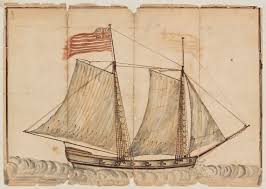
The Liberty (from JAR)
The Americans had inflicted a great deal of damage on the British despite having a crew about one-fifth the size of the enemy, half the number of ships, fewer and smaller cannons, and sailors with almost no combat experience, many without much experience at sea.

Yet even with their good work that day, they remained trapped in Valcour Bay.  The British fleet blocked passage to the south, rocks and debris blocked escape to the north, and hundreds of Indians along the shore prevented any escape overland.  While Carleton anticipated his final victory over the American fleet, Arnold revealed his escape plan to his officers.

General Carleton had organized his fleet at the mouth of the Bay, the only realistic escape route for the Americans.  When Arnold met with his officers on the night of October 11, 1776, he needed a plan to get his men, and hopefully his ships, past the British fleet to sail back to Fort Ticonderoga where the main force of Continentals prepared to meet the British..

The Slip

General Arnold was nothing if not daring.  He informed his officers that they would sail their ships right through the British fleet that night.  Arnold ordered the captain of each ship to tie a lantern made out of tin, so that it only emitted a small sliver of light, which would shine on a line of chalk drawn onto the stern of each boat. The lit chalk line could only be seen for about 50 feet by someone directly behind the boat. This would serve as a guide for each boat to follow the one in front of it, as they passed through the enemy fleet.

It certainly was a risky scheme, but amazingly, it worked.  That evening, after dark, the American ships moved slowly through the enemy lines.  The sailing vessels had only one small sail up, so that they would drift slowly through the fleet.  The row gallies would use muffled oars so that the enemy could not hear them.

By some accounts, they passed so close to the British flag ship Maria that sailors reported hearing the officers laughing in their cabin as they discussed plans for the following day.  The weather apparently cooperated by providing a fog that made it difficult to see much of anything in the dark.  If any British were aware of another ship drifting nearby, they must have assumed it was one of their own fleet. There is no evidence that any British watchman challenged any of the American ships.  Later, other officers critical of Carlton, blamed Arnold’s escape on Carleton's orders to pull back several ships away from the mouth of the bay, giving the Americans the space they needed to pass through.

The Chase

At dawn on October 12, the British were amazed to find the American fleet had vanished.  Carleton first assumed that the Americans had escaped to the north, going through the difficult waters at the northern tip of Valcour Island.  He immediately ordered his fleet to move north to intercept the Americans before they could attack any targets in the British rear.  Carleton was so stunned and moved so quickly, that he forgot to give any orders to the soldiers he had put ashore that night in the expectation of boarding the American fleet in the morning.

Although the Americans were only a few miles to the south, a morning fog prevented British lookouts from discovering their position.  It took Carleton until about noon that day to realize he was moving in the wrong direction.  By mid-day, the fog had lifted. British lookouts spotted sails miles to the south on the lake and moving further south.  By the time Carleton got his fleet turned around, he only made it back as far as Valcour Island by nightfall.  He ended up spending a second night in almost the same spot as the previous night.

Lake Champlain region (from Wikimedia)
Arnold, however, was not in the clear yet.  While Carleton was sailing north in search of Arnold’s fleet, the Americans had to spend most of October 12, repairing their ships to the point where they could remain afloat and on the move.  Arnold scuttled three of his mostly badly damaged gondolas, the Providence, New York, and New Jersey.  He sent his fastest ship, the Liberty down the lake as fast as it could go.  It would deliver dispatches to Crown Point and Ticonderoga that the British fleet was on its way and could not be stopped.  He also begged for any reinforcements that the forts could send.  The Liberty also carried the wounded away from the battle.

Late on the day of October 12, after spending the previous day in battle, the previous night escaping through the British fleet, that day repairing ships, Arnold planned for yet another sleepless night sailing his fleet further south on another dangerous nighttime naval movement to escape the British.  This time, nature was not on his side.  Unfavorable winds, tired rowers, and damaged ships still taking on water allowed the fleet to sail only 12 miles that night.  The following morning, the weather cleared and the British had the American fleet still in view.

Arnold’s men were still sailing against a southerly wind, meaning they made little progress.  Meanwhile, the British caught a northerly wind and were sailing speedily toward the American fleet.  Arnold knew it would only be a matter of hours before the British caught up with his fleet.  He ordered his five fastest ships to speed ahead and attempt to make their escape.  Arnold would stay behind aboard the Congress which would remain with the badly damaged Washington and four smaller gunboats to engage the enemy and slow their progress.

End of the Line

When the British got within five miles of his fleet, the American fleet finally picked up the northern wind that had been giving the advantage to the British all morning.  But even with a favorable wind, their tattered sails prevented them from moving as fast as the British.  Eventually, the British Inflexible caught up with the Washington, which had been taking on water and moving much slower than the other ships.

After receiving only a few shots, the Captain Hawley struck his colors and surrendered.  Only 16 men  from the crew escaped in small boat while the rest of the crew of 122 surrendered.  Hawley had always been at a disadvantage with his heavily damaged ship.  On top of that, the Inflexible’s guns had a much longer range and could fire on the Washington without getting in range of the Washington’s guns.  Even so, Captain Hawley, who had commanded the Royal Savage two days earlier, had the distinction of surrendering two ships without firing a shot.

With the Washington out of the fight, the British could focus all their attention on Arnold’s Congress and the four smaller gunships. While making repairs on the 12th, Arnold had prepared for this possibility.  He had mounted his largest cannons on the rear of each ship so that they could fire on the enemy as it gained on them.

Arnold also reached his location of choice for battle, a narrow area known as Split Rock, that provided the greatest difficulty to the British to maneuver their ships.  Arnold’s diminished fleet continued its running firefight with the British for nearly five hours.  Arnold personally aimed cannon out of the windows of his cabin in the stern of the Congress.  His small fleet continued to use its rear cannons effectively to smash at the British ships.  The British, of course, returned fire and inflicted more casualties and damage on the Americans.

By late afternoon, the seven large British warships had surrounded what remained of the American fleet and continued to blast away at them more effectively with broadsides.  Twenty seven of Arnold’s remaining seventy officers and crew were killed or seriously wounded.  Not only were Arnold’s remaining ships badly damaged, they were almost entirely out of ammunition.

Arnold's Fleet at Buttonmould Bay (from HistoryNet)
But General Arnold was not a surrender kind of guy.  He still had one more card to play.  Arnold had carefully mapped out Lake Champlain during the year that he controlled it.  He knew that nearby Buttonmould Bay was deep enough for his small ships, but too shallow for the larger British warships to follow.  Arnold steered his fleet into Buttonmould Bay and grounded his ships along the shore, grounding his ship the Congress last.  He ordered the ships not to strike their colors but to set them on fire with the flags still flying.  He would not surrender his ships, but he surely would deny them to the enemy.

Arnold ordered his marines to take positions along the shore and fire at British longboats attempting to board his grounded ships.  Then, another event happened that would haunt Arnold’s reputation.  Arnold had ordered the wounded removed from the ships and for the crew to blow up the ships in order to deny them to the enemy.  In the confusion a Lieutenant Goldsmith, suffering from a serious leg wound, got left aboard one of the ships.  Just before the ship exploded, he called out for help.  No one, however, was willing to risk their life to reboard the ship.  As it exploded both Americans and British watched Goldsmith’s body get blown into the air and fall to earth dead.

Both British officers and some of Arnold’s enemies within the Continental Army, circulated the story that Arnold had ordered the ships blown up with the wounded still aboard.  Of course, Arnold had ordered no such thing.  When he found out what had happened, he threatened to run through the crewman who had been tasked with helping Goldsmith off the ship.  The only thing that may have stopped Arnold from going through with his threat was a British artillery assault on his position, which forced everyone to scatter.

Aided by locals and taking a little known trail, Arnold and his men spent a third sleepless night carrying their wounded in slings made out of the remnants of ship sails twenty miles back to Crown Point.  They successfully avoided the Indian patrols looking for them and arrived at Crown Point early on October 14th, only hours ahead of the first British landing parties.

Arnold still could not rest.  He ordered all buildings burned along with any supplies they could not carry, in order to deny Crown Point to the enemy.  From there, his men continued on foot to Fort Ticonderoga.  While some of Carleton's forces arrived that same day, Carlton himself apparently spent several days on the lake, not arriving at Crown Point until October 20, nearly a week after Arnold had come and gone.  British troops occupied the ruins, sleeping in tents as an early snow covered them.

Carlton Withdraws

For the next two weeks, Arnold and the Continentals prepared for the British assault on Fort Ticonderoga.  The small force waited for the attack to come, and waited, and then waited some more.  Finally, after sending reconnaissance to Crown Point, Arnold discovered the British had left.

Carlton had remained at Crown Point until November 1, trying to decide on his next steps.  Although he had destroyed Arnold’s fleet, and still had his own fleet in relatively good shape, the winter weather convinced him it was the wrong time to attack Fort Ticonderoga.  The fort’s defenses would almost certainly require a lengthy siege.  If the fleet remained in open water when it froze, the British would be trapped there.  Even though they controlled the lake, supplying a siege force from their main base in Canada over the winter, across a frozen lake, would be extremely difficult.  Having cleared the American fleet from Lake Champlain, Carlton could easily sail back in the spring and begin his siege then.  So the 1776 fighting season ended with the Americans having lost control of Lake Champlain, but still in control of Fort Ticonderoga.

Aftermath

Many historians have credited Arnold’s loss at Valcour Bay as a success.  He prevented the British from moving down the Hudson River that year as planned, connecting up with the main force in New York, and cutting off New England from the rest of the colonies.  It is true that the British failed in that goal, but the fighting at Valcour Bay really did not contribute much to the British failure.  Had Arnold scuttled his fleet at the first sign of British movement, it probably would have only allowed them to arrive at Ticonderoga a few days sooner.

Benedict Arnold
Rather than the fight itself, it was Arnold’s efforts in building his fleet on Lake Champlain in the first place that made the difference. The mere existence of his fleet forced Carlton to spend all summer building an even bigger fleet.  That was the delay that prevented Carlton from making any further progress that year.

Most of Carlton’s officers seemed to support his decision to return to Canada for the winter.  Leaving his army exposed in New York surrounding Fort Ticonderoga would have left many dead from exposure if nothing else.  But the retreat back to Canada did not go over well in London.  Lord Germain was deeply disappointed in Carlton’s lack of progress, and would eventually push aside Carlton for command of the following year’s offensive.  It did not help that over the winter, General Burgoyne returned to London and told everyone who would listen that Carleton was far too cautious and timid.  If he had simply let Burgoyne attack when he wanted, this whole campaign would have been long over.

Similarly, Arnold received mixed reviews for his efforts.  Most top officers admired Arnold’s ability to take the fight against a superior force and for his ability to keep the British in Canada from moving down into New York that year.  Similarly, Arnold’s popularity among the people seemed secure as one of the few fighting generals who fought gallantly.

But many in the Continental Congress were less impressed.  The politicians were hearing stories from all the junior officers who hated Arnold and who said everything they could to detract from his efforts.  While Arnold had spent the summer and fall building his fleet and fighting the British, men like Colonel James Easton and Major John Brown spent months in Philadelphia doing everything they could to disparage Arnold.  The fact that Arnold had lost at Quebec, then lost Canada, and now lost Lake Champlain, did not exactly make for a winning general, despite the good excuse of being outmanned and outgunned at every step.

In late November, after it became clear that Carlton really was gone for the winter and that his withdrawal was not some sort of ruse, Arnold decided to return home to Connecticut for the first time in a year and a half.  Before doing so, he returned to Albany to meet with Generals Schuyler and Gates.  There, the generals convinced Arnold that he should probably go to Philadelphia and attempt to clear up all the stories about him being told to members of Congress.  But unable to stay away from battle, Arnold ultimately accompanied Gates with some of the forces from Fort Ticonderoga.  He eventually met up with General Washington in New Jersey.

Fort Ticonderoga remained under the command of Generals Gates and Schuyler.  Both generals, however, remained in Albany.  Direct command at the fort itself fell to lesser officers simply holding it as winter quarters.

Next Week: We return to southern New York where General Howe slowly but surely pushes Gen. Washington’s army out of New York.

- - -

Next Episode 112: Battle of White Plains

Previous Episode 110: The Battle of Valcour Island


Click here to donate
American Revolution Podcast is distributed 100% free of charge. If you can chip in to help defray my costs, I'd appreciate whatever you can give.  Make a one time donation through my PayPal account. 
Thanks,
Mike Troy


Click here to see my Patreon Page
You can support the American Revolution Podcast as a Patreon subscriber.  This is an option for people who want to make monthly pledges.  Patreon support will give you access to Podcast extras and help make the podcast a sustainable project.  Thanks again!


Further Reading

Websites

Ray, Stephen, The Battle of Lake Champlain: http://www.let.rug.nl/usa/essays/before-1800/the-battle-of-lake-champlain

Barbieri, Michael "The Battle of Valcour Island" Journal of the American Revolution, Jan. 2, 2014: https://allthingsliberty.com/2014/01/battle-valcour-island

Barbieri, Michael "The Fate of the Royal Savage" Journal of the American Revolution, May 2, 2014:
https://allthingsliberty.com/2014/05/the-fate-of-the-royal-savage

Gadue, Michael "The Thunderer, British Floating Gun Battery on Lake Champlain" Journal of the American Revolution, April 4, 2019: https://allthingsliberty.com/2019/04/the-thunderer-british-floating-gun-battery-on-lake-champlain

Gadue, Michael "The Liberty, First American Warship Among Many Firsts" Journal of the American Revolution, June 10, 2019: https://allthingsliberty.com/2019/06/the-liberty-first-american-warship-among-many-firsts

Valcour Bay Research Project: http://www.historiclakes.org/vbrp/vbr1.htm

Pippenger, C.E. "Recently Discovered Letters Shed New Light on the Battle of Valcour Island"  Journal of the American Revolution, Oct. 11, 2016: https://allthingsliberty.com/2016/10/recently-discovered-letters-shed-new-light- battle-valcour-island

Seelinger, Matthew Buying Time: The Battle of Valcour Island, 2014: https://armyhistory.org/buying-time-the-battle-of-valcour-island

Hubbard, Timothy W. "Battle at Valcour Island: Benedict Arnold As Hero" American Heritage Magazine, Vol. 17, Issue 6, Oct. 1966: http://www.americanheritage.com/content/battle-valcour-island-benedict-arnold-hero

Videos

C-Span: author James Arnold discusses his book, Benedict Arnold’s Navy (2006): https://www.c-span.org/video/?193388-1/benedict-arnolds-navy

Benedict Arnold's Legacy: Tales from Lake Champlain, Center for Research on Vermont (2016): https://archive.org/details/Benedict_Arnold_s_Legacy_-_Tales_from_Lake_Champlain

Free eBooks
(from archive.org unless noted)

Carrington, Henry B. Battles of the American Revolution, 1775-1781, A.S. Barnes & Co, 1876.

Digby, William The British Invasion from the North: The Campaigns of Generals Carleton and Burgoyne from Canada, Joel Munsell’s Sons, 1887.

Force, Peter American Archives, Series 5, Vol 3, M. St. Claire Clarks, 1837.

Hill, George Benedict Arnold: A Biography, Boston: E.O. Libby & Co. 1858.

Kingsford, William The History of Canada, Vol. 6,  Toronto: Roswell & Hutchinson, 1887.

Palmer, Peter Battle of Valcour on Lake Champlain, October 11th, 1776, Lake Shore Press, 1876.

Smith, Justin Our Struggle for the Fourteenth Colony: Canada, and the American Revolution, Vol. 2, New York: G.P. Putnam's Sons, 1907.

Books Worth Buying
(links to Amazon.com unless otherwise noted)*

Atkinson, Richard The British Are Coming: The War for America, Lexington to Princeton, 1775-1777, Henry Holt & Co. 2019.

Darley, Stephen, The Battle of Valcour Island: The Participants and Vessels of Benedict Arnold's 1776 Defense of Lake Champlain, CreateSpace Independent Publishing, 2013.

Fleming, Thomas 1776: Year of Illusions, W.W. Norton & Co., 1975.

Hatch, Robert Thrust for Canada, Houghton-Mifflin, 1979.

Martin, James Benedict Arnold: Revolutionary Hero, NYU Press, 1997.

Randall, Willard Benedict Arnold: Patriot and Traitor, William Morrow & Co. 1990.

Philbrick, Nathaniel Valiant Ambition: George Washington, Benedict Arnold, and the Fate of the American Revolution, Viking, 2016 (book recommendation of the week).

Wheeler, Richard Voices of 1776: The Story of the American Revolution in the Words of Those Who Were There, Plume Publishing, 1997.

* As an Amazon Associate I earn from qualifying purchases.


Sunday, August 18, 2019

Episode 110: Battle of Valcour Island


Most of the summer of 1776 focused on New York City.  That was where Britain sent the bulk of its troops and that’s where most of the fighting took place.  As I discussed a few episodes back, Britain also sent a large contingent to Canada to secure that area.  When General Johnny Burgoyne arrived with 8000 regulars in the spring, General Guy Carlton did not even wait for the entire force to arrive before he brought his forces out of Quebec and chased the Americans out of Canada entirely.

But at the Quebec border, the offensive came to a halt.  The British could not easily transport their navy from the St. Lawrence River onto Lake Champlain.  General Benedict Arnold had built up a fleet of Continental ships on the lake.  Carleton did not want to challenge Arnold’s fleet until he could do so with overwhelming force.

Battle of Valcour Island (from Wikimedia)
As I discussed back in Episode 106, Burgoyne, who had led the reinforcements from Britain to Canada, did not share Carlton’s reluctance to attack.   Burgoyne grew frustrated sitting around all summer waiting for something to happen.  He spent most of the summer bad mouthing his superior to everyone he knew back in London.

But if the two top British generals in Canada did not get along, that was nothing compared to the infighting on the American side.  General Philip Schuyler still commanded the northern army in New York.  Congress had sent General Horatio Gates to command the army in Canada. But now that the Americans in Canada had retreated back to New York, both generals spent most of the summer fighting over who was really in charge. Schuyler was the senior officer, but Gates had received an independent command.

The junior officers also continued their own infighting.  General Arnold had spent most of the war making enemies of just about all the other officers he met.  Over the summer, he had gotten into the tussle over the court martial of Colonel Moses Hazen, which resulted in the court seeking permission to arrest Arnold for his expression of contempt for the court.

Gates refused to allow any such arrest because, the British were going to attack any day and Arnold was their best battlefield commander.  Next, Arnold had to fight to take back his command of the fleet after Schuyler had given command to Colonel Jacobus Wynkoop.  That fight led to Gates again backing Arnold and arresting Wynkoop.  So by the end of the summer of 1776, Arnold was once again in command of the fleet on Lake Champlain and ready to face the enemy.

The British Fleet

British General Carleton came from the same school of leadership as General William Howe in New York: take your time, don’t do anything risky, wait until you are in a position to overwhelm the enemy so there can be only one outcome.  While Howe used the late summer and fall of 1776 to nudge Washington’s army slowly out of New York, Carleton got an even later start.  His fleet did not leave St. Jean until October 4.  But when it did, Carleton was well prepared to defeat any Continental resistance on the lake.

The Thunderer (from JAR)
Carlton’s delay was the result of assembling a fleet of about 25 warships, either built at St. Jean or broken into pieces at Three Rivers, and then hand carried and reassembled at St. Jean.  The largest, the Thunderer was more of a floating battery, about 500 feet long.  Its six 12 pounder cannons alone made her the equal of any American ship on the lake, but Thunderer also had six 24 pounders as well as howitzers, meaning no other ship came close to her firepower.  Because the ship was so large and unwieldy, the presumed purpose was to float down to the forts at Crown Point and Ticonderoga to use as part of a siege.

Carlton had other ships ready for a full scale naval battle on Lake Champlain.  The Inflexible had sixteen 12 pounders and two 9 pounders. The Carleton had twelve 6 pounders and the Maria, named after Carleton’s wife had fourteen 6 pounders.  They also built a gondola called the Loyal Convert with six 9 pounders and a single 24 pounder.  In addition, the fleet included several smaller row ships with a single cannon mounted on the bow.  At least ten of these smaller ships had been built in Britain and sent across the Atlantic as kits to be reassembled on the lake.

In addition to the twenty-five warships armed with cannon, the fleet included troop transports as well as several hundred Indian canoes.  Most of the regulars remained behind, waiting until the fleet cleared the lake. But the fleet did take about one thousand regulars, as well as hundreds of Canadian militia and Indians prepared to do battle with any land forces they met along the shores.

The American Fleet

To counter the British fleet, the Continentals had assembled and built their own fleet.  The largest ships were the Royal Savage and the Enterprise, which Arnold had captured on the lake a year earlier.  They also had built the Revenge, the Liberty, and the Lee.  Most of these were armed with six or four pounder cannon, although the Lee had one 12 pounder.  Size really mattered with these cannons since the goal was to rip large holes in the enemy ships to sink them.  Larger cannon made bigger holes.  They could also usually be fired from a greater distance.

The Americans  put most of their heaviest guns on four large row gallies, the Trumbull, the Washington, the Congress, and the Gates, all of which had one or two 18 pounders, as well as a few 12 pounders and some smaller cannon.  In battle, these could be rowed into position easier than a sailing vessel, hopefully getting in some successful shots before the enemy could get into position to return fire.  The disadvantage of these gallies is that they required a lot of men to row them and were much slower in open water, meaning the enemy would have an easier time overtaking them. The Continental navy rounded out its fleet with eight smaller gunboats: the Philadelphia, the New York, the New Jersey, the Connecticut, the Providence, the New Haven, the Spitfire, and the Boston.  Like the gallies, each had to be rowed.  Each had at least one 9 or 12 pounder as well as a few smaller cannon.

Strategy

With the superior force, better trained crews, and far more resources, Carleton felt confident he could move down Lake Champlain, encounter the American fleet at any point of their choosing, defeat them and continue on down to Fort Ticonderoga at the southern tip of the lake.  He expected Arnold to confront his fleet at Cumberland point, one of the narrowest places on the lake, where the smaller Continental fleet would be at less of a disadvantage.

Map showing battle location (from Wikimedia)
Gates ordered Arnold to keep his fleet between Fort Ticonderoga and Carleton’s fleet and do his best to put up a defense.  The expected outcome to be eventually falling back to Fort Ticonderoga.  There, backed by the fort’s guns, they could put up a final defense against the fleet.

Arnold thought those were stupid orders, but did not bother to fight about it. Instead, he just ignored orders and implemented his own plan.  He knew that Carlton was too cautious to move until the winds were in his favor, and that Carlton would not leave an enemy fleet in his rear while proceeding down to Fort Ticonderoga.  Arnold wanted to lure Carlton into a fight at a point where the Americans would have the greatest advantage.

Valcour Island was a small island just off the west coast of Lake Champlain, just below Cumberland point.  The point of entry from the northern part of the island into the narrow water between the island and the western shore was too full of rocks and debris for most of the large British ships to enter.  Therefore, they would need to sail around the east to the southern part of the island and then tack north into Valcour Bay.  Since Carlton would have waited to set sail until he had a steady northerly wind to carry him down the lake, the wind would be against him as he sailed back up into Valcour Bay to meet Arnold’s fleet.

Arnold chained his ships together in an arc inside the bay.  That way, all his ships could concentrate fire on the British ships entering the bay, which they would have to do one or two at a time and against the wind.  That would give Arnold’s fleet time to demolish each ship as it entered without having to face the entire British fleet at once.

The Battle

The plan actually seemed to work reasonably well.  As expected, Carlton waited for good weather and a favorable northerly wind before proceeding south on October 10.  That night, the British fleet lay at anchor just a few miles north of Valcour Island.

There is some dispute as to what actually happened.  Carlton, of course, issued a formal report after the battle.  But a year later, several of his subordinate officers wrote An Open Letter to Captain Pringle published in London that greatly contradicted many of the facts as Carlton presented them, and also accused Carlton of cowardice.  The three officers who filed this report were upset that Carlton had assumed command of the fleet, rather than allowing Burgoyne that honor.  They were also upset that Carlton had appointed Captain Thomas Pringle as fleet commander over the three of them who had seniority.  Therefore their anti-Carlton bias might have been as strong as Carleton’s bias to paint a picture that put himself in the best possible light.

American ships at Valcour Island (from Wikimedia)
Carlton said he had no idea that the American fleet was in Valcour Bay.  He fully expected to find them at Cumberland point. When he did not, he continued to sail south taking advantage of a strong northerly wind that morning, sailing past Valcour Island and down the lake.  The report by the dissenting officers said that he did know about the American fleet.  While Carleton had sidelined Burgoyne on Lake Champlain, Burgoyne had sent light infantry down the coast of the lake looking for the enemy.  They reported back that they spotted the fleet near Valcour Island on October 9.  The Open Letter said that Carlton knew about this and refused to act on the intelligence.

The truth is likely that there was some report of the enemy in the area two days earlier.  But Carlton, after not finding the enemy where he expected, simply assumed they were in full retreat down the lake as fast as they could go.  There is no evidence that Carlton received intelligence specifically showing the enemy’s exact position behind Valcour Island.  So Carleton let every ship sail at full speed in down the lake.

The Inflexible and Thunderer were far down the lake past the Island when Arnold began to fear that the fleet might just sail past him entirely.  This might have been a good thing since then Arnold could have come down on the British fleet from the rear, taking out the troop transports before the warships could turn around and defend them.  But Arnold wanted the fleet to attack him in Valcour Bay.  By late morning, as the fleet was moving south, Arnold ordered the Royal Savage and three of the row gallies to move south toward an intercept with the British fleet.

Guy Carleton (from Wikimedia)
As soon as the British spotted his ships, Arnold ordered them to turn around and return to the line.  He had gotten the attention of the British fleet and knew they would sail into his defensive lines now.  But while the row gallies could return to the American lines, the Royal Savage had trouble tacking against the wind.  The inexperienced crew was unable to get back to the lines as British gunboats surrounded and bombarded her, taking out most of her sails.  The British Inflexible soon came within range and used its heavy artillery to destroy the hull and rigging.  Soon the Royal Savage crashed into the coast of Valcour Island where the surviving crew abandoned ship and escaped into the island.  Some made their way back to the fleet, others would be captured by Indians who Carlton deployed on the island later that day.

A British boarding party was able to capture the Royal Savage and began using the cannon on the stranded ship to fire on the American fleet.  But the Americans soon focused their fire and forced the British to abandon the sinking ship.  Instead, they burned it down to its water line later that evening.  Although Arnold had not been aboard the ship that day, he did have his personal property and papers aboard ship, the loss of which would come to haunt him later.

The Royal Savage went down quickly in early fighting, giving hope to the British that this would be an easy fight.  The first British gunboats sailed into Valcour Bay along with the Carleton, and that is the ship Carleton, not to be confused with the Maria, where General Carleton was aboard. As the ship Carleton entered Arnold’s trap, all the American ships concentrated their fire.  The Carleton’s commander, a young Lieutenant named James Dacres took a hit in the head and was knocked unconscious.  At first the crew thought he had been killed, and were about to throw his body overboard, as was customary at the time.  Fortunately for Dacres, an alert midshipman named Edward Pellew, realized Dacres was still alive and prevented him from being thrown overboard.  Years later, both Dacres and Pellew would become British admirals fighting in the Napoleonic wars.  Pellew is known better by his later title, Admiral Lord Exmouth.

The Royal Savage (from JAR)
The Carlton was in danger of sinking or being captured.  With its rigging shot away, it could not even sail away from battle.  Midshipman Pellew had to climb into the rigging and while under fire, kick at a sail to get it to unfurl properly.  With the assistance of British gunboats, the Carlton eventually retreated from the line of fire and escaped with heavy damage.

Overall, Arnold’s plan was working well.  The British fleet could not attack him en masse.  His American gunners, despite little experience, effectively hit the few ships that made it into the bay.  The British Thunderer and Loyal Convert were too far downwind to make it back in time for battle at all that day.  The large square rigged Inflexible was not able to get into the Bay where it could effectively fire on the Americans.

With the Carlton out of commission, that left only the Maria and the smaller British gunships.  The Maria was not the largest ship in the fleet, but it was one of the fastest, and had the fleet commander Captain Pringle and General Carlton aboard.  As the Maria approached the bay, an American cannonball passed over the deck nearly taking off Carlton’s head.  Reportedly, Carlton simply turned to a colleague, Dr. Knox, standing next to him and also almost killed by the same ball, and asked him “Well doctor, how do you like a sea battle?”  But that shot was enough for Captain Pringle to order the ship to pull back and drop anchor, where the commanders could observe the fight from a safe distance.  This later resulted in charges of cowardice against Pringle.

Carlton ordered his Indians to land on Valcour Island and along the New York coast as well.  From there, the Indians fired on the American ships with muskets.  The fire was mostly distracting for a few ships closest to shore.  Arnold had prepared for such an eventuality by building wooden breastworks on the ships to shield the men from musket fire.

A few Indians attempted to row out to the ships and board them.  But effective use of swivel guns quickly dissuaded them from those attempts.  Mostly the Indians on shore prevented the Americans from any attempts to abandon ship and make their way overland back to Fort Ticonderoga.

Battle at Valcour Island (from British Battles)
Throughout the day, both the enemy and his own men observed General Arnold in the thick of the fighting, moving from cannon to cannon to direct fire.

By late in the day, the Inflexible finally got itself within range of the American ships.  With its superior firepower, it did some damage, but also took considerable fire from the Americans.  Before long, dusk ended the fighting, after about seven hours of battle.  Many of the American ships were running out of ammunition, as were many of the smaller British gunships.

Overall Arnold’s plan worked well.  He had forced the British to attack him with only a few ships at a time, and against the wind.  But Carlton’s advantage in numbers of ships, men, guns, and ammunition made it virtually impossible that the Americans would destroy or capture the British fleet entirely.

When the second day began, Arnold would no longer have the element of surprise.  He remained trapped in Valcour Bay.  Escape to the north was impossible given the rocks and impediments. Even if the American fleet could get through to the north, it would still be trapped between the British fleet and the British rear where 7000 British regulars were there to meet them.  Carlton’s fleet blocked a southern escape.  Hundreds of Indians patrolled the forests on both Valcour Island and the mainland, preventing Arnold from simply scuttling his ships and attempting an escape overland.

To the British, and probably to most American officers, it looked like Arnold’s choices the following morning were surrender, burn the ships and surrender, or fight it out as the British fleet crushed the Americans.  Any of these results would be reasonable.  Arnold’s fleet has served its purpose.  It had delayed the British attack on Fort Ticonderoga for nearly the entire 1776 fighting season.  If the British captured the fleet, it would mean a few hundred prisoners, about the same as when the British captured Montgomery and Arnold’s attack force at Quebec nine months earlier. It was an acceptable sacrifice for keeping 12,000 British and allies from taking the Hudson Valley and linking up with British forces in New York City that year.

Despite his position though, Arnold was not ready to surrender yet.  That night, at a council of war, he revealed his plan to escape from the British fleet.

Next Week, Arnold attempts to escape from the British fleet.

- - -

Next Episode 111: Retreat from Lake Champlain

Previous Episode 109: Great fire of NY & Hanging Nathan Hale


Click here to donate
American Revolution Podcast is distributed 100% free of charge. If you can chip in to help defray my costs, I'd appreciate whatever you can give.  Make a one time donation through my PayPal account. 
Thanks,
Mike Troy


Click here to see my Patreon Page
You can support the American Revolution Podcast as a Patreon subscriber.  This is an option for people who want to make monthly pledges.  Patreon support will give you access to Podcast extras and help make the podcast a sustainable project.  Thanks again!


Further Reading

Websites

Ray, Stephen, The Battle of Lake Champlain: http://www.let.rug.nl/usa/essays/before-1800/the-battle-of-lake-champlain

Barbieri, Michael "The Battle of Valcour Island" Journal of the American Revolution, Jan. 2, 2014: https://allthingsliberty.com/2014/01/battle-valcour-island

Barbieri, Michael "The Fate of the Royal Savage" Journal of the American Revolution, May 2, 2014:
https://allthingsliberty.com/2014/05/the-fate-of-the-royal-savage

Gadue, Michael "The Thunderer, British Floating Gun Battery on Lake Champlain" Journal of the American Revolution, April 4, 2019: https://allthingsliberty.com/2019/04/the-thunderer-british-floating-gun-battery-on-lake-champlain

Gadue, Michael "The Liberty, First American Warship Among Many Firsts" Journal of the American Revolution, June 10, 2019: https://allthingsliberty.com/2019/06/the-liberty-first-american-warship-among-many-firsts

Valcour Bay Research Project: http://www.historiclakes.org/vbrp/vbr1.htm

Pippenger, C.E. "Recently Discovered Letters Shed New Light on the Battle of Valcour Island"  Journal of the American Revolution, Oct. 11, 2016: https://allthingsliberty.com/2016/10/recently-discovered-letters-shed-new-light- battle-valcour-island

Seelinger, Matthew Buying Time: The Battle of Valcour Island, 2014: https://armyhistory.org/buying-time-the-battle-of-valcour-island

Hubbard, Timothy W. "Battle at Valcour Island: Benedict Arnold As Hero" American Heritage Magazine, Vol. 17, Issue 6, Oct. 1966: http://www.americanheritage.com/content/battle-valcour-island-benedict-arnold-hero

Videos

C-Span: author James Arnold discusses his book, Benedict Arnold’s Navy (2006): https://www.c-span.org/video/?193388-1/benedict-arnolds-navy

Benedict Arnold's Legacy: Tales from Lake Champlain, Center for Research on Vermont (2016): https://archive.org/details/Benedict_Arnold_s_Legacy_-_Tales_from_Lake_Champlain

Free eBooks
(from archive.org unless noted)

Carrington, Henry B. Battles of the American Revolution, 1775-1781, A.S. Barnes & Co, 1876.

Digby, William The British Invasion from the North: The Campaigns of Generals Carleton and Burgoyne from Canada, Joel Munsell’s Sons, 1887.

Force, Peter American Archives, Series 5, Vol 3, M. St. Claire Clarks, 1837.

Hill, George Benedict Arnold: A Biography, Boston: E.O. Libby & Co. 1858.

Kingsford, William The History of Canada, Vol. 6,  Toronto: Roswell & Hutchinson, 1887.

Palmer, Peter Battle of Valcour on Lake Champlain, October 11th, 1776, Lake Shore Press, 1876.

Smith, Justin Our Struggle for the Fourteenth Colony: Canada, and the American Revolution, Vol. 2, New York: G.P. Putnam's Sons, 1907.

Books Worth Buying
(links to Amazon.com unless otherwise noted)*

Atkinson, Richard The British Are Coming: The War for America, Lexington to Princeton, 1775-1777, Henry Holt & Co. 2019.

Fleming, Thomas 1776: Year of Illusions, W.W. Norton & Co., 1975.

Hatch, Robert Thrust for Canada, Houghton-Mifflin, 1979.

Kelly, Jack Valcour: The 1776 Campaign That Saved the Cause of Liberty, St. Martin's Press, 2021.

Martin, James Benedict Arnold: Revolutionary Hero, NYU Press, 1997.

Randall, Willard Benedict Arnold: Patriot and Traitor, William Morrow & Co. 1990.

Darley, Stephen, The Battle of Valcour Island: The Participants and Vessels of Benedict Arnold's 1776 Defense of Lake Champlain, CreateSpace Independent Publishing, 2013 (book recommendation of the week)

Wheeler, Richard Voices of 1776: The Story of the American Revolution in the Words of Those Who Were There, Plume Publishing, 1997.

* As an Amazon Associate I earn from qualifying purchases.