Sunday, February 4, 2024

ARP297 March to Yorktown

We last left the main Continental Army under George Washington in Episode 290.  Washington and Rochambeau discussed their options for the 1781 fighting season during the spring.  Washington wanted to attack New York City and force the main British Army under General Clinton to surrender.  Rochambeau wanted to go to Virginia and take out the British southern army under General Cornwallis.  Washington’s goal would have been a more decisive way to end the war.  However, the chances of taking New York seemed much lower.  Washington convinced Rochambeau to probe the defenses in northern Manhattan, but those probes only confirmed Rochambeau’s belief that they could not take the British there.

French Alliance Flag
In August of 1781, Washington received confirmation that the French fleet under Admiral de Grasse was sailing for Virginia.  Washington gave up on his plans for New York and conceded that he would have to follow the French strategy

Washington had already deployed General Lafayette to Virginia to prevent the British from occupying Richmond.  The British forces took a defensive posture along the Chesapeake coast, despite having a larger army created by the combination of the forces that General William Philips led from New York and the army under General Cornwallis from South Carolina.

Washington received confirmation from Lafayette that the British Army was building a defensive position at Yorktown.  Washington knew the area well. In 1777, Virginia General Thomas Nelson had proposed building a monitoring station at Yorktown to track British ships coming and going from the Chesapeake.  Washington advised against it, saying that the narrow Yorktown peninsula could easily be cut off by land and trap any soldiers holding that position.  

Now, in 1781, his enemy was taking that same position.  Washington ordered Lafayette to prevent Cornwallis from gaining any path where he might march by land back down to the Carolinas.  Lafayette did not have enough men to attack Cornwallis’ army successfully, but he could build defenses that would likely  keep the enemy where they were.

Needs of the Army

Washington’s army in August only had a few thousand Continentals.  None of the states had raised their quotas for the 1781 fighting season, so they had little more than the number that had survived on winter encampments from the prior year.  He would also have to leave some portion of his army around New York so that the main British army under Clinton did not go on the offensive. So even if you combined Washington’s army with the Continentals already in Virginia, the British force under Cornwallis would still probably outnumber them by nearly 2-1.  On top of that, Washington was struggling more than ever to feed and supply his army.  The states had gotten tired of supporting an army and refused to come up with the necessary money and supplies to keep even a small army in the field.

Vicomte de Rochambeau

To get even his small army into fighting condition, Washington needed more of everything.  Fortunately, Colonel John Laurens had been successful in his efforts to get the King of France to contribute more to the cause.  In June of 1781, Lauren sailed into Boston with arms and equipment to resupply Washington’s army. This had been made possible through a large gift of cash from the King of France.

In addition to the equipment, however, Washington needed money to pay his soldiers.  The Continentals were promised monthly pay.  A private was entitled to $6.67 per month.  Of course, with inflation, that money literally was not worth the paper it was printed on.  A month’s pay would be worth less than one cent in specie, that is gold or silver.  To add to the insult, Congress had not even bothered to supply the paper money to pay the soldiers for many months.  Washington had begun 1781 with a mutiny because they were not getting what they were promised..  His men, rightfully, felt forgotten and neglected by the rest of the country.  

To forestall mutinies or desertions during this critical campaign, Washington wrote two letters to Robert Morris, the Superintendent of Finance for the Continental Congress.  Washington pleaded with Morris to come up with one month’s pay for the soldiers in specie to help with morale.

I must entreat you if possible to procure one months pay in specie for the detachment which I have under my command part of those troops have not been paid any thing for a very long time past, and have upon several occasions shewn marks of great discontent—The service they are going upon is disagreeable to the Northern Regiments, but I make no doubt that a douceur of a little hard money would put them in proper temper.

Morris, of course, had no money to give.  He immediately sent letters to the states, pleading that they provide money immediately: 

The Exigencies of the Service require immediate Attention, We are on the Eve of the most Active Operations, and should they be in anywise retarded by the want of necessary Supplies, the most unhappy Consequences may follow. Those who may be justly chargeable with Neglect, will have to Answer for it to their Country, to their Allies, to the present generation, and to all Posterity. I hope, intreat, expect, the utmost possible Efforts on the Part of your State; and I confide in your Excellency’s Prudence and Vigor, to render those Efforts effectual.

Despite the need for money, Washington could not wait for it to arrive.  He believed the French fleet was on its way to the Chesapeake, hoped it would arrive in August.  He has also received word from the fleet’s commander, Admiral de Grasse, that the fleet would only be available until mid-October, when it had to return to the West Indies.  That meant that Washington had a two month window to march his army to Virginia and defeat the British.

New York to Philadelphia

Washington moved his Continental Army into New Jersey in late August.  With him was the French army under Rochambeau that numbered about 5000 men.   Rochambeau's French Army was twice the size of the Continental Army led by Washington.  The armies first marched north to a point where they could cross the Hudson River into New Jersey.  They moved down the western coast of the river, bringing boats with them in hopes of convincing the British in New York that they planned a river crossing into New York to attack the city.

That ruse would not last long since they had to march west toward Pennsylvania.  By the end of August the armies were at Princeton.  They rested there for a couple of days, arriving in Trenton by September 2.  There, the armies crossed the Delaware River into Pennsylvania.

When they reached Philadelphia, the army set up camp in the unpopulated area west of town.  This was along the eastern bank of the Schuylkill River over to the vacant land where Philadelphia City Hall sits today.  The armies paused there for a few days, marching down Market Street for a grand review by the Congress and the people of Philadelphia. 

Also while in the city, Washington hoped to collect some money to help pay for the Army’s travel expenses and to pay his soldiers.  As usual, Congress had nothing.  Robert Morris ended up going around to his wealthier friends in the city, borrowing money on his own personal credit.  He managed to scrape together about $30,000, which would help to cover some of the costs of moving the army, but not not enough to issue any pay.  Morris even managed to borrow $2000 in specie from General Rochambeau, probably from the French Army payroll.  Morris had to promise to repay by October 1.  Morris’ efforts were also aided by the arrival of Colonel Laurens in late August with some of the money provided by the King of France.

In effect, this was a French campaign.  The French army under Rochambeau was twice as large as the Continental Army.  France was also paying for almost all of the Continental Army’s expenses.  To have any hope of success, these combined armies had to unite with the French fleet under Admiral de Grasse.  The British army at Yorktown was being kept in place by the army under General Lafayette.

On Tuesday, September 4, Washington attended a dinner in Philadelphia hosted by the French Minister Luzerne.  The following morning, the Armies began marching for Head of Elk, Maryland.  At least part of the French army moved down the Delaware River by ship.  But the limits of ships and money forced the Continentals to walk.  Just after leaving Philadelphia, Washington received news that Admiral de Grasse had reached the Chesapeake.

Marching to Yorktown

As Washington had feared, his small army saw a number of desertions on the march.  Morale remained low.

On his arrival at Head of Elk, Washington received some good news.  General Rochambeau had written to Admiral de Grasse months earlier that the campaign was in desperate need of cash.  De Grasse convinced Spanish officials in Havana, Cuba to provide a loan of 500,000 Spanish pesos, which de Grasse carried to America.  Spain also agreed to use its navy to protect French merchant vessels in the West Indies, allowing de Grasse to take more ships with him to Virginia.

Spanish officials had to scramble to collect this massive amount of cash.  Although the Spanish Empire pulled tons of gold and silver out of its mines in Latin America, it did not keep piles of specie on hand in one place.  

The Spanish minister in Havana, Don Francisco Saavedra, worked with officials all across the Spanish Empire, including with Bernardo de Galvez in New Orleans, to come up with the money.  Saavedra was supposed to get the money from mines in Mexico, but the ships had not arrived by the time the French fleet was ready to leave.

The Spanish minister had to call on the people of Havana to lend the money until the treasure ships from Mexico arrived.  The people of Havana quickly responded, allowing the government to raise the necessary cash in just six hours.  The French fleet departed with the needed money and sailed for Virginia.

Confident that he would have the cash necessary to complete the campaign, Washington paused at Head of Elk to do something he had never done before: pay his soldiers for a full month’s pay in hard money.

Sergeant Joseph Plum Martin, who had been with the army since 1776 later wrote about the incident at Head of Elk. 

we each of us received a MONTH’S PAY, in specie, borrowed, as I was informed, by our French officers from the officers in the French army. This was the first that could be called money, which we had received as wages since the year ‘76, or that we ever did receive till the close of the war, or indeed, ever after, as wages.

Another soldier, John Hudson, also wrote: 

I received the only pay that I ever drew for my services during the war, being six French crowns, which were a part of what Robert Morris borrowed on his own credit from the French commander to supply the most urgent necessities of the soldiers. My comrades received the same amount. 

The money did wonders for morale.  

The bad news at Head of Elk was that there were not nearly enough ships to transport the army to Virginia.  About 1000 of the soldiers boarded ships.  The other 6500 or so continued to march overland.  The army made its way to Baltimore, where it once again was received happily by the residents of the town.

Then, Washington had another wartime “first”.  On September 8, he left while much of his army was still marching to Baltimore and rode to his home at Mount Vernon.  This was the first time he had seen his estate since he rode off to the Second Continental Congress in early 1775.  Washington brought with him several of his aides, as well as a few top French officers, including General Rochambeau.  During the years he had been away, Washington had provided instructions for updating the house and the grounds.  This was his first opportunity to see those changes.  But he did not really discuss that.  The leaders spent a couple of days at the plantation, working out some logistical details for the remainder of the campaign.

Planning at Yorktown
The morning of September 12, the group left Mount Vernon, headed for Williamsburg.  A week later, Generals Washington and Rochambeau boarded Admiral de Grasse’s flagship to discuss their military plans.

Although the leaders had arrived, the armies were still marching.  Some were still waiting for ships at Head of Elk.  Others were still marching to Baltimore.  Part of the army was able to board ships at Baltimore.  But the French did not believe the available ships were seaworthy and opted to continue marching overland.  Some of the transport ships arrived at the mouth of the York River on September 22.  Many of the ships continued to arrive over the following days.

There, the combined armies received more reinforcements. In addition to ships and money, Admiral de Grasse brought with him another 3300 French soldiers to join in the fight.  Washington also made contact with the Continental Army under Generals Lafayette, Anthony Wayne, and von Steuben.  The remainder of the army would continue to trickle in over the next few weeks.  

British Reaction

As the French and Continental Armies began marching to Virginia, the British command seemed unconcerned. General Clinton continued to focus on his own  position in New York.  In mid-July, Admiral Graves had taken the British fleet at New York and sailed off in search of a French supply fleet that intelligence reported might be headed for New England.  So Clinton was focused on security concerns of being without the protection of the Navy for a month.

London had not intended Graves to command this important mission.  The naval commander in North America Admiral Arbuthnot had resigned a few weeks earlier and sailed for London. Officials in London deployed Admiral Robert Digby to replace him.  But Arbuthnot was gone, and Digby had not arrived, so Graves served as the temporary commander of the fleet.
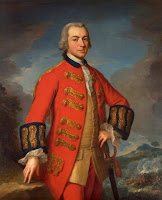
Gen. Henry Clinton

The British received reports that the French fleet under de Grasse might be headed for New York.  His local spies still told him that General Washington was focused on efforts to retake New York.  Although Washington had given up on that idea by mid-August, his musings about taking New York over the summer continued to come to Clinton in intelligence reports.

When the British fleet returned on August 16th, Clinton wrote to Admiral Graves suggesting an attack on the very small French presence that remained in Newport, Rhode Island.  Clinton had received intelligence that the fleet under de Grasse was headed for Newport, and thought the British fleet might seize the town again before de Grasse arrived.

Around this same time, the French and American armies left New York to begin their march across New Jersey. By late August, Clinton received intelligence reports telling him that the enemy was marching toward Baltimore.

Several officers under Clinton argued that the British should move into New Jersey and chase down the enemy armies while they were on the march.  Clinton dismissed these proposals, fearing the marches were a ruse to draw them out of Manhattan so that the enemy could attack the city while the bulk of the British army was in New Jersey.

Clinton still believed that Washington could not seriously hope to march to Yorktown.  The British navy could defeat the fleet under de Grasse.  The combined French and British armies did not have the overwhelming force to take Cornwallis’ defenses, and the British could evacuate by sea in the event of an unlikely military defeat.

These beliefs convinced  Clinton remained that Washington’s march was just an attempt to draw the British into New Jersey.  

A small British fleet under Admiral Samuel Hood had also sailed up from the West Indies and found no real enemy naval presence in the Chesapeake.  Hood, however, was concerned that the French fleet under de Grasse might be able to control the waters around Yorktown.  Hood continued on and arrived in New York at the end of August, but found General Clinton and Admiral Graves unconcerned about any possible attack on the British southern army at Yorktown.  Graves was still awaiting the repair of several ships.  Clinton was still concerned that de Grasse might target New York and that the enemy’s march to the south was just a ruse.

Lord Cornwallis

Similarly, in late August, General Cornwallis remained unconcerned.  His army outnumbered his enemy. Cornwallis had a force under his command of between 7000 and 8000 soldiers.  The army he faced, led by Lafayette, Anthony Wayne, and Baron Von Steuben numbered less than 2000, which could grow for short periods with the use of local militia.  But the prior experience with Virginia militia had proven them less than formidable.

Because General Clinton did not believe that Washington and Rochambeau were really headed for Yorktown, he didn’t bother to warn Cornwallis of the approaching armies.  After the arrival of the French fleet, Cornwallis saw his opportunity for an escape by sea limited only if the British fleet could take out the French.  

At this time, in late August, Cornwallis had the numbers to defeat the enemy forces against him.  At the very least, he could have marched out and defeated the smaller continental force against him before the larger combined force under Washington and Rochambeau arrived. That was the strategy that Colonel Banastre Tarleton was urging.  But since Cornwallis was not aware of their imminent arrival, he remained contently behind his defensive lines at Yorktown.  

Even after Cornwallis learned in late September that the larger combined French and Continental armies were assembling against him, he refused to attack.  Instead, he later claimed he expected General Clinton to provide reinforcements before he would engage with the enemy.  Of course, those reinforcements would almost certainly have to arrive by sea in order to arrive in time to be of any use.  That meant that the British fleet would have to defeat the French fleet for control of the Chesapeake.

Next week: we’ll see how that turns out when the British and French fleets do battle for control the Chesapeake.

- - -

Next Episode 298 Battle of the Capes 

Previous Episode 296 Eutaw Springs

 Contact me via email at mtroy.history@gmail.com

 Follow the podcast on Twitter @AmRevPodcast

 Join the Facebook group, American Revolution Podcast 

 Join American Revolution Podcast on Quora 
 
Discuss the AmRev Podcast on Reddit

American Revolution Podcast Merch!

T-shirts, hoodies, mugs, pillows, totes, notebooks, wall art, and more.  Get your favorite American Revolution logo today.  Help support this podcast.  http://tee.pub/lic/AmRevPodcast

American Revolution Podcast is distributed 100% free of charge. If you can chip in to help defray my costs, I'd appreciate whatever you can give.  Make a one time donation through my PayPal account. You may also donate via Venmo (@Michael-Troy-20) or Zelle (send to mtroy1@yahoo.com)


Click here to see my Patreon Page
You can support the American Revolution Podcast as a Patreon subscriber.  This is an option making monthly pledges.  Patreon support will give you access to Podcast extras and help make the podcast a sustainable project.

An alternative to Patreon is SubscribeStar.  For anyone who has problems with Patreon, you can get the same benefits by subscribing at SubscribeStar.

Help Support this podcast on "BuyMeACoffee.com"


Visit the American Revolution Podcast Bookshop.  Support local bookstores and this podcast!


Signup for the AmRev Podcast Mail List

* indicates required

Further Reading

Websites

National Washington Rochambeau Revolutionary Route Association: https://w3r-us.org

Marching to Victory: The Washington-Rochambeau National Historic Trail: https://www.battlefields.org/learn/articles/marching-victory-washington-rochambeau-national-historic-trail

Washington-Rochambeau Revolutionary Route: https://www.nps.gov/waro/learn/historyculture/washington-rochambeau-revolutionary-route.htm

How the Battle of Yorktown was bankrolled by Spain and France: https://www.statutesandstories.com/blog_html/how-the-battle-of-yorktown-was-bankrolled-by-spain-france

Bankrolling the Battle of Yorktown: https://www.historynet.com/bankrolling-the-battle-of-yorktown

VIDEO: Robert Selig discussed the routes taken by the armies under Washington and Rochambeau:  https://www.c-span.org/video/?327130-1/march-yorktown

Free eBooks
(from archive.org unless noted)

March to Victory: Washington, Rochambeau and the Yorktown Campaign of 1781 (army.mil).

Baker, William S. Itinerary of General Washington from June 15, 1775, to December 23, 1783, Philadelphia, J.B. Lippincott Co. 1892. 

Johnston, Henry P. The Yorktown Campaign and the surrender of Cornwallis, 1781, New York: Harper & Brothers, 1881.

Rice, Howard C. The American Campaigns of Rochambeau's Army, 1780, 1781, 1782, 1783, Princeton University Press, 1972 (borrow only). 

Tarleton, Banastre A History of the Campaigns of 1780 and 1781, in the Southern Provinces of North America, London: T. Cadell 1787. 

Books Worth Buying
(links to Amazon.com unless otherwise noted)*

Davis, Burke The Campaign that Won America, Eastern Acorn Press, 1970 (borrow on archive.org). 

Fleming, Thomas Beat the Last Drum;: The siege of Yorktown, 1781, St. Martin’s Press, 1963 (borrow on archive.org

Grainger, John D. The Battle of Yorktown, 1781: A Reassessment, Boydell Press, 2005 
(borrow on Archive.org

Ketchum, Richard M. Victory at Yorktown: The Campaign That Won the Revolution, Henry Holt and Co. 2004. 

Lumpkin, Henry From Savannah to Yorktown: the American Revolution in the South, Univ of SC Press, 1981 (borrow on archive.org). 

Philbrick, In the Hurricane’s Eye: The Genius of George Washington and the Victory at Yorktown, Penguin Books, 2019. 

Ward, Christopher The War of the Revolution, Macmillan Company, 1952. 

* As an Amazon Associate I earn from qualifying purchases.


Sunday, January 28, 2024

ARP296 Eutaw Springs


We last left General Nathanael Greene and the southern Continental Army back in Episode 287 when the patriots forced the British to give up most of their outposts in South Carolina, including the large base at Fort Ninety-Six.  By this time, Greene's Continental soldiers were exhausted.  The summer heat and spreading malaria finally convinced Greene to give his men a rest.  In mid-July 1781, Greene set up camp in the High Hills of the Santee where the heat was a bit less oppressive, and the mosquitoes a bit less unbearable.

Eutaw Springs
As the Continentals recovered, the South Carolina state soldiers and militia continued to harass smaller British deployments and supply lines.  Then, after the Dog Days campaign, which I covered in Episode 292, South Carolina General Thomas Sumter released most of the state soldiers and himself left for his plantation in North Carolina.  This left the only significant force still in the field, a relatively small group of militia under Colonel Francis Marion.

Greene wasn’t sure of his next steps.  With Sumter’s state troops mostly gone home, the Continental soldiers under his command felt abandoned, and not particularly motivated to defend a state where the locals seemed to be taking a break.  One possible course of action was to march his Continentals back to North Carolina and take the loyalist stronghold at Wilmington.  Greene was still concerned that the larger British army under General Cornwallis might march south once again to confront his army.  If he took Wilmington, then marched north to link up with Lafayette's division in Virginia, the two of them might take on Cornwallis there.

Moving his small Continental army north, however, might give the appearance that the patriots were ceding South Carolina.  With discussion of a European peace negotiation, leaving the state might cause a negotiation to cede South Carolina to the British.  There was also word of a French fleet sailing up from the West Indies, which Greene hoped might cooperate with him in an effort to retake Charleston.  In the end, Greene opted to remain in South Carolina and continue to harass the British presence there.

Maintaining an Army

On August 5, Greene deployed the cavalry under Colonel Light Horse Harry Lee to reconnoiter the enemy.  Several days later, Lee reported using his sixty horsemen to attack a British supply train escorted by 300 British infantry.  The enemy held formation and repulsed Lee’s attack.  Lee believed he could continue to harass the British on the outskirts of Charleston, and requested that Greene send more infantry to back up his cavalry.

But with most of the state soldiers having gone home, Greene did not think this was the right time to risk his army in a major assault on Charleston.  There was also the issue of marching back through swampy lowlands at the height of malaria season.  Only Colonel Marion’s militia remained active in the field around this time.

Instead, Greene focused on rebuilding an army that could be a real threat to the British in South Carolina.  Greene wrote to Colonel William Henderson, who had taken command of what was left of Sumter’s Brigade, and also to Andrew Pickens to assist in the enlistment of 500 men for one year to support the Continentals in South Carolina.  He also wrote to General Jethro Sumner to recruit an army in North Carolina that could be of assistance.

It was also around this same time that word spread of the execution of Isaac Hayne in Charleston.  This assisted with recruiting as South Carolinians were inspired to fight to avenge Hayne’s murder.

In early August, Governor John Rutledge returned to the state, arriving in Greene’s Camp.  Rutledge meant that Greene could coordinate with a civil authority that might also help to get more men to join the fight. 

Greene and Rutledge had known each other for nearly a year by this time.  There is a funny story about Greene and Rutledge having to share a bed shortly after the Battle of Guilford Courthouse.  Each man complained during the night that the other was hogging most of the space in the bed and nearly pushing the other one out of it.  After a time, they realized that an actual hog had climbed into bed with them and was looking for it's own warm night’s rest as well.

The two men had a good working relationship.  Both men agreed that they needed to raise more troops and do whatever was necessary to keep people from failing to pick a side.

Shortly after his arrival, Rutledge issued a proclamation to prevent the militia from plundering civilian homes.  This was a concern that might cause popular opinion to turn against the cause.  Rutledge also issued orders to Marion that no soldier should be granted leave for any reason other than sickness.  Any man who refused to serve should be sent to British lines and have his property confiscated.  The family of any man who was serving with the British would also be removed from their homes and sent to the British.  He also ordered arrest and property confiscation of several merchants who had cooperated with the British in the past, despite their current willingness to back the patriot cause, as well as the execution of any “negroes” who granted any aid or assistance to the enemy.

Greene also realized he needed to ensure the soldiers under his command did not show signs of mutiny.  Making an example was considered an important part of this.  Sergeant John Hadley was brought up on charges of being disrespectful to an officer, and of stating that he would never again endeavor to injure the enemy.  Essentially, the sergeant was saying that he was done with the war and would no longer take orders.  Greene ordered a court martial.

Perhaps due to bad timing, the court martial met on August 5, the day after the British execution of Isaac Hayne.  The court found the sergeant guilty and ordered his execution.  The following day, General Greene ordered the army to parade and bear witness as Sergeant Hadley was shot and killed.  

Greene also hanged other soldiers around this same time.  All of these were Continental soldiers who had deserted and had joined with loyalist forces against the patriots.  Several others convicted of desertion or plundering were punished with severe lashings.

Return to the Field

One August 23, 1781, Greene’s Continentals broke camp and took his army back into the field.  His army has spent just over one month in camp and was ready to reengage with the enemy.

The largest remaining British force in South Carolina, outside of Charleston, was the force that Lord Rawdon had left at Orangeburg after giving up Camden and Fort Ninety-Six.  After Rawdon gave up his command and returned to London, command fell to Lieutenant Colonel Alexander Stewart.  

Back in June of 1781, Colonel Stewart had arrived in South Carolina in command of the 3rd Regiment of Foot, one of three regiments sent to Charleston as reinforcements.  Stewart was an experienced officer, a veteran of the Seven Years War, about 40 years old and with over 25 years in the army. This, however, appears to have been his first deployment in North America.

Stewart was the officer who opposed the plan by Lord Rawdon and Nisbet Balfour to send a relief force to protect the British outpost at Fort Ninety-Six.  There was also a fight about overall command in the South.  General Cornwallis had left Rawdon in command, but the newly arrived Stewart outranked him.  Eventually Rawdon led the attempt to relieve Fort Ninety-Six.  Stewart brought out his own relief force to assist Rawdon, eventually settling in Orangeburg, about 70 miles northwest of Charleston.

The British force at Orangeburg held a good defensive position, which is why Greene avoided an attack there before giving his army a rest in August.  That said, many South Carolina leaders wanted to remove this last British outpost and force all of the enemy back into Charleston.  

While the Americans were in camp, the British had begun to spread out again.  Stewart had taken a position as McCord’s Ferry, about twenty miles north of Orangeburg and only about 15 miles south of Greene’s Camp in the high hills.  

Flooding, however, made a direct approach for either army impossible. Greene marched his Continentals north to Camden so that they could approach the enemy from another direction. Greene left his soldiers who were too sick for duty in Camden, then marched the rest toward the British camp.  By September 1, the Continentals were camped near Beaver Creek, just outside of the loyalist stronghold at Orangeburg.  Greene remained there for several days, awaiting expected reinforcements under Henderson and Pickens.

By September 7, the Continentals were at Burdell’s Plantation, only about seven miles from the enemy. Most of the militia and state troops had arrived, and Greene planned his attack for the following morning.

Plan of Attack

Using an unorthodox deployment that had worked well for him in recent battles, Greene deployed his militia in front.  Of course this time, the lines would not simply be awaiting a British attack.  He expected those troops to advance on the enemy.  Most of the militia were experienced soldiers.  There were two battalions from South Carolina and two from North Carolina. The right flank fell under the command of Colonel Marion.  Andrew Pickens led the left flank. 

 The two center battalions were led by Continental Colonel François Malmédy-Gray, better known as the Marquis de Malmédy.  I haven’t mentioned Malmédy before.  He was one of the first French officers to join the Continental Army, arriving in Rhode Island in late 1776, nearly a year before Lafayette.  Before that he had been serving as a lieutenant in the French army in Martinique.  Lieutenant Malmédy briefly served as a brigadier general with the Rhode Island militia, before receiving a colonel’s commission in the Continental army.  Malmédy complained to Washington that he was not commissioned as a general, but got nowhere. Later Washington transferred him to serve under General Horatio Gates.

Malmédy appears to have remained a troublesome officer.  After Gates was defeated at Camden and Greene took command, Malmédy spent time badmouthing Greene and calling for his removal.  Greene eventually sent Malmédy to North Carolina to recruit militia and obtain more supplies.  Malmédy returned with a brigade of North Carolina militia in time to participate in the battle.  Greene gave him command of the center of his front line.

Backing up this front line of militia were two small field cannons, three pounders.  The artillery came under the command of Captain Lieutenant William Gaines.

Continentals made up the rear line.  On the right, the North Carolina line marched under the command of General Sumner.  Colonel Otho Holland Williams commanded the right, made up of the Maryland line.  In the center, Lieutenant Colonel Richard Campbell led two regiments of the Virginia Line.

Greene also deployed an advance force of about 200 South Carolina State troops under the command of Lieutenant Colonel William Henderson and Light Horse Harry Lee’s cavalry. In reserve, Greene held William Washington’s Continental Dragoons, and the Delaware line under Captain Robert Kirkwood. Greene formed his men into four columns and began the march before dawn on September 8.

Battle

Despite his proximity to the enemy, the British commander had no idea that an attack was imminent.  The British had lost most of their cavalry and were unable to conduct effective reconnaissance.

At around 6:00 AM, two American deserters entered the British camp and told Colonel Stewart that he was about to be attacked.  Stewart deployed Major John Coffin with 140 infantry and 50 cavalry to investigate.


After marching about three miles, Coffin spotted the American advance force under Henderson and immediately ordered a charge.  The South Carolina soldiers held their ground and returned fire, killing five and wounding others from the attacking force.

Greene moved his army from columns into lines. The British advance force under Coffin continued to return fire as it slowly fell back.  By about 9:00 AM the American advance made contact with the main British force.

Stewart had three regiments of British regulars, supplemented by Provincial regiments, primarily from New York and New Jersey.  These were mostly experienced soldiers who had been fighting in the southern campaign for over a year.  Provincial Lieutenant Colonel John Harris Cruger, the former commander of Fort Ninety Six, commanded the advance line. Stewart also deployed Major John Majoribanks in a blackjack thicket along the river to cover the British right.

Behind the British right flank was a large brick house that gave coverage to the entire battlefield and whose walls were strong enough to block musket balls.  Stewart ordered a detachment of New York Provincials to take cover in the house and fire from the second story windows if the Americans were able to push forward.

Greene probably expected that his front line of militia would break and fall back after a few volleys.  While many of the militia had fought in skirmishes before, few of them were experienced in field battles that required them to stand in lines and exchange fire with the enemy.  The British fired into their line, including using field cannons.  The militia, however, held their lines and continued to fire volleys back at the British.

Colonel Williams later noted that “It was with equal astonishment that both the second line and the enemy second line and the enemy contemplated these men, steadily, and without faltering advance with shouts and exhortations, into the hottest of the enemy’s fire, unaffected by the continual fall of their comrades around them.”

The two lines stood and continued fire for some time.  Eventually, the North Carolina militia under Malmédy began to falter.  Greene pushed forward the Continentals under Sumner to hold the line.  Eventually, patriot lines began to run low on ammunition.  As the rate of fire began to decrease, the loyalist provincials rushed forward with a bayonet charge.

The patriots withdrew in good order, then pushed forward again.  Williams’ command of the American right flank advanced into the British lines.  On the American left, the British fire from the blackjack thicket took a heavy toll on the Maryland line.  Greene ordered Colonel Washington to advance into the thicket with his dragoons and the Delaware infantry to clear out the enemy fire.  Washington charged his horsemen into the thicket quickly, with the infantry unable to keep up. 

When the British held their position, Washington’s horsemen found themselves in the midst of the wooded thicket, unable to maneuver their horses effectively.  The British fire decimated the horsemen.  Washington’s horse was shot.  When it fell, the colonel was trapped under his horse.  A British soldier rushed forward and bayoneted Washington in the chest.  The cavalry were decimated by the time the Delaware infantry finally arrived and was able to push back the British line in the thicket.

As the American left advanced, the British defenders took their position inside the brick house ,as planned. Some of Lee’s infantry chased the British into the house, hoping to gain access before they could close the doors.  There was apparently a real struggle at the door, but the British managed t close it.  The Americans had to pull back, using prisoners as human shields against the fire from inside the house.

As the Americans pushed into the British camp, behind the main lines, the army seemed to dissolve. Exhausted and hungry soldiers fell out of line and began pillaging the tents for food and anything else of value.  As the American lines fell apart, the British counter attacked.

Greene had brought up his six-pounder cannons to use against the brick house as the Americans tried to push back against the British counterattack in their camp. Colonel Campbell fell, mortally wounded.  The artillery crews drew heavy fire from provincial riflemen inside the house, taking heavy casualties.  The British then pushed forward and seized the cannons from the enemy and pulled them back to their own line.  They also drove the American looters out of their camp and sent them running.

Although the British successfully recaptured the camp, their leader, Major Majoribanks was fatally wounded in the fighting.  The Americans pulled back to a wood line, then rallied again.  By this time, the fight had been in full engagement for hours.  The Americans were running low on ammunition and water.  At this point, General Greene opted to pull back and withdraw.

Aftermath

Given the ferocity of the fighting and the unwillingness of either side to back down, the casualty rates were extremely high.  The well-directed rifle fire from the house particularly took its toll on American officers.  56 Officers and 40 sergeants were killed or wounded.  Colonel Washington managed to survive his bayonet wound to the chest, but was taken prisoner. Militia General Andrew Pickens also survived a bullet wound to the chest, which troubled him for the rest of his life.  In total, the Americans took over 500 casualties - about a quarter of those engaged.  The British suffered an even higher casualty rate, of about 450 killed and wounded, and another 350 captured.

Greene Medal for Eutaw Springs
Both commanders claimed victory.  Greene reported a total victory over the enemy. Although he left the field, he had left a picket guard behind to watch the enemy.  Greene had nothing but good things to say about his officers, even Colonel Lee, who many others criticized that day for not remaining with his cavalry during the battle and being all over the place.  

Stewart claimed a British victory to his superiors, since he had held the field at the end of the day.  However, the British casualties forced him to withdraw over the following days, eventually having to pull back to the main British lines around Charleston.  From a strategic level, that was Greene had hoped to accomplish in the first place. Greene also withdrew.  A week later, his army was back in camp in the High Hills of Santee.

A few skirmishes continued in the following days, but both sides needed to contend with their large numbers of wounded.  Eutaw Springs would be the last major battle of the war in the Carolinas.  

Next week, we move north again, as George Washington attempts to move the combined French and Continental Armies south toward Virginia.

- - -

Next Episode 297 March to Yorktown 

Previous Episode 295 New London Raid

 Contact me via email at mtroy.history@gmail.com

 Follow the podcast on Twitter @AmRevPodcast

 Join the Facebook group, American Revolution Podcast 

 Join American Revolution Podcast on Quora 
 
Discuss the AmRev Podcast on Reddit

American Revolution Podcast Merch!

T-shirts, hoodies, mugs, pillows, totes, notebooks, wall art, and more.  Get your favorite American Revolution logo today.  Help support this podcast.  http://tee.pub/lic/AmRevPodcast

American Revolution Podcast is distributed 100% free of charge. If you can chip in to help defray my costs, I'd appreciate whatever you can give.  Make a one time donation through my PayPal account. You may also donate via Venmo (@Michael-Troy-20) or Zelle (send to mtroy1@yahoo.com)


Click here to see my Patreon Page
You can support the American Revolution Podcast as a Patreon subscriber.  This is an option making monthly pledges.  Patreon support will give you access to Podcast extras and help make the podcast a sustainable project.

An alternative to Patreon is SubscribeStar.  For anyone who has problems with Patreon, you can get the same benefits by subscribing at SubscribeStar.

Help Support this podcast on "BuyMeACoffee.com"


Visit the American Revolution Podcast Bookshop.  Support local bookstores and this podcast!


Signup for the AmRev Podcast Mail List

* indicates required

Further Reading

Websites

Eutaw Springs: https://www.battlefields.org/learn/revolutionary-war/battles/eutaw-springs

Eutaw Springs: https://www.carolana.com/SC/Revolution/revolution_battle_of_eutaw_springs.html

Kyte, George W. “General Greene’s Plans for the Capture of Charleston, 1781-1782.” The South Carolina Historical Magazine, vol. 62, no. 2, 1961, pp. 96–106. JSTOR, http://www.jstor.org/stable/27566339

Free eBooks
(from archive.org unless noted)

Greene, George Washington The Life of Nathanael GreeneVol. 1Vol. 2, & Vol. 3, New York: Cambridge Univ. Press 1867-1871. 

Hartley, Cecil B. Life of Major General Henry Lee & The Life of General Thomas Sumter, New York: Derby & Jackson, 1859. 

Lee, Henry Memoirs of the War in the Southern Department of the United States, Washington: Peter Force, 1827. 

McCrady, Edward The History of South Carolina in the Revolution, 1780-1783, New York: The Macmillan Co. 1902.  

Ramsay, David The History of the Revolution of South-Carolina, from a British province to an independent state, 1749-1815, Vol. 2, Trenton: Isaac Collins, 1785. 

Simms, William G. The Life of Francis Marion, New York, Derby, 1854. 

Weigley, Russell Frank The Partisan War: the South Carolina Campaign of 1780-1782, Univ. of SC Press, 1970 (borrow only). 

Books Worth Buying
(links to Amazon.com unless otherwise noted)*

Buchanan, John The Road to Charleston, Univ. of Va Press, 2019. 

Dunkerly, Robert M. & Irene Boland Eutaw Springs: The Final Battle of the American Revolution’s Summer Campaign, Univ. of SC Press, 2017. 

Golway, Terry Washington's General : Nathanael Greene and the triumph of the American Revolution, H. Holt, 2006. (borrow on Archive.org)

Lumpkin, Henry From Savannah to Yorktown: the American Revolution in the South, Univ of SC Press, 1981 (borrow on archive.org). 

Oller, John The Swamp Fox: How Francis Marion Saved the American Revolution, Da Capo Press, 2016 (borrow on archive.org).

Swager, Christine R. The Valiant Died, The Battle of Eutaw Springs, September 8, 1781, Heritage Books, 2019. 

Tonsetic, Robert L. 1781: The Decisive Year of the Revolutionary War, Casemate, 2011 (borrow on archive.org). 

* As an Amazon Associate I earn from qualifying purchases.

Sunday, January 21, 2024

ARP295 New London Raid


We last left General Benedict Arnold in Virginia, where his raid on Richmond encouraged General Henry Clinton to send reinforcements to the state.  It also encouraged General Charles Cornwallis to move up from the south to join the fighting in Virginia.  

Arnold had proven Virginia to be relatively weak, but he did not remain there long.  Many other British officers still did not trust Arnold.  His fight with the Navy over a share of the booty in Virginia did nothing but add to his reputation as a greedy officer who put personal profit above duty.  He left Virginia after Cornwallis arrived.  He claimed he was sick, but by most accounts he did not seem to suffer from anything serious, other than gout.  By June of 1781, he was back in New York City, with nothing to do.

Arnold in New York

Arnold may have had personal reasons for returning to New York.  He had left behind his wife Peggy, who was pregnant with her second child.  On August 29, the Arnolds welcomed their son James Robertson Arnold, named after Major General James Robertson, the Royal Governor of New York.  Robertson was one of the few officers to befriend Arnold shortly after his arrival behind British lines.

Arnold Viewing the Destruction
 of New London
Arnold was also still trying to obtain money.  In November of 1780, he had managed to obtain a British ensign’s commission for his son, Benedict Arnold VI, who was 13 at the time.  After his return to New York in 1781, he granted commissions to his two sons Richard (age 12) and Henry (age 9) as lieutenants in his own regiment.  

He did this, despite the fact that the three boys were still living with his sister Hannah, in Connecticut, behind enemy lines.  By granting them commissions, the three boys would receive pay as officers, and that pay would be collected by their father.

Even other British officers willing to overlook his years fighting with the enemy, did not trust Arnold.  Arnold's efforts to line his pockets simply didn’t sit well.  One British officer in New York wrote to a friend that Arnold “has hurt himself by discovering too much fondness for cash. . . . If he has attached to the latter, as is represented, he is no loss to the cause he has deserted and eventually can be no acquisition to us.”

His wife Peggy, however, seemed to fit in quite well.  Not that she also wasn’t concerned about money.  She learned that Major Andre had sent £200 to the Arnolds at West Point, to help them flee to New York.  When the plot fell apart, the money never arrived before they had to flee.  After Peggy arrived in New York, she tracked down the British agent who was supposed to have delivered the money and demanded he pay it to her.

When Peggy first arrived, other officers’ wives gave her the cold shoulder.  As the wife of a rebel traitor, and as a colonist, they didn’t think much of her.  But over time, Peggy’s good manners and charm won over most of them.  One woman noted that a British Officers’ ball, Peggy “appeared as a star of the first magnitude, and had every attention paid to her as if she had been Lady Clinton.”

Arnold’s efforts to enrich himself also did nothing to endear him to the British Commander, General Henry Clinton.  The General still felt the loss of Major Andre and believed that Arnold’s behavior contributed to the loss of that beloved officer.  Arnold’s American Legion had also proven a major disappointment.  Arnold had promised that thousands of American soldiers would join him in his new loyalist command.  Instead, he only enlisted a few hundred men, almost all of whom were already loyalists before Arnold switched sides.  During his time in Virginia, much of his regiment deserted, meaning he returned to New York with a legion of only ninety officers and men.

Shortly after Arnold first joined the British, he also wrote to Secretary of State Germain, advising the government on strategies to win the war, and differing from the strategies of General Clinton, were inherently critical of General Clinton’s strategies.  Arnold also asked for a promotion to major general.  Clinton, of course, had received word of Arnold’s letters to London.

Clinton and Arnold apparently had a conversation about this after Arnold returned from Virginia to New York in June.  A short time later, Arnold wrote again to Lord Germain, this time being much more supportive of General Clinton’s strategies. 

Instead of another command, Clinton assigned Arnold to various administrative duties, including coming up with a list of names of American sympathizers in Quebec.

Raid on New London

General Clinton continued to hope for substantial reinforcements from Europe.  In early August, 1781, he received 3000 Hessians.  A few weeks later, a fleet from the west Indies brought three regiments of regulars.  That was a help, but not nearly enough to go on offensive operations.

Arnold still wanted to lead a British army to capture West Point. Clinton refused to consider it.  Even after Clinton received word that a combined army of Washington’s Continentals and the French Army from Rhode Island was marching south, he refused to take any offensive actions against the American defenses around New York City. 

Sir Henry, however, was willing to consider a raid on civilian towns.  Arnold suggested a series of raids along the New England coast.  Although Clinton was not ready to embark on an entire campaign of raids, he would consider allowing one raid.  

Connecticut had proven to be a thorn in the British side ever since they had captured New York.  Patriots raids from Connecticut against Long Island kept the British from securing the distant parts of that island.  Connecticut harbors also supported fleets of privateers that harassed British shipping.

On September 2, 1781, Clinton gave orders for Arnold to raid the American port at New London Connecticut. New London was only a few miles from Arnold’s boyhood home. He would be attacking his former friends and neighbors.  I sometimes wonder if Clinton chose this target as a way of forcing Arnold to prove his loyalty to the British cause.  

Clinton, of course, had other reasons for such an attack.  A privateer had captured a British transport ship, the Hannah, in early August, carrying valuable cargo.  It was one of hundreds of prize ships taken to New London over the course of the war.  Another motive for the attack was that, with the enemy headed to Virginia with most of its forces, a raid to annoy the enemy posed little risk.  The raiders would likely only face resistance only from local militia.  It was clear by this time that the enemy was not going to attack New York City, so sending soldiers out of the city for a raid would not create a worry about the defenses in New York.

Almost as soon as Arnold received the orders, he heard rumors that Clinton might rescind them and keep Arnold in New York.  Clinton seemed to second guess himself quite often these days, and regularly changed his strategic views.  To avoid giving Clinton an opportunity to reconsider, Arnold had his forces aboard ship and was sailing for Connecticut before dawn on September 4.

Arnold’s target New London, Connecticut was a port on the eastern side of the coast, just north of the eastern tip of Long Island.  The town was set along the Thames River.  The area was a harbor used primarily by privateer ships that prevented the passage of British supply ships in and out of New York.  To access New London, ships would have to sail into the mouth of the Thames River, under the cannons of Fort Griswold.  There were no Continental troops in the area.  The fort and other defenses were manned by militia, most of whom would have to leave their homes and get to their defenses once someone spotted the enemy.

Arnold moved up the Long Island sound with a fleet of 32 ships carrying about 1700 soldiers.  He personally would lead about half of the attacking force against the town of New London.  By the night of September 5, the fleet was at the mouth of the Thames River, but an unfavorable wind prevented them from entering.  

At dawn the following morning the lookout at Fort Griswold spotted the enemy fleet and fired two cannon shots to alert the local militia of an imminent attack. Just after firing the second warning shot, the British fleet fired a third shot.  Three shots indicated a prize ship entering the harbor.  Arnold knew this and ordered the third shot fired in order to confuse the enemy.  Militia who might have dropped everything and rushed the fort after the two shot signal, would likely ignore the three shot signal.  This confusion would slow the militia from turning out.

Arnold’s division of about 900 men landed just south of New London, near the lighthouse.  The general deployed four companies to attack the smaller Fort Trumbull by land.  Fort Trumbull was set up with several large cannons to bombard any enemy ships trying to move up the Thames River.  Its small garrison of 24 officers and men were not prepared to defend against a land attack.  

The fort commander, Captain Adam Shapley ordered his men to fire a volley of grapeshot against the attackers.  The garrison then spiked the cannons and jumped into nearby rowboats to sail across the river to the larger Fort Griswold.

Having taken Fort Trumbull, Arnold continued his march northward, he encountered another small redoubt at a place called Fort Nonsense.  Again, the defenders opened fire but then quickly retreated as the enemy advanced.

Arnold’s forces quickly took possession of New London, although many of the ships they hoped to capture or destroy had time to sail up river.  Arnold set about burning all buildings or supplies of any military value in the town.  Many of the loyalist soldiers with Arnold were also from Connecticut and very familiar with the town.  According to Arnold, the men moved to the northern end of town first, setting fire to buildings, while moving back to the south.  

The goal was not to burn private property, but when one of the fires hit on a hidden cache of gunpowder, the explosion set a larger area of the town on fire, assisted by the wind.  This destroyed much of the town.  The raiders also took as prisoners several citizens of New London who were known to favor the patriot cause.

In all, later reports indicated sixty-five homes were burned, along with thirty-one stores and warehouses and twenty barns.  The Episcopal Church, the courthouse, jail, market and customs house were all put to the torch, as were the wharves and any ships that had failed to escape.  

Arnold reported six of his own soldiers had been killed and another six wounded, while he inflicted the same number of casualties on the enemy.

Battle of Groton Heights

While Arnold was destroying New London, the other half of his raiding party landed on the eastern shore of the Thames, with the task of taking Fort Griswold.  British Lieutenant Colonel Edmund Eyre led a force of about 800 regulars, loyalists, and Hessian Jaegers, against the fort.  He also brought several artillery pieces.

Fort Griswold was a small star fort atop a hill that overlooked the Thames River.  Like the other forts, it was designed to deter enemy ships from moving upriver.  Connecticut had built the fort in late 1775, after the outbreak of the war, and completed it in 1778.

The fort did not have a large regular garrison, but expected to be garrisoned by militia when the enemy approached.  Because the British managed to confuse the canon signal, only a portion of the militia arrived quickly.  Connecticut Colonel William Ledyard arrived that morning, and eventually accumulated about 160 men, including those who had evacuated from Fort Trumbull.

The British had to push their way toward the fort through swampy and heavily wooded terrain, taking several hours.  General Arnold had already taken New London before Colonel Eyre could reach the fort.  From across the river, it appeared to Arnold that the fort was too well fortified.  Also, one of the main reasons Arnold had wanted to take the fort early was so that the British could use the fort's cannons to prevent American ships from escaping upriver unharmed.  Since the ships had already escaped, and given the fort’s defense, Arnold sent a messenger to call off the attack on the fort.

Before the messenger could arrive, Colonel Eyre arrived at the outskirts of the fort with a portion of his men.  Eyre sent Captain George Beckwith under a flag of truce. Colonel Ledyard came out of the fort to parley. The British officer demanded the fort’s surrender, but the American commander refused.  Both parties returned to their lines.  Eyre believed a direct assault on the fort would be successful but costly.  He sent a second demand for surrender, informing the defenders that if they refused to surrender, the garrison would be denied quarter once the British took the fort.  Ledyard replied that they would resist to the last extremity.  With that, the men once again returned to their lines and prepared for battle.

Colonel Eyre led a group of soldiers against the southwest bastion of the fort.  At the same time, Major William Montgomery led a second assault against the eastern side of the fort.  Both assaults met with fierce resistance from the garrison.  The defenders unleashed grapeshot from the fort’s cannons.  Although they took heavy casualties, the attackers reformed and continued to advance.  Colonel Eyre and several of his officers were wounded. 

The second assault force under Montgomery came under similar fire. Montgomery was killed in hand to hand combat with the enemy, allegedly by a militiaman using a ten foot pike.  The man who claimed to kill Montgomery was Jordan Freeman, a free black militiaman who had previously been a slave to Colonel Ledyard.  Despite the resistance and the loss of their leader, Montgomery’s division forced open the main gate and allowed both divisions to swarm into the fort.  What happened next is a matter of controversy.

Fort Griswold Massacre

According to American witnesses, the fort defenders attempted to surrender.  The attackers ignored the calls for quarter and continued to cut down the surrendering garrison.  According to one account Colonel Ledyard attempted to hand his sword to an enemy officer as that officer stabbed Ledyard. The British officer then took Ledyard’s sword and used it to stab him again.  Another soldier, Lamboth Latham then killed the British officer who just killed Ledyard.  Latham himself was then killed by the enemy.

British testimony after the fact claimed that they were not aware the Americans were trying to surrender.  Others said that at one point the fort’s flag came down, which they thought was a surrender, then was raised again as the defenders continued to fight.  They believed this to be a false claim of surrender.  Therefore, they did not believe the enemy when they tried to surrender again once the British were inside the fort.

The British had taken heavy casualties during the storming of the fort.  That and the death or wounding of most of their officers may have accounted for the decision to continue killing an enemy that was trying to surrender.  American witnesses said that the British continued the slaughter and only stopped when they believed their continued fire might blow up the fort’s powder magazine.

British reports filed after the battle reported 48 British soldiers killed and another 145 wounded, almost all of whom were hurt in the assault on Fort Griswold.  That was roughly one-fourth of the division that assaulted the fort.

When the British entered the fort, survivors reported that the defenders had lost only about a half dozen killed.  After the attempted surrender and subsequent massacre, nearly the entire garrison was dead or wounded.  Arnold reported 85 Americans dead in the fort, and another sixty wounded, most of them believed to be mortally wounded.

Aftermath

After completing their day of destruction, both British divisions withdrew back to their boats before dark.  The raiders took their wounded, their prisoners, and their booty back aboard their fleet and sailed back to New York City.

Although the raid was a British success, both sides criticized Arnold.  The Americans, of course, were outraged at the butchering of surrendering soldiers.  They blamed Arnold as the commander, even though he was nowhere near the fort when it happened.

Many of Arnold’s own officers and men were critical of their commander for remaining in New London and leaving the much bloodier fight against Fort Griswold to others.  They also said that Arnold greatly under-reported British casualties, claiming it was more like 400 or 500 men killed or wounded.  They called it a “Bunker Hill Expedition” recalling the 1775 battle when the British took the hill but suffered intolerable losses in doing so.

Whether the higher casualty estimates are accurate is impossible to say.  But the criticism does make clear that those serving under Arnold did not respect nor trust their commander.

After his return to New York City, Arnold requested leave to go to London.  He wanted to confer with Secretary Germain and other officials on a strategy to win the war.  Clinton refused to let Arnold go, and instead kept him in the city, once again behind a desk, pushing paper.  He remained in New York for about three months, when news of the events in Virginia arrived, along with General Cornwallis, who was on parole.

Cornwallis and Arnold both boarded a ship for London.  Arnold’s family also sailed on a separate ship for London. The family took more comfortable quarters aboard a merchant ship.  Arnold and Cornwallis had to sail on a military ship to reduce the chances they might be captured by the enemy.  As they sailed out of New York, it would be the last time either Arnold or Cornwallis would set foot in the United States.

Next Week: we return to South Carolina for the Battle of Eutaw Springs.

- - -

Next Episode 296 Eutaw Springs 

Previous Episode 294 Dogger Bank

 Contact me via email at mtroy.history@gmail.com

 Follow the podcast on Twitter @AmRevPodcast

 Join the Facebook group, American Revolution Podcast 

 Join American Revolution Podcast on Quora 
 
Discuss the AmRev Podcast on Reddit

American Revolution Podcast Merch!

T-shirts, hoodies, mugs, pillows, totes, notebooks, wall art, and more.  Get your favorite American Revolution logo today.  Help support this podcast.  http://tee.pub/lic/AmRevPodcast

American Revolution Podcast is distributed 100% free of charge. If you can chip in to help defray my costs, I'd appreciate whatever you can give.  Make a one time donation through my PayPal account. You may also donate via Venmo (@Michael-Troy-20) or Zelle (send to mtroy1@yahoo.com)


Click here to see my Patreon Page
You can support the American Revolution Podcast as a Patreon subscriber.  This is an option making monthly pledges.  Patreon support will give you access to Podcast extras and help make the podcast a sustainable project.

An alternative to Patreon is SubscribeStar.  For anyone who has problems with Patreon, you can get the same benefits by subscribing at SubscribeStar.

Help Support this podcast on "BuyMeACoffee.com"


Visit the American Revolution Podcast Bookshop.  Support local bookstores and this podcast!


Signup for the AmRev Podcast Mail List

* indicates required

Further Reading

Websites

Benedict Arnold Turns and Burns New London https://connecticuthistory.org/benedict-arnold-turns-and-burns-new-london

The Battle of Groton Heights https://revolutionarywar.us/year-1781/battle-groton-heights

The Battle of Groton Heights, September 6, 1781: The Fort Griswold Massacre: https://emergingrevolutionarywar.org/2017/07/17/the-battle-of-groton-heights-september-6-1781-the-fort-griswold-massacre

VIDEO: The Life of Lt. Col. William Ledyard Groton Municipal Television: https://archive.org/details/gmtvct-The_Life_of_Lt._Colonel_William_Ledyard


Free eBooks
(from archive.org unless noted)

Burnham, Norman H. The Battle of Groton Heights: A Story of the Storming of Fort Griswold, and the Burning of New London, on the sixth of September, 1781, New London: Bingham Paper Box Co.'s Print, 1903. 

Copp, John J. The Battle of Groton Heights, Groton Heights Centennial Committee, 1879. 

Harris, William Wallace The Battle of Groton Heights: A Collection of Narratives, Official Reports, Records, &c., of the Storming of Fort Griswold, and the Burning of New London by British Troops, Under the Command of Brig.-Gen. Benedict Arnold, on the sixth of September, 1781, New London: 1870. 

Hempstead, Stephen Description of the monument on Groton Heights, with the inscription and names, New London: Williams & Bacon, 1853. 

Ollier, Edmund Cassell's History of the United States, Vol. 2, London: Cassell, Petter & Galpin, 1874.

Rathbun, Jonathan The Narrative of Jonathan Rathbun, of the capture of Fort Griswold, the massacre that followed, and the burning of New London, Conn., September 6, 1781. With the narratives of Rufus Avery and Stephen Hempstead, eye witnesses, New York: W. Abbatt, 1911. 

Rogers, Zabdiel & Thomas Mumford Groton Heights and New London, Brooklyn, N.Y., Priv. print. 1881. 

Books Worth Buying
(links to Amazon.com unless otherwise noted)*

Brandt, Clare The Man in the Mirror: A Life of Benedict Arnold, Random House, 1994 (borrow on archive.org). 

Jacob, Mark Treacherous Beauty: Peggy Shippen, The Woman Behind Benedict Arnold's Plot to Betray America, Lyons Press, 2012 (borrow on archive.org).

Willcox, William B. Portrait of a General; Sir Henry Clinton in the War of Independence, Knopf, 1964 (borrow on archive.org)

Merrill, Jane & John Edicott The Late Years of Benedict Arnold: Fugitive, Smuggler, Mercenary, 1780-1801,  Mcfarland, 2022. 

* As an Amazon Associate I earn from qualifying purchases.