Sunday, August 21, 2022

ARP253 Connecticut Farms


We last left the main armies around New York City in Episode 246, in the spring of 1780. For nearly four years, Washington had kept his main army just outside of New York City, waiting for an opportunity to recapture what he had lost.  Britain had taken the city and the surrounding islands  in 1776, but since then had seen almost no success in being able to expand outside of the immediate area and permanently occupy the region around it.  The British had used New York as a base to capture other areas such as Philadelphia, or Newport, Rhode Island, but had to withdraw from those possessions after a short time anyway. 

Connecticut Farms
British General Clinton had hoped to end that stalemate by capturing Charleston and beginning a new offensive in the south.  In doing so, he took the bulk of his army, leaving New York in its weakest state since the British had captured it in 1776.  Hessian General Wilhelm von Knyphausen held the region with only a few thousand soldiers, mostly Hessians and loyalist militia.  

But if British defenses at New York were weak, the Continentals were even weaker. Washington’s army was starving and on the verge of mutiny.  The Continentals were in no condition to launch a major spring offensive against New York.  The British navy still controlled the waters around New York, meaning that even if the Americans did somehow retake the city, they would be vulnerable to being surrounded and captured.  Consequently, General Washington waited for the promised arrival of a French army and a French fleet to help him deliver the final blow to the British in New York. June of 1780 was mostly sitting around waiting for the arrival of the French.

Trumbull v. Watt

With much of the British forces to the south, the Continental Navy managed to get one of its frigates out of Connecticut and into the Atlantic Ocean.  Congress had approved the  28-gun Trumbull to be built in 1775, but shortages and delays meant that this was her maiden voyage, leaving in May, 1780.  

The Trumbull
Captain James Nicholson commanded a crew of about 200 men.  Nicholson was the most senior captain in the Continental Navy, ahead of more notable men such as John Paul Jones or John Barry.  Most accounts I’ve read say that he received such a position of prominence mostly because he came from a wealthy and well-connected family in Maryland at a time when Congress was trying to get southern states more involved in the war.  Nicholson was an experienced officer though.  He was with the British when they invaded Havana at the end of the Seven Years War.

In the Revolution, his career had been rather undistinguished.  Captain Nicholson lost his first ship, the Virginia, when he ran it aground in the Chesapeake Bay trying to escape from a British ship.  The captain fled, leaving his ship and crew to be captured.  He returned the next day under a flag of truce, but only to collect his personal property from the captured ship.  Despite this, Congress gave him command of the Iris, but he lost that after his crew refused to fight.

Nicolson’s command of the Trumbull in 1780 seemed like a final opportunity to prove himself worthy of his command.  When the Trumbull spotted a sail in the Atlantic about 250 miles north of Bermuda, Captain Nicholson closed in for an attack.  The other ship turned out to be the Watt, a British privateer out of Liverpool.  The 32-gun Watt and the 28-gun Trumbull were pretty evenly matched as they approached one another.  The two ships sailed within firing range in the early afternoon of June 1, and opened fire. The battle ensued for about two and a half hours, with the ships circling each other at nearly point blank range and firing as fast as they could.  Both ships took serious damage and were in danger of sinking.  Eventually, the Watt sailed away to New York.  The Trumbull was too damaged to pursue and instead headed to Boston for repairs.  The American crew took about 40 casualties to the Watt’s 90.  But since neither ship managed to capture or sink the other, the battle is generally considered a draw.

British Division

Back on land though, the armies in New York and New Jersey with limited manpower mostly struggled to survive the freezing winter and await reinforcements.  In late May, word of the British capture of Charleston reached New York.  Hessian General Knyphausen knew that General Clinton would soon return to New York, but exactly when was uncertain.  It had taken the British fleet more than a month to sail from New York to Charleston in bad weather.  Clinton had sent word to Knyphausen that he was on his way and that Knyphausen should be prepared to launch an offensive against the Continentals, once he returned.  But those messages never reached New York, so Knyphausen was left in the dark.

Wm Von Knyphausen

Even without orders, Knyphausen knew that Clinton would return.  Knyphausen had received intelligence that the Continental Army under Washington at Morristown had fallen to about 3500 men.  He also knew the enemy was starving and on the verge of mutiny. Knyphausen saw an opportunity to sweep into northern New Jersey, hit Morristown, and possibly destroy what remained of Washington’s army.

Supporting Knyphausen’s plan to invade New Jersey were New Jersey’s royal governor, William Franklin, and New York Governor James Robertson.  Franklin, the royal Governor of New Jersey had been forced from his position in 1776 and taken prisoner by the rebels.  The son of Benjamin Franklin remained in a Connecticut jail for two years, before finally being exchanged in a prisoner swap.  He was sent to British-occupied New York where he consistently advocated for aggressive actions to recapture New Jersey.  He also helped organized loyalist militia, often used for guerilla raids into New Jersey.

James Robertson and only arrived in New York a few weeks earlier.  While Clinton was away taking Charleston, London replaced New York Governor William Tryon with Robertson.  Tryon and Clinton had clashed regularly. Tryon advocated using the army to attack civilian targets, which Clinton opposed. Tryon wanted to destroy morale among the patriots by imposing destruction and misery, and Clinton had a very different policy.  

Tryon was an army general as such had to take orders from General Clinton.  But since he was also governor, he had authority to act on his own in his civilian capacity.  This often led to conflicts. Clinton’s complaining about this eventually led to Robertson replacing Tryon as governor.  Tryon remained in New York as a major general, but was frustrated that Clinton would not give him a command after his raids against Connecticut towns in 1779.  As a result, while Tryon was around for the summer, he would return to London in September, 1780.

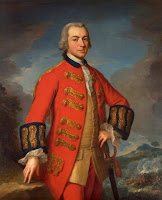
James Robertson

Robertson was also a major general in the regular army.  His background is a bit unusual.  The son of a Scottish freeholder, Robertson did not come from poverty, but his family did not have a title or political connections.  It certainly did not have enough money to buy a commission for him.  Robertson got his start in military life by enlisting in the marines.  He was one of the few men of his time who started as a private, but then was able to receive a position as an officer through merit.  He showed conspicuous bravery in leadership in several actions including some under Admiral Vernon in the West Indies, where he served along with Lawrence Washington, a young colonist whose half-brother George would later rise to prominence.

James Robertson
In 1746, Robertson was able to raise enough money to purchase a captaincy in the regular army.  Robertson had cultivated the patronage of several powerful men, including the Earl of Loudon.  That, along with a marriage to an English woman who brought a substantial dowry, permitted him to advance in rank.  He served in America during the French and Indian War, primarily as a staff officer, in charge of quartermaster or other administrative duties. Even so, his abilities and his political connections allowed him to rise in rank. The British commander Jeffrey Amherst helped Robertson receive his lieutenant colonelcy.  He then served under General Thomas Gage, as Barack-master for North America, responsible for the quartering of regulars, something that became a point of contention in the early 1770s.

As open rebellion in the colonies drew closer, Robertson received a commission as brigadier general in America, which would only apply as long as he remained there, and did not come with a bump in pay. Robertson was in Boston during Lexington and Bunker Hill.  His duties remained administrative.  Although he regularly volunteered to lead men in combat, he remained sidelined, eventually evacuating Boston in early 1776 with the rest of the army.

Robertson led a battalion at the battle of Long Island, but only in the second wave, meaning he did not see much combat.  His administrative skills and ability to work with locals helped him to win an appointment as the military commandant of occupied New York.  His reputation in that role was a man of compassion, who tried not to create unnecessary suffering, even for rebels, but at the same time focused on restoring the king’s authority.

In February, 1777, Robertson returned to London, carrying General Howe’s dispatches about the rebel attacks at Trenton and Princeton.  Robertson spent considerable time with Lord Germain, mostly supporting General Howe’s leadership.  Two years later, in 1779, Robertson testified extensively before Parliament, where he was highly critical of General Howe’s actions that had allowed the Continental Army to escape New York and then strike back.  He also advocated for a policy that stressed diplomacy with the colonists, and less reliance on brute military force.  Robertson believed the colonists were mostly disposed to being loyalists, if treated properly.  

It was during this time when Robertson was supporting Germain against Howe in the Parliamentary hearings, that Germain decided to appoint Robertson as the new governor of New York, although it would be another year before Robertson actually took the position.  His commission was signed in May 1779, but Robertson did not arrive in New York City until March 1780.  At the time General Clinton was down in South Carolina and General Knyphausen was considering his plans to attack the Continentals in New Jersey.

Connecticut Farms

Even though Knyphausen had received no word from General Clinton, the support of Governor Robertson and New Jersey Governor Franklin gave him enough backing to proceed with an invasion into New Jersey.  The governors were convinced that the Continentals were on the verge of collapse, and that the long-suffering local New Jersey population would welcome a return to peace, stability, and prosperity under the king’s rule.  They only needed the British to show up and give them a push.

The British assembled a force of about 6000 regulars, Hessians, and loyalists, split into two divisions. The first came under the Command of Brigadier General Thomas Stirling.  The second commander was Major General Edward Mathew.  A smaller third division which Knyphausen commanded himself, along with General Tryon, would also cross into New Jersey and be available as needed. 

The plan was to cross the harbor into New Jersey at night, landing in Elizabethtown at about midnight on the morning of June 7.  From there, Stirling’s division would march north to capture Springfield and Hobarts Gap, while the ships that had carried them would return to New York and continue ferrying Mathew’s division to Elizabethtown.  Stirling’s capture of Hobarts Gap  would give the British a relatively straight shot at Morristown where they would attack what remained of Washington’s main army.

Lord Stirling
General Washington, of course, was well aware of the dangers of a British offensive.  The British had made several forays into New Jersey over the winter.  The Continental officer with overall responsibility for American defenses was Major General William Alexander, Lord Stirling, no relation to the British division commander Thomas Stirling.  More directly responsible for the area was Brigadier General William Maxwell, also a Continental general from New Jersey.

As the British began their landing at Elizabethtown in the early night hours of June 7, Maxwell’s New Jersey militia opened fire.  There were only a few dozen defenders to hold off a landing of thousands of enemy soldiers, so there was no expectation that this would be anything other than harassing fire.  The militia, however, managed to hit General Stirling. He would survive, but command of his division fell to Hessian Colonel Ludwig von Wurmb

The ensuing confusion slowed the move out of Elizabethtown.  Meanwhile the militia commander at Elizabethtown, Colonel Elias Dayton, sent word to General Maxwell and General Washington that a landing of several thousand of the enemy was taking place at Elizabethtown.  Within hours, Washington was personally leading his Continentals toward the battle, while also sending out alerts for the local militia to turn out.

Around dawn, Colonel Wurmb began the 1st division’s march out of Elizabethtown toward an alerted countryside full of Continentals and militia.  Colonel Dayton had pulled back his militia to the small village of Connecticut Farms (known today as the town of Union) about four miles inland.  His militia tore up several bridges along the way to slow the British advance.  At Connecticut Farms, they were joined by more local militia and backed up by General Maxwell, who had deployed the 1st and 2nd New Jersey regiments to prevent a British flanking maneuver against the militia.

When the British division under Wurmb arrived after daylight, the commander sent out probes to test the enemy’s size and position.  A short time later, General Knyphausen himself arrived on the scene with his third division.  

The Americans managed to fight an effective rearguard action, giving up each house and piece of land at a cost for the attackers.  The British force, which was mostly Hessian and loyalist, had been aggravated by a night of constant harassing fire, let loose on the village, looting and burning homes.

One of the homes was that of Reverend James Caldwell, an infamous rebel according to the loyalists.  Caldwell was known as the fighting parson, having regularly used his sermons to support the patriot cause and the fight against the king’s rule.  Loyalists had burned his church in Elizabethtown a year earlier, at which point he had moved his family to the relative safety of Connecticut Farms.

Reverend Caldwell had also served as a chaplain with Maxwell’s regiments.  At the time of the attack, he was in Morristown with the main Continental Army.  Although most civilians had abandoned their homes, Caldwell’s wife and children remained behind.

Later accounts state that a Hessian soldier deliberately shot Caldwell's wife, Hannah Caldwell, as she and her children cowered in the kitchen of their home.  Whether it was deliberate murder or an accident, Hannah Caldwell was killed instantly by an enemy bullet.  The soldiers then burned the home as the children and the maid fled for their lives.  The murder would soon become another rallying cry for the Americans.

By about 9:30, the British had taken Connecticut farm and then paused again to await the arrival for more reinforcements as well as baggage and artillery.

The Americans under General Maxwell, continued to grow as more militia arrived from the surrounding area.  By 11:00 AM, Maxwell ordered an assault on the British lines, having acquired enough men for a frontal assault, as well as attacks on both the right and left enemy flanks.  Under some heated hand to hand combat, the British held their positions and drove back the Americans, who retreated back to a bridge over the Rahway River.  

Knyphausen had no interest in pursuing the Americans until his reinforcements arrived.  Instead, he dug in and began building entrenchments.  A bit later, General Robertson arrived. Although he had no command in this action, the Governor came over to New Jersey on his own, and brought with him the regiment that Knyphausen had been left to hold Elizabethtown.  Knyphausen was annoyed that Robertson had removed the guard holding the town that he needed for a withdrawal should the Americans get the better of them.  He did not press the matter, since starting a quarrel with the new governor could only cause problems for him later.

As the British dug in at Connecticut Farms, Washington moved the bulk of his main army to Short Hills, a few miles to the north.  With him were his top generals, including Von Steuben, Lafayette, and Greene.  The main army did not join in the fight.  Instead, they took defensive positions in case the British pushed through the thin American lines and continued to move north toward Morristown.

As night fell, the British under Knyphausen remained at Connecticut Farms, getting a poor night’s sleep as they had to remain alert for an attack.

Mass grave marker for British
and Hessian Troops killed
Washington held a council of war and discussed the idea of making a pre-dawn attack on the British camp.  However, a strong rain began to fall around midnight, scuttling any such plans.  The New Jersey militia kept up a harassing fire for most of the night, at least until the rain began, forcing the British and Hessians to burn through much of their ammunition in return fire, and get little rest.

The following morning, Knyphausen took the advice of General Tryon to burn all of the buildings at Connecticut Farms as punishment for the American resistance.  Knyphausen’s goal of taking Morristown was dead by this time.  The Americans had taken up good defensive positions in the hills and more militia seemed to be turning out by the hour.  That evening, Knyphausen ordered the British to return to Elizabethtown and retreat back across the water to New York.  Another evening thunderstorm prevented the Americans from pursuing the retreating army.

When he learned about it the following morning, Washington remained cautious that the retreat could be a ruse to get the Americans out of their defensive positions and fight them on an open field.  He kept the bulk of his army in its defenses, and sent a division of only about 800 men under General Edward Hand to harass the enemy’s retreat.  

Knyphausen left a couple of regiments of regulars and Hessians to hold a rearguard action as he moved the last of his army back across the water to Staten Island.

By the morning of June 9, the British were back on Staten Island or Manhattan, and the battle was at an end.  

The Americans had taken a few dozen casualties while the British had taken nearly 200.  The bulk of these were wounded Hessians who were in the fight with Maxwell’s attack on the morning of the first day of fighting.  The Americans also reported capturing several dozen stragglers who did not retreat quickly enough with the rest of the army.

While the British had failed to take their objective, they were not done yet either.   And we will take up a continuation of the story next week, when we cover the Battle of Springfield.

- - -

Next Episode 254 Springfield 


 Contact me via email at mtroy.history@gmail.com

 Follow the podcast on Twitter @AmRevPodcast

 Join the Facebook group, American Revolution   Podcast: https://www.facebook.com/groups/132651894048271

 Join American Revolution Podcast on Quora 


American Revolution Podcast Merch!

T-shirts, hoodies, mugs, pillows, totes, notebooks, wall art, and more.  Get your favorite American Revolution logo today.  Help support this podcast.  http://tee.pub/lic/AmRevPodcast


American Revolution Podcast is distributed 100% free of charge. If you can chip in to help defray my costs, I'd appreciate whatever you can give.  Make a one time donation through my PayPal account. You may also donate via Venmo (@Michael-Troy-20), Zelle, or popmoney (send to mtroy1@yahoo.com)


Click here to see my Patreon Page
You can support the American Revolution Podcast as a Patreon subscriber.  This is an option making monthly pledges.  Patreon support will give you access to Podcast extras and help make the podcast a sustainable project.

An alternative to Patreon is SubscribeStar.  For anyone who has problems with Patreon, you can get the same benefits by subscribing at SubscribeStar.

Help Support this podcast on "BuyMeACoffee.com"


Visit the American Revolution Podcast Bookshop.  Support local bookstores and this podcast!


Signup for the AmRev Podcast Mail List

* indicates required

Further Reading

Websites

Battle of Connecticut Farms: https://revolutionarywar.us/year-1780/battle-connecticut-farms

Battle of Connecticut Farms: https://www.revolutionarywarnewjersey.com/new_jersey_revolutionary_war_sites/towns/union_nj_revolutionary_war_sites.htm

Battles of Connecticut Farms and Springfield: https://revolutionarynj.org/storylines/battle-of-springfield/

Battle of Connecticut Farms: https://military-history.fandom.com/wiki/Battle_of_Connecticut_Farms

II. General Orders (morning orders), 7 June 1780,” Founders Online, National Archives, https://founders.archives.gov/documents/Washington/03-26-02-0233-0003

“III. From George Washington to Major General Stirling, 7 June 1780,” Founders Online, National Archives, https://founders.archives.gov/documents/Washington/03-26-02-0233-0004

“V. General Orders (second general orders), 7 June 1780,” Founders Online, National Archives, https://founders.archives.gov/documents/Washington/03-26-02-0233-0006

“George Washington to Major General William Alexander, Lord Stirling, 8 June [1780],” Founders Online, National Archives, https://founders.archives.gov/documents/Hamilton/01-26-02-0002-0037

.“VI. General Orders (morning orders), 8 June 1780,” Founders Online, National Archives, https://founders.archives.gov/documents/Washington/03-26-02-0233-0007

“From George Washington to Samuel Huntington, 10 June 1780,” Founders Online, National Archives, https://founders.archives.gov/documents/Washington/03-26-02-0253

Sobol, Thomas T. “William Maxwell, New Jersey’s Hard Fighting General” Journal of the American Revolution, August 15, 2016. https://allthingsliberty.com/2016/08/william-maxwell-new-jerseys-hard-fighting-general

Free eBooks
(from archive.org unless noted)

Corbin, William H. Connecticut Farms, Elizabeth, N.J. Journal press, 1905. 

Duer, William  A. The life of William Alexander, Earl of Stirling, Major-General in the Army of the United States during the Revolution: with selections from his correspondence, New York: Wiley & Putnam, 1847. 

Klein, Milton M. (ed) & Howard, Ronald W. (ed) The Twilight of British Rule in Revolutionary America: The New York Letter Book of General James Robertson, 1780-1783, Cooperstown, NY: New York State Historical Association, 1983. 

Nelson, William (ed) Documents relating to the revolutionary history of the state of New Jersey : extracts from American newspapers, Vol. 4 Trenton: State Gazette Pub. Co. 1914. 

Books Worth Buying
(links to Amazon.com unless otherwise noted)*

Fleming, Thomas, The Forgotten Victory: The Battle for New Jersey - 1780, Reader’s Digest Press, 1973 (borrow on Archive.org). 

Lengel, Edward The Battles of Connecticut Farms and Springfield, 1780, Westholme Publishing, 2020. 

* As an Amazon Associate I earn from qualifying purchases.


Sunday, August 7, 2022

ARP252 Gordon Riots


This week we return to England to go over some important events of 1780.  The American Revolution was beginning its sixth year, and had only become more of a mess with the entry of France and Spain into the war.

Gordon Riots
As with any war, the costs of fighting this one caused pain and sacrifice among the people. Taxes were up to pay for a large army and navy.  Trade was risky due to privateers and enemy naval vessels. After years of pain and sacrifice for the war effort, people begin asking each other, what are we really fighting for, and is it worth it?

More and more criticism circled around King George III.  It was literally treason to criticize the king directly.  For decades, there had been an understanding that the king would remain aloof from politics and that criticism for bad policy would be directed at his ministers only.  But George was much more involved in policy than his predecessors, and saw maintaining control of his North American colonies as something he had to advocate.  As the war’s popularity fell, the king’s reputation sank along with it.

In Episode 237, I discussed some of the demonstrations in Ireland in late 1779 that were an expression of unrest caused by the economic impact of the war.  Workers in England also seemed to be increasingly upset by their situation, and were looking for changes in policy that would make things better.

Yorkshire Association

In December of 1779 a group of freeholders in Yorkshire formed the Yorkshire Association.  The Association sought to petition Parliament for “Economical Reform”.  Specifically, they wanted to do something about high taxes and wasteful positions within the government.  

The Reverend Christopher Wyvill was a large landowner in the Yorkshire area.  He became the driving force behind the new movement.  He hoped to organize not only his area but surrounding counties.  The plan was to coordinate a series of petitions to Parliament to give them more emphasis by them all arriving at once, and to spark reform by responsive politicians in the months leading up to the 1780 parliamentary elections.

Christopher Wyvill
Wyvill began a media campaign, getting area newspapers to print articles about the extravagant spending by the government, the loss of trade, and the general decline in the standard of living for the landed gentry.  He encouraged anonymous letters to newspapers to encourage more people to support his petitions, including a suggestion that the government may revamp its land-tax assessments, to the great disadvantage of the region.

One key line in the petition said “Whence the Crown has acquired a great and unconstitutional influence, which if not checked, may soon prove fatal to the Liberties of this Country.” Many Whigs had been arguing that the king should have nothing more than a ceremonial role in government, much like George I and George II had.  George III’s active involvement in recommending policy to his ministers was seen as an overstep.  The fact that the king’s recommended policies resulted in disaster for Britain was evidence of why kings should not behave this way. The Yorkshire Association, which met in late December 1779 with over 600 landowners present, approved this petition to Parliament. 

The movement spread to surrounding counties and the petitions to Parliament grew.  By early 1780, Parliament had received 40 such petitions signed by thousands of voters.  Considering that only a little over 200,000 people had the right to vote in Britain at this time, members of Parliament took these numbers seriously.

Discussion began of organizing these protest groups into a “National Assembly” or “Anti-Parliament” to return political power to the people, by which they meant the full 3% of the population who owned land, and the right to vote - not just a few hundred aristocrats, who really controlled all power at this time.  The freeholders wanted their own influence on government to be greater.  They were not looking to  give political power to the other 97% of British subjects who could not vote.

Criticism

Even this limited assertion of power by the landed class was unprecedented.  The movement drew great controversy for involving small landowners in public policy, something that should be left to their betters.  Stirring up the voters was bad enough.  But criticizing the king’s role in government was arguably criminal sedition.    

While controversial, these ideas were not new. Radical Whigs had discussed the idea of a new national body before, and also had traditionally supported that the king be limited to a ceremonial role only.  Many earlier pamphlets had also suggested creating a new political organization. But this had only been talk until this time.  The current political climate seemed to be giving these ideas a chance of actual enactment.

Opponents derisively referred to the new protest organizations as a “Congress” making reference to the treasonous Continental Congress in America that also challenged government authority.  The House of Commons was supposed to represent the common people, again, by which I mean the 3% of voters who owned land but who did not have aristocratic titles.  Having another political body organized by these same people to counter the House of Commons seemed absurd, unless the criminal motive of overthrowing the government was the real motive.  The House of Commons was really controlled by a small elite group through some very creative districting and other practices that really kept the Commons under the effective control of aristocratic families.

Other proposals suggested greatly expanding the House of Commons to allow in new blood that would help enact these popular reforms.  Again, opponents saw this as dangerous interference in the fundamental structure of the government, by people who could not possibly understand the ramifications of their suggested changes.

Members of parliament especially saw this as a direct attack on their authority.  Although these were just petitions, talk at the political meetings already predicted that Parliament would reject them and that they would have to take more extreme measures to reassert political power.  Calls to take “the Irish receipt” meant to emulate Ireland, which was on the verge of revolution itself, to take extra legal actions to force the change.  One option discussed was a tax boycott, everyone simply refusing to pay their taxes.  Such action might not only cause the war effort to fail, it might lead to another civil war within Britain.

Dunning Motion

There were radical Whigs in Parliament, particularly the Rockinghamites who tried to use this movement to their advantage.  Another prominent Whig, John Wilkes, also got involved.  Wyvill and the Yorkshireists, were reluctant to join with current career politicians, believing they would simply co-opt the movement and real reforms would not happen.

John Dunning
Even so, many members of Parliament who were up for reelection in these areas wanted to show they were on the side of the radicals and could be instruments of change.  On April 6 John Dunning called for a vote on two questions.  Dunning was a member of the radical Whig establishment.  He had been solicitor general of England and Wales, and had been a member of Parliament for more than a decade.  At the same time, he aligned himself with the radicals.  Dunning had served as one of the attorneys who defended John Wilkes many years earlier when the crown was trying to destroy Wilkes.  Dunning had a reputation as a liberal reformer and someone who fought against costly pensions and sinecures for well-connected elites, although he was not above taking them himself..  

Dunning’s motions called on Parliament to vote on a resolution that said "the influence of the crown has increased, is increasing, and ought to be diminished."  The second motion said that "it is competent to this house to examine into and correct abuses in the expenditure of the civil list revenues, as well as in every other branch of the public revenue, whenever it shall appear expedient to the wisdom of the house so to do".  In other words, Parliament should address the concerns of the petitioners.

The Prime Minister, Lord North, strongly opposed these motions as a direct attack on the King.  The first motion could have been treated as sedition.  It was not, in part because the ministry knew the position was a politically popular one.  Whigs especially, and the government more generally wanted the king to remain aloof from policy and to leave that to his ministers.  That was what the Yorkshire petitions were demanding.  Despite the Prime Minister’s opposition, Dunning's motion passed by a vote of 233-215.  The vote was a warning to both the ministry and to George III himself.  A king who involved himself in public policy that became unpopular, could result in the king himself becoming unpopular with his subjects.

Dunning’s other motion was a little less controversial.  Of course Parliament had the authority to review expenditures which Parliament had to pay for, and it passed by acclamation, with no real opposition.  Looking into waste fraud, and abuse at a time when voters are unhappy with expenses is a time-honored practice for politicians of any age.

Whig Principles

Dunning’s motion looked as though it might cause serious problems for government policy.  But another event quickly overtook Parliament’s vote to recommend that the king stay out of politics.  

Gordon leads Anti-Catholic Rally
Whig ideology held as its core principles not only the role of Parliament over the King in running the government, but also the supremacy of Protestantism and suppressing Catholicism.  To the modern listeners the anti-Catholic sentiment might seem strange.  For those in the Church of England, the fight with Catholics was not over obscure doctrine like whether transubstantiation was real, or if confession should be a sacrament.  Rather, it was much more political.  Protestants viewed Catholic loyalty to the Pope as a risk to all liberties.  Protestants often derisively referred to Catholics as “papists” for their slavish obedience to the Pope.

Papal authority was seen as absolute and would not safeguard traditional rights of Englishmen.  English Protestants looked at the rights in Catholic countries like France or Spain as proof of this point.  Allowing Catholics to have a place in British society put fundamental liberties at risk.  

A good modern comparison might be the way some modern conservative Christians in the west view Islam.  Whatever the disagreements over religious doctrine, the driving antipathy has more to do with the way Christians view the governments and lack of freedom in self-proclaimed Islamic countries, and they don’t want that to be imported. 

That is what Protestants thought of Catholicism in the 18th century.  The English Civil War, only a century earlier, had been fought primarily because Parliament wanted to prevent King James II from allowing more Catholics to have a place in British society, and also to ensure the primacy of Parliament over the king in setting policy.

George Gordon

Another radical Whig member of Parliament was George Gordon.  As the third son of a Duke, Gordon was not in line to inherit a title, but did come from a wealthy and influential family.  At the age of seven, his family purchased an army ensign’s commission for him.  When he was eleven, however, he decided to join the navy instead.  Several years before he resigned his naval commission at the ripe old age of twenty-five, Gordon got elected to parliament.  Another member of parliament essentially bought him a seat so that Gordon would not run against him for a different seat.

George Gordon
Gordon was an outspoken opponent of the war in America and even spoke in favor of American independence.  A regular critic of the North Ministry, Gordon was also a pretty disagreeable guy who would also attack other radical Whigs. He regularly attacked the Whig leader James Fox.

As the Yorkshire movement was gaining steam in late 1779 and early 1780, Gordon had another issue that he was used to stir up the public.  In 1778, Parliament had passed the Papists Act, which was actually a reform to an earlier 1698 law.  Now before you get too excited that I’m going to do a deep dive into the legislative history of this matter, I’ll warn you that I need to keep it short.

The 1698 Popery Act was passed by Parliament a few years after the Glorious Revolution that threw out James II and brought in William and Mary because James was seen as too friendly to Catholics. The Popery Act, along with laws passed around this time, barred Catholics from purchasing or inheriting land, which also meant that they could not vote.  It also prevented Catholics from serving in the British Army and called for life imprisonment for any priest saying mass or educating students in Britain. 

The 1778 Papists Act was a liberal reform of some of these earlier measures.  It was sponsored by John Dunning, the same radical Whig, who I just mentioned earlier had sponsored the motion to tell the King to stay out of  politics.  Dunning’s 1778 bill said that if a Catholic subject took an oath they could have certain rights restored.  

The oath rejected the authority of Catholic claimants to the British throne.  It rejected the Pope’s legal authority over British subjects.  It also swore that the oath taker would not follow any Catholic edicts to kill the Protestant King of Britain.  If a Catholic subject took this oath, the 1778 act permitted him to purchase or inherit land, and also to join the army.  The act also removed the penalty of lifetime imprisonment for a priest saying mass within Britain.

The 1778 Act was an important wartime measure.  It would help with enlistments by allowing Catholics to enlist in the army.  It was also seen as a way of preventing a rebellion by Catholics, particularly in Ireland, if the government grew too weak as a result of the war.

Gordon Riots

Some radical Whigs, like Gordon, were horrified when these reforms passed.  The following year, Gordon formed the Protestant Association, devoted to repealing these reforms.  Gordon successfully prevented the Scottish Parliament from passing a reform bill similar to the Papists Act passed by Parliament.  With that success, he attempted to get the British Parliament to repeal the bill.

Gordon Riots
On May 29, 1780, Gordon called for a march on Parliament, to take place on June 2.  The purpose of the march was to deliver a petition to repeal the Papists act of 1778 and to make sure Catholics had no place in Britain. Gordon gave numerous speeches about the dangers of letting Catholics into the army, that these reforms would allow Catholics to restore an absolute monarchy and that, despite any oaths, they would work with Catholics on the continent to overthrow the Protestant government in Britain.

Historians who looked into the matter argue that the protesters who marched on June 2 were not just motivated by anti-Catholic views.  They represented a much larger anti-government sentiment, motivated by a stagnating economy, inflation, and unemployment.  There was also a large contingent of anti-war protesters - although many were probably against the war primarily because of its impact on the economy.

With the mob outside of Parliament, Gordon entered the House of Commons to deliver the petition.  As the protesters waited outside, some of them began attacking the carriages of members who were just arriving at Parliament.  House members scrambled to summon a detachment of regulars to disperse the mob.  They then overwhelmingly voted down the petition by a vote of 192-6.

Rioters at Newgate Prison
Although the crowd left Parliament, angry protesters continued to march through the streets of London. That night, they attacked several foreign embassies which were known to have Catholic chapels in them.   They also destroyed the homes of several wealthy Catholics who lived in London.  Officials called out the constables who arrested a number of rioters, but the mayor did not read the Riot Act, which would have permitted authorities to force the rioters to return home or face violent consequences.

The following night, June 3, the rioters invaded the neighborhood of Moorefields where many poor Irish Catholic immigrants worked. The rioters burned homes and beat up suspected Catholics.  The rioters also attacked Newgate Prison, freeing rioters being held there from the prior night.  Someone scrawled on the wall that the prisoners were freed by  “His majesty, King Mob”

Regulars suppress riots
Over the next three nights, mobs rampaged through London, wreaking havoc and destroying property.  One June 7 the protesters burned the home of the Lord Chief Justice, Lord Mansfield.  They also attacked the Bank of England, and were only thwarted by the arrival of several companies of regulars who defended the bank.  Similarly soldiers had to block a mob trying to assault the prime minister’s home at 10 Downing Street.

Even after five days of open and uncontrolled rioting, the Lord Mayor still refused to read the Riot Act.  He was a radical Whig himself and did not want to be seen as crushing his own political supporters.  By the night of June 7th, however, military officials had had enough.  They issued orders to regulars to go out into the streets and fire on any groups of four or more people who refused orders to disperse.

The regulars ended up shooting and killing 285 protesters and wounding an estimated 200 more.  I suspect that number is low because many wounded people probably returned home and did not seek medical care since it might result in their arrest.  Authorities did end up arresting about 450 protesters.

Aftermath

The Gordon Riots, as they came to be known, were probably the worst London had ever seen.  I think only the Great Fire of London before the Riots, and the Battle of Britain much later during WWII were the only events that did more damage to the city.

Between twenty and thirty leaders were tried and executed.  Lord Gordon was charged with high treason for his role, but was acquitted.  His lawyers argued successfully that Gordon had only intended to create political pressure for his petition, which was designed to protect Britain and the King from outside threats.  Because he did not intend for the riots to destroy Britain, he could not be found guilty of treason.

The riots also damaged the political career of John Wilkes, who led a militia against the rioters in an attempt to restore order. The rioters were just the sort of people who usually supported Wilkes, so his attempts to subdue them cost him politically.  Lord Mayor Brackley Kennett, who had refused to read the riot act against the protesters, was later convicted of criminal negligence and fined.

The riot also damaged Britain’s reputation abroad. The ministry had been attempting to draw Catholic Austria into an alliance against Spain and France.  These anti-Catholic riots in London resulted in an end to those talks. Britain had also opened secret negotiations with Spain to get it to end its war with Britain.  After hearing of the riots, Spain also ended negotiations, not necessarily because of the anti-Catholic sentiment of the riots, but because the Spanish believed the British government was close to collapse.

The Gordon Riots remained a deep scar on London and would be remembered for generations.

Next time, we return to New Jersey, where British forces from New York destroy the town of Connecticut Farms.

- - -

Next Episode 253 Connecticut Farms 


 Contact me via email at mtroy.history@gmail.com

 Follow the podcast on Twitter @AmRevPodcast

 Join the Facebook group, American Revolution   Podcast: https://www.facebook.com/groups/132651894048271

 Join American Revolution Podcast on Quora 


American Revolution Podcast Merch!

T-shirts, hoodies, mugs, pillows, totes, notebooks, wall art, and more.  Get your favorite American Revolution logo today.  Help support this podcast.  http://tee.pub/lic/AmRevPodcast


American Revolution Podcast is distributed 100% free of charge. If you can chip in to help defray my costs, I'd appreciate whatever you can give.  Make a one time donation through my PayPal account. You may also donate via Venmo (@Michael-Troy-20), Zelle, or popmoney (send to mtroy1@yahoo.com)


Click here to see my Patreon Page
You can support the American Revolution Podcast as a Patreon subscriber.  This is an option making monthly pledges.  Patreon support will give you access to Podcast extras and help make the podcast a sustainable project.

An alternative to Patreon is SubscribeStar.  For anyone who has problems with Patreon, you can get the same benefits by subscribing at SubscribeStar.

Help Support this podcast on "BuyMeACoffee.com"


Visit the American Revolution Podcast Bookshop.  Support local bookstores and this podcast!


Signup for the AmRev Podcast Mail List

* indicates required

Further Reading

Websites

Black, Eugene Charlton. “The Tumultuous Petitioners: The Protestant Association in Scotland, 1778-1780.” The Review of Politics, vol. 25, no. 2, 1963, pp. 183–211. JSTOR, http://www.jstor.org/stable/1405622 

Butterfield, H. “The Yorkshire Association and the Crisis of 1779-80.” Transactions of the Royal Historical Society, vol. 29, 1947, pp. 69–91. JSTOR, https://doi.org/10.2307/3678550

Christie, Ian R. “The Yorkshire Association, 1780-4: A Study in Political Organization.” The Historical Journal, vol. 3, no. 2, 1960, pp. 144–61. JSTOR, http://www.jstor.org/stable/3020473 

Christie, Ian R. “Economical Reform and ‘The Influence of the Crown’, 1780.” Cambridge Historical Journal, vol. 12, no. 2, 1956, pp. 144–54. JSTOR, http://www.jstor.org/stable/3021092

Kilburn, Matthew Association Movement https://www.oxforddnb.com/view/10.1093/ref:odnb/9780198614128.001.0001/odnb-9780198614128-e-104413

The Papist Act of 1778 (full text): https://members.pcug.org.au/~ppmay/acts/relief_act_1778.htm

The Popery Act of 1698 (full text): https://www.british-history.ac.uk/statutes-realm/vol7/pp586-587

Donovan, Robert Kent. “The Military Origins of the Roman Catholic Relief Programme of 1778.” The Historical Journal, vol. 28, no. 1, 1985, pp. 79–102. JSTOR, http://www.jstor.org/stable/2639376

Rudé, George F. E. “The Gordon Riots: A Study of the Rioters and Their Victims: The Alexander Prize Essay.” Transactions of the Royal Historical Society, vol. 6, 1956, pp. 93–114. JSTOR, https://doi.org/10.2307/3678842

Jones, Brad A. “‘In Favour of Popery’: Patriotism, Protestantism, and the Gordon Riots in the Revolutionary British Atlantic.” Journal of British Studies, vol. 52, no. 1, 2013, pp. 79–102. JSTOR, http://www.jstor.org/stable/41999182

The Gordon Riots: https://www.nationalarchives.gov.uk/pathways/blackhistory/rights/gordon.htm

The Gordon Riots Mapped: https://georgiasouthern.libguides.com/gordonriotsmapped/home

Gordon Riots of 1780: https://penandpension.com/2015/11/24/the-gordon-riots-of-1780

Gordon Riots: https://www.newadvent.org/cathen/06649c.htm

White, Jerry "The Gordon Riots, 1780" London Historianshttps://www.londonhistorians.org/index.php?s=file_download&id=45

VIDEO Gordon Riots, Prof. Ian Haywood: https://www.youtube.com/watch?v=1gd4Mbh8tm8

Free eBooks
(from archive.org unless noted)

“Protestant gentleman” A Dispassionate Enquiry into the Causes of the Late Riots in London: in which the arcana of popery are candidly disclosed, London: Printed for J. Almon and J. Debrett, 1781. 

Butterfield, Herbert George III, Lord North, and the People, New York: Russell & Russell, 1949 (borrow only).

Burke, Edmund Some Thoughts on the Approaching Executions (from The Writings and Speeches of Edmund Burke - Google books).

Dickens, Charles Barnaby Rudge: a tale of the riots of 'eighty, New York: Harper & Brothers, 1874. 

Holcroft, Thomas A plain and Succinct Narrative of the Gordon Riots of 1780, Emery Univ. 1944 (from Hathitrust).

O'Beirne, Thomas Lewis Considerations on the late disturbances, London: Printed for J. Almon, 1780. 

Smelt, Leonard, An Account of some Particulars relating  to the Meeting held at York, London: T. Becket, 1780 (Qspace). 

Smelt, Leonard, The Yorkshire question, or petition, or address: (being a short and fair state of the case, upon the principles, the views, the means, and the objects of both parties as confessed by themselves) : most earnestly and seriously addressed to the consideration of the people of England assembled in their several county, city, and other meetings, London: J. Almon, 1780.  

Watson, Robert The Life of Lord George Gordon: with a philosophical view of his political conduct, London, Printed for H. D. Symonds, 1795. 

Williams, David A plan of association on constitutional principles, for the parishes, tithings, hundreds, and counties of Great Britain, by which the outrages of mobs, and the necessity of a military government will be prevented, and the English constitution in a great measure restored, in 3 letters to a Member of Parliament, London: Printed by G. Kearsly, 1780. 

Wyvill, Christopher A state of the representation of the people of England, on the principles of Mr. Pitt in 1785; with an annexed state of additional propositions, by the Rev. Christopher Wyvill, W. Blanchard, 1793.

Wyvill, Christopher Political papers, chiefly respecting the attempt of the county of York, and other considerable districts, commenced in 1799 ... to effect a reformation of the parliament of Great-Britain, Vol 1, York: W. Blanchard, 1794 (Google Books). 

Books Worth Buying
(links to Amazon.com unless otherwise noted)*

Bindman, Yirmeyahu Lord George Gordon, Cis Pub, 1991. 

Christie, Ian R. Myth and Reality in Late-Eighteenth-Century British Politics, and Other Papers, Univ. of California Press, 1970.

Christie, Ian R. Wilkes, Wyvill and reform; the Parliamentary reform movement in British politics, 1760-1785, London: Macmillan; New York, St. Martin's Press, 1963 (borrow on Archive.org).

Frasier, Antonia The King and the Catholics: England, Ireland, and the Fight for Religious Freedom, 1780-1829, Doubleday, 2018.  

Haywood, Ian (ed) & John Seed (ed) The Gordon Riots: Politics, Culture and Insurrection in Late Eighteenth-Century Britain, Cambridge Univ. Press, 2012. 

Hibbert, Christopher King Mob: The Story of Lord George Gordon and the Riots of 1780, Hippocrene Books, 1989.

Nicholson, John The Great Liberty Riot of 1780, BM Bozo,1985


* As an Amazon Associate I earn from qualifying purchases.


Sunday, July 24, 2022

ARP251 Waxhaws Massacre


We last left South Carolina in Episode 248 where the greatest American loss of the war led to the capture of the entire southern army under General Benjamin Lincoln at Charleston.  British General Henry Clinton had assembled one of the largest British armies of the war and used a cautious siege strategy to capture the entire American army inside the city.

Following that victory, General Clinton prepared to return to New York City with roughly one-third of his army, leaving the remainder under General Cornwallis to control the southern colonies now under British authority: South Carolina, Georgia, and East and West Florida.  Cornwallis also had authority to take North Carolina on his own initiative if the opportunity presented itself.

Clinton Plan for Peace

Clinton issued two decrees before leaving South Carolina. One threatened the seizure of the property of any person who continued in rebellion against the King. The other granted a full pardon to anyone who peaceably returned to the King’s rule, despite whatever past acts of rebellion he might have committed.  Although he had imprisoned the Continental Army officers and solders who were captured at Charleston, Clinton permitted the South Carolina militia to return home on parole, with only the promise that they never again take up arms against the King.

Battle of Waxhaws
Clinton had requested Charleston loyalist James Simpson determine the leanings of South Carolinians, particularly in the backcountry, following the fall of Charleston.  Simpson divided his fellow colonists into four groups.  The first, were the rather wealthy who had seen the problems living under independence and were more than happy to return to royal rule.  The second group were people who had no particularly strong political views, who had also become disenchanted by patriot rule and were perfectly willing to support the king. The third group were rebels who had become convinced the cause was lost and would now submit to the reality of British rule.  The fourth and final group consisted of unrepentant rebels who would continue the fight.  Simpson made these groups, but did not seem to guess at how large any of these groups were and admitted that he had no real direct communication with any of the third or fourth groups.  

Simpson’s conclusion though was that peace and order would continue to grow if, and only if, the British continued to provide support and protection via the regular army.  Failure to maintain a strong presence in the colony would only embolden the rebels and allow more to return to a state of rebellion.

Clinton sent three expeditions inland to secure pledges of allegiance and issue pardons.  His reports back to London indicate great success from the response of the locals.

Waxhaws Massacre

Clinton’s strategy of pardons for past wrongdoing, and threats of punishment for future wrongdoing seemed to be working well.  Most South Carolinians were either retiring to their homes, or outright joining the British in loyalist regiments.

There were still a few pockets of resistance. Governor John Rutledge and several other top rebel officials had slipped out of Charleston a few weeks before the city’s surrender.  They had met up with a small detachment of Continental soldiers under Colonel Abraham Buford who had been on their way to Charleston, but had not arrived by the time it fell. Buford commanded a little less than 400 men and two small field cannons.  The men at this point were fleeing the state, headed for North Carolina.

Even so, capturing the rebel president would be good public relations, and would remove another possible rallying point for the rebels.  The escaping rebels already had a week’s head start.  Cornwallis deployed his most aggressive field commander, Colonel Banastre Tarleton to capture the party.  With his typical enthusiasm, Tarleton pushed his cavalry, riding more than 100 miles in about two days, through the summer heat, in an attempt to capture the governor.

Tarleton's attack at Waxhaws
On the afternoon of May 29, Tarleton’s force of about 150 cavalry men caught up with Buford near the North Carolina border.  Tarleton’s cavalry were less than half the size of Buford’s force.  With customary bluster, Tarleton demanded Buford’s immediate surrender and claimed to have the Americans surrounded with a superior force.  Buford rejected the offer and put his men into a line of battle.  

Tarleton quickly formed three columns and charged the American lines.  The Continentals held their fire until the cavalry was only ten yards away.  They let loose a devastating volley, but it failed to break the charge.  Tarleton’s cavalry swept over the Continental lines.

During the melee, Tarleton had his horse shot out from under him, but his cavalry continued the attack.  Colonel Buford managed to flee the battlefield on his horse, leaving his men to their fates. The hand-to-hand combat quickly turned into a massacre. The stunned Continentals attempted to surrender, but were shot down anyway.  British soldiers used swords and bayonets to finish off the wounded who lay on the ground.

When the fighting stopped, the British had suffered only five killed and fourteen wounded. The Continentals suffered 113 men killed and 203 wounded, a roughly 80% casualty rate.  The battle of Waxhaws, also known as Buford’s massacre, became a rallying point for the patriots.  It also sealed Tarleton’s reputation as a butcher.  Tarleton later claimed that the men went on a killing spree after he fell, because they assumed he had been killed and wanted to avenge his death. While that excuse may have been accepted by his superiors, it certainly did not fly with the patriots.  The term “Tarleton’s Quarter” became a call for no surrender - kill or be killed in battle.

Governor Rutledge managed to escape before the battle began and found refuge in North Carolina.  From there, he began lobbying the Continental Congress to send a new army to recapture South Carolina, and assisted with efforts to raise resources for resistance within the state.

Clinton’s Proclamation

Several days after the Waxhaws Massacre, General Clinton issued one last proclamation before leaving for New York.  In a prior declaration, Clinton had permitted all rebel militia to return to their homes on parole and receive pardon.  By custom, this meant that parolees were out of the war and could not fight for either side.

Clinton’s June 2 proclamation changed all that.  With the return of the King’s rule, all South Carolinians, including parolees, must swear allegiance to the King and rejoin the fight in the loyalist militias.  In hindsight, this decree has been heavily criticized.  But I can see why it made sense to Clinton.  

Gen. Henry Clinton

Several years earlier, when General Howe captured Philadelphia, he respected the neutrality of most of the local population.  The result was that many patriots simply laid low and remained in the area, meaning the British were never really able to secure the land more than a few miles from their garrisons.

By requiring the locals in South Carolina to pick a side, Clinton could be assured exactly who was with him and who was against him.  He would not have to tolerate thousands of patriots simply biding their time to strike in a moment of weakness.  Most locals would submit to British authority.  Those who did not would be dealt with right away.

But the impact of the proclamation was that many men who had returned home on parole now had a decision to make.  Prior to the proclamation, most of these men seemed to be of the opinion that the war was over for them.  They could return to their plantations and simply focus on rebuilding their lives.  They had a perfect excuse for not joining another patriot army since they had taken an oath not to do so while they remained on parole.

With Clinton’s new proclamation, toiling away on one’s farm under a quiet neutrality was no longer an option. These men had to decide whether they were willing to join a loyalist militia, and go to war against their friends and neighbors, or whether they were going to continue to resist British rule.  There was no in-between.  The result was that many paroled patriot militia returned to the field and became partisans.  

Clinton’s proclamation coming at the same time most South Carolinians received word of the Waxhaws massacre, stirred up war sentiment that had seemed extinct a week earlier.  Irregular partisan groups took to the swamps where they would resist British control of the area and continue the struggle.

Thomas Sumter

One new leader that emerged was Thomas Sumter.  Later known as the Gamecock, Sumter had been an old Indian fighter, before the war.  He was born and raised in Virginia.  Along with George Washington, and many other future leaders, Sumter served in the militia under General Braddock at the beginning of the French and Indian War.  Sumter also served under then-Colonel Adam Stephen in the Anglo-Cherokee war in the 1760s.  Following the war, Sumter accompanied several Cherokee leaders to London.

Thomas Sumter
Debts resulted in the young Virginian serving time in debtor’s prison.  He later settled in South Carolina.  There, he became a justice of the peace and ran a country store.  Soon after, he married into a local planter family allowing him to become a plantation owner.

Sumter was an early supporter of the patriot cause.  He helped raise a militia in early 1776, becoming the lieutenant colonel of the regiment, and later the colonel.  Sumter was leading a regiment of riflemen in Charleston during Clinton’s first attempt to take the city in 1776.  At that time, Sumter played no active role.  As the war raged in New England and then the middle colonies, there really was not much to do for a militia officer in South Carolina.  Sumter had participated in the efforts to invade Florida, which never really amounted to anything.  Sumter only managed to catch a bad case of malaria during the efforts.  In 1778, Sumter resigned his commission and returned home to his plantation.

When the British invaded Georgia and began sending soldiers into South Carolina in early 1779, Sumter remained at home, instead focusing on raising crops and farm animals to sell to the army.  He felt no obligation to return to military command.  Even after the British army began its full-scale siege of Charleston, Sumter remained on his plantation.  During William Washington’s escape from the battle at Monck’s Corner, his troops marched past Sumter’s plantation.  Sumter provided the soldiers with food and even a horse for Colonel Washington, but did so only because the army paid top dollar for the supplies.

It was only in late May of 1780, after learning that Banastre Tarleton was planning to arrest him that Sumter put on his uniform and left his plantation.  Tarleton’s men, frustrated at not finding Sumter at home, looted and burned his plantation.

To do anything, Sumter first had to raise an army.  He stayed ahead of British patrols, riding to find other men, many of whom had served under him in the militia regiment that had been disbanded a few years earlier.  General Clinton’s proclamation that required the men of South Carolina either to join Tory regiments being raised or be branded traitors, forced many men to join guerrilla units like the one Sumter was raising.  Since men could not remain neutral, they would join the patriots.

Sumter began a guerrilla campaign.  His men would hide in swamps. They would attack isolated British units or outposts when the opportunity arose.  They would harass and attack any loyalist plantations that they could target.  Within weeks of fleeing his plantation, the men elected Sumter as their leader and declared him to be a brigadier general of the South Carolina militia.

Francis Marion

Another leader who rose to the occasion was Colonel Francis Marion, later known as the Swamp Fox.  Marion was born in South Carolina and lived on his family’s plantation.  The most interesting story from his youth was the time a 16 year-old Marion boarded a ship for the west Indies.  His ship crashed into a whale and sank.  Marion spent days in a lifeboat, where several members of the crew died for lack of water.  After about a week in the lifeboat, another ship rescued them and he returned home.  

Francis Marion
Since South Carolina did not really play much of a role in the French and Indian War, Marion lived the quiet life of a planter.  Like all white men in South Carolina, Marion served in the militia, but he did not see active duty.  When the Anglo-Cherokee war began, Lieutenant Marion, serving in Colonel William Moultrie’s regiment, saw some action.  He was a witness to some of the brutality that attended that war with the Cherokee, and apparently came away from it with a profound distaste for military service.

Marion returned to the life of a farmer, growing his small plantation over time, largely avoiding any active role in politics.  But in 1774, he was elected to attend South Carolina’s First Provincial Congress, which was a challenge to British colonial authority.  When South Carolina established its patriot militia in 1775, Marion received a commission as a captain, again serving in a regiment commanded by Colonel William Moultrie.

In September, Captain Marion was part of the force that captured Fort Johnson in Charleston Harbor.  A few months later, Marion was part of the 1776 defense of Fort Sullivan against the British attack led by General Clinton.  Marion’s conspicuous efforts that day in defense of the fort led to a commission as a lieutenant colonel in the Continental Army.  Marion commanded the second regiment, stationed in Charleston.  He got a reputation there as a no-nonsense officer who was quick to punish infractions.  More than ¼ of his regiment was subject to lashings for various violations during his leadership.  Colonel Marion was among the officers who argued with the civilian leadership who wanted to surrender Charleston to a British raiding party in 1779.

Colonel Marion led his regiment into combat at the failed siege of Savanna.  He led his men in a charge that saw a nearly 50% casualty rate.  After the battle, the Second Regiment was stationed about halfway between Charleston and Savannah.  It was not until January of 1780, after the British attack on Charleston became clear, that Marion returned to the city.

It is likely that Marion would have been taken prisoner, along with the rest of the Continental Army under General Lincoln, but for an accident.  Marion attended an officer’s party on March 19.  For some reason, he jumped out of a second story window and broke his ankle.  A few weeks later, as the British siege tightened, General Lincoln ordered all officers and men who were unfit for duty to leave the city, in order to conserve food and other resources.  Marion left for home only a few days before the British sealed off most of the escape routes around Charleston.

As a result, Marion was one of the few Continental officers in South Carolina who escaped capture at Charleston.  He could no longer recuperate from his injury at his plantation, as he became a wanted man under the new British authority.  He fled into the local swamps, avoiding capture by British patrols, and continued to wait for his ankle to heal.

Huck’s Defeat

Despite a few rebels hiding the swamps, from the British perspective, South Carolina had fallen.  Capturing the army under Lincoln in Charleston seemed to crush the resistance in the state.  The British set about the task of raising loyalist regiments to control the recaptured colony and crush any remaining signs of resistance.

Martha Bratton Threatened
Banastre Tarleton is often held up as an example of the brutality used to reassert British control.  But Tarleton was far from the only one who believed that harsh treatment was the only way to put down the rebellion.  Another such officer was Christian Huck.

Before the war Huck had immigrated to Philadelphia from a German state.  In his new home, he studied law and became an attorney.  When the war came, Huck was decidedly a loyalist, but like many loyalists in Philadelphia, kept quiet about it to avoid attack by patriot mobs.  When the British took control of the city in late 1777, Huck gladly assisted the army.  

After the British evacuation back to New York in 1778, Pennsylvania added Huck’s name to a list of traitors who had actively assisted the British during the occupation.  The state confiscated his property and threatened to punish him as a traitor if caught.  Huck had seen that his activities during the occupation would not sit well and had already left the city. In June 1778, he received a commission as a captain in a German-speaking loyalist regiment raised in New York.

Huck’s regiment came south with Clinton’s army to take Charleston.  His loyalist infantry fought under Colonel Tarleton at Waxhaws. Huck got a reputation as a tough fighter and a fervent loyalist who had no sympathy for traitors to the crown.  After Waxhaws, Captain Huck operated independently in the backcountry.   His orders were to recruit more loyalist soldiers. 

Huck developed a reputation for a foul mouth and a violent temper, one that did not tolerate anyone who refused to provide unequivocal support to British authority.  Several accounts have him threatening to kill uncooperative civilians as he attempted to capture fleeing rebels.  He and his soldiers burned numerous plantations and other property belonging to suspected patriots.  One account said that his men shot and killed a boy who was just sitting by the road, reading the bible.  I’m sure there is more to the story than that, but clearly these were soldiers who fought for keeps.

You can find several more paintings
related to Hucks Defeat at this link. 
They are modern works to which I
could not get copyright permission
to display here.
In July, Huck led a force of about 120 men, who encamped on the Williamson plantation in York County.  There, they captured five patriots hiding in the corn crib.  The loyalists camped around the plantation house for the night.

One of their targets was Colonel William Bratton, a local patriot militia officer.  Huck had personally threatened to kill Bratton’s wife Martha in an attempt to get her to give up her husband’s location.  Martha managed to get a slave to send a message to her husband, who was camped nearby.  

Bratton marched a force of about 200 South Carolina militia and attacked the loyalists at the Williamson plantation at dawn on July 12.  The battle was over in minutes as the surprised loyalists mostly fled into the woods.  The attackers shot Captain Huck in the head, killing him as he attempted to mount his horse.

The problem with the British treating the patriots so brutally, is that it often resulted in receiving similar treatment from the enemy when the tables were turned.  The militia chased down the loyalists and took out their wrath on those they found.  The loyalists under Huck suffered 85% casualties that day, while the Americans suffered only one killed and one wounded.

Huck’s defeat was one example of many that the British pacification of South Carolina was far from over.  That there were still men ready to fight, and that their numbers would seem to grow over time.

Next week: We head to London where the Yorkshire Association challenges the King’s rule, and the Gordon Riots burn London.

- - -

Next Episode 252 Gordon Riots


 Contact me via email at mtroy.history@gmail.com

 Follow the podcast on Twitter @AmRevPodcast

 Join the Facebook group, American Revolution   Podcast: https://www.facebook.com/groups/132651894048271

 Join American Revolution Podcast on Quora 


American Revolution Podcast Merch!

T-shirts, hoodies, mugs, pillows, totes, notebooks, wall art, and more.  Get your favorite American Revolution logo today.  Help support this podcast.  http://tee.pub/lic/AmRevPodcast


American Revolution Podcast is distributed 100% free of charge. If you can chip in to help defray my costs, I'd appreciate whatever you can give.  Make a one time donation through my PayPal account. You may also donate via Venmo (@Michael-Troy-20), Zelle, or popmoney (send to mtroy1@yahoo.com)


Click here to see my Patreon Page
You can support the American Revolution Podcast as a Patreon subscriber.  This is an option making monthly pledges.  Patreon support will give you access to Podcast extras and help make the podcast a sustainable project.

An alternative to Patreon is SubscribeStar.  For anyone who has problems with Patreon, you can get the same benefits by subscribing at SubscribeStar.

Help Support this podcast on "BuyMeACoffee.com"


Visit the American Revolution Podcast Bookshop.  Support local bookstores and this podcast!


Signup for the AmRev Podcast Mail List

* indicates required

Further Reading

Websites

Brown, Alan S. “James Simpson’s Reports on the Carolina Loyalists, 1779-1780.” The Journal of Southern History, vol. 21, no. 4, 1955, pp. 513–19. JSTOR, https://doi.org/10.2307/2955051

Waxhaws: https://www.battlefields.org/learn/revolutionary-war/battles/waxhaws

Battle of Waxhaws (Burford’s Massacre): https://revolutionarywar.us/year-1780/battle-waxhaws-bufords-massacre

Waxhaws: https://www.carolana.com/SC/Revolution/revolution_battle_of_waxhaws.html

Huck’s Defeat: https://www.battlefields.org/learn/revolutionary-war/battles/williamsons-plantation

Battle of Williamson’s Plantation (Huck’s Defeat): https://revolutionarywar.us/year-1780/battle-williamsons-plantation

Battle of Huck’s Defeat: https://chmuseums.org/battle-of-hucks-defeat-hb

Brinkley, W. David Back to the Future: the British Southern Campaign, 1780-1781,  School of Advanced Military Studies, 1998. https://apps.dtic.mil/sti/pdfs/ADA356998.pdf

Free eBooks
(from archive.org unless noted)

McCrady, Edward The History of South Carolina in the Revolution, 1780-1783, New York: The Macmillan Co. 1902.  

Ramsay, David The History of the Revolution of South-Carolina, from a British province to an independent state, 1749-1815, Vol. 2, Trenton: Isaac Collins, 1785. 

Simms, William G. The Life of Francis Marion, New York, Derby, 1854. 

Weems, M. L. Life of Gen'l Francis Marion, New York: J.W. Lovell Co. 1882 (originally published 1809). 

Weigley, Russell Frank The Partisan War: The South Carolina Campaign of 1780-1782, Columbia: Univ. of South Carolina Press, 1970 (borrow only). 

Books Worth Buying
(links to Amazon.com unless otherwise noted)*

Bass, Robert D. Gamecock: The Life And Campaigns Of General Thomas Sumter, Holt, Rinehart and Winston, 1961 (Read on Archive.org).

Buchanan, John The Road to Guilford Courthouse: The American Revolution in the Carolinas, Wiley, 1999. 

Edgar, Walter B. Partisans and Redcoats: The Southern Conflict That Turned the Tide of the American Revolution, New York: Morrow, 2001. 

Ferling, John Winning Independence: The Decisive Years of the Revolutionary War, 1778-1781, Bloomsbury Publishing, 2021. 

Holbrook, Stewart Hall The Swamp Fox of the Revolution, Random House 1959. (borrow on archive.org

Lumpkin, Henry From Savannah to Yorktown: the American Revolution in the South, Univ. of SC Press, 1981 (borrow on archive.org).

Oller, John The Swamp Fox: How Francis Marion Saved the American Revolution, Da Capo Press, 2016 (borrow on archive.org).

Russell, David Lee. The American Revolution in the Southern Colonies. McFarland & Company, 2000. 

Ward, Christopher The War of the Revolution, Macmillan Company, 1952. 

Willcox, William B. Portrait of a General; Sir Henry Clinton in the War of Independence, Knopf, 1964  (borrow from Archive.org).

Wilson, David K. The Southern Strategy: Britain’s Conquest of South Carolina and Georgia 1775-1780, Univ. of S.C. Press, 2005. 

* As an Amazon Associate I earn from qualifying purchases.